

68
2 Basic Elements of Spintronics
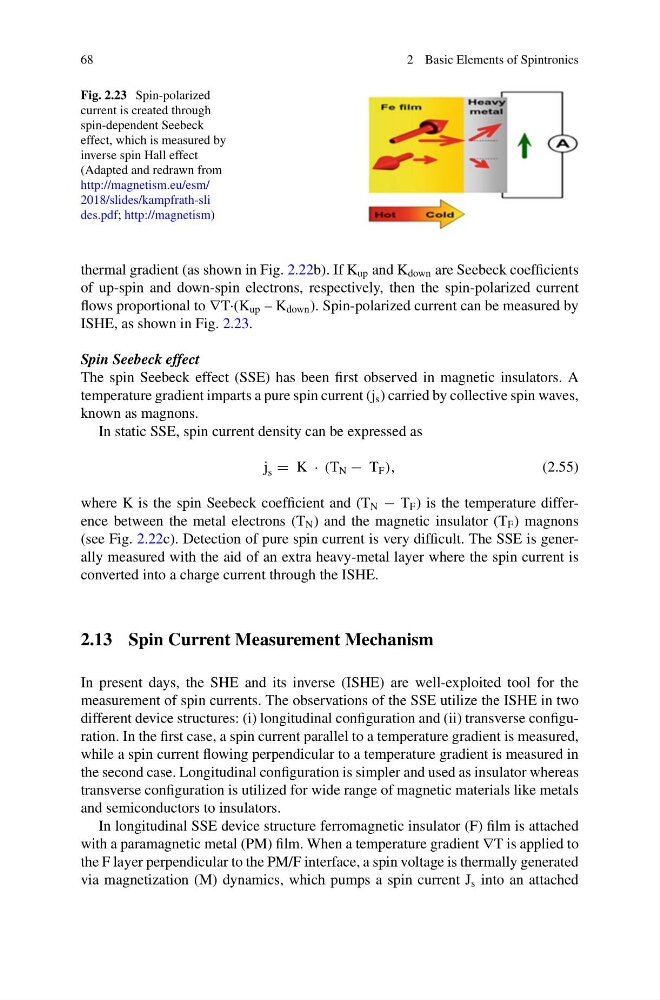
Fig. 2.23 Spin-polarized
current is created through
spin-dependent Seebeck
effect, which is measured by
inverse spin Hall effect
(Adapted and redrawn from
http://magnetism.eu/esm/
2018/slides/kampfrath-sli
des.pdf; http://magnetism)
thermal gradient (as shown in Fig. 2.22b). If K up and K down are Seebeck coefficients
of up-spin and down-spin electrons, respectively, then the spin-polarized current
flows proportional to ∇T·(K up – K down ). Spin-polarized current can be measured by
ISHE, as shown in Fig. 2.23.
Spin Seebeck effect
The spin Seebeck effect (SSE) has been first observed in magnetic insulators. A
temperature gradient imparts a pure spin current (j s ) carried by collective spin waves,
known as magnons.
In static SSE, spin current density can be expressed as
j s = K · (T N − T F ),
(2.55)
where K is the spin Seebeck coefficient and (T N − T F ) is the temperature difference between the metal electrons (T N ) and the magnetic insulator (T F ) magnons
(see Fig. 2.22c). Detection of pure spin current is very difficult. The SSE is generally measured with the aid of an extra heavy-metal layer where the spin current is
converted into a charge current through the ISHE.
2.13 Spin Current Measurement Mechanism
In present days, the SHE and its inverse (ISHE) are well-exploited tool for the
measurement of spin currents. The observations of the SSE utilize the ISHE in two
different device structures: (i) longitudinal configuration and (ii) transverse configuration. In the first case, a spin current parallel to a temperature gradient is measured,
while a spin current flowing perpendicular to a temperature gradient is measured in
the second case. Longitudinal configuration is simpler and used as insulator whereas
transverse configuration is utilized for wide range of magnetic materials like metals
and semiconductors to insulators.
In longitudinal SSE device structure ferromagnetic insulator (F) film is attached
with a paramagnetic metal (PM) film. When a temperature gradient ∇T is applied to
the F layer perpendicular to the PM/F interface, a spin voltage is thermally generated
via magnetization (M) dynamics, which pumps a spin current J s into an attached
2 Basic Elements of Spintronics
Fig. 2.23 Spin-polarized
current is created through
spin-dependent Seebeck
effect, which is measured by
inverse spin Hall effect
(Adapted and redrawn from
http://magnetism.eu/esm/
2018/slides/kampfrath-sli
des.pdf; http://magnetism)
thermal gradient (as shown in Fig. 2.22b). If K up and K down are Seebeck coefficients
of up-spin and down-spin electrons, respectively, then the spin-polarized current
flows proportional to ∇T·(K up – K down ). Spin-polarized current can be measured by
ISHE, as shown in Fig. 2.23.
Spin Seebeck effect
The spin Seebeck effect (SSE) has been first observed in magnetic insulators. A
temperature gradient imparts a pure spin current (j s ) carried by collective spin waves,
known as magnons.
In static SSE, spin current density can be expressed as
j s = K · (T N − T F ),
(2.55)
where K is the spin Seebeck coefficient and (T N − T F ) is the temperature difference between the metal electrons (T N ) and the magnetic insulator (T F ) magnons
(see Fig. 2.22c). Detection of pure spin current is very difficult. The SSE is generally measured with the aid of an extra heavy-metal layer where the spin current is
converted into a charge current through the ISHE.
2.13 Spin Current Measurement Mechanism
In present days, the SHE and its inverse (ISHE) are well-exploited tool for the
measurement of spin currents. The observations of the SSE utilize the ISHE in two
different device structures: (i) longitudinal configuration and (ii) transverse configuration. In the first case, a spin current parallel to a temperature gradient is measured,
while a spin current flowing perpendicular to a temperature gradient is measured in
the second case. Longitudinal configuration is simpler and used as insulator whereas
transverse configuration is utilized for wide range of magnetic materials like metals
and semiconductors to insulators.
In longitudinal SSE device structure ferromagnetic insulator (F) film is attached
with a paramagnetic metal (PM) film. When a temperature gradient ∇T is applied to
the F layer perpendicular to the PM/F interface, a spin voltage is thermally generated
via magnetization (M) dynamics, which pumps a spin current J s into an attached