

56
2 Basic Elements of Spintronics
2.8.1 Where Does the Bir-Aronov-Pikus Mechanism of Spin
Scattering Occur?
Bir-Aronov-Pikus spin relaxation mechanism is dominant in bipolar semiconductors.
As the mechanism suggests, this mode of spin relaxation is ineffective in case of
unipolar transport, when current carriers are either electrons or holes, but not both
simultaneously. It is noteworthy that in spin-based organic light-emitting diodes, this
spin relaxation process plays a dominant role.
2.9 Hyperfine Interaction
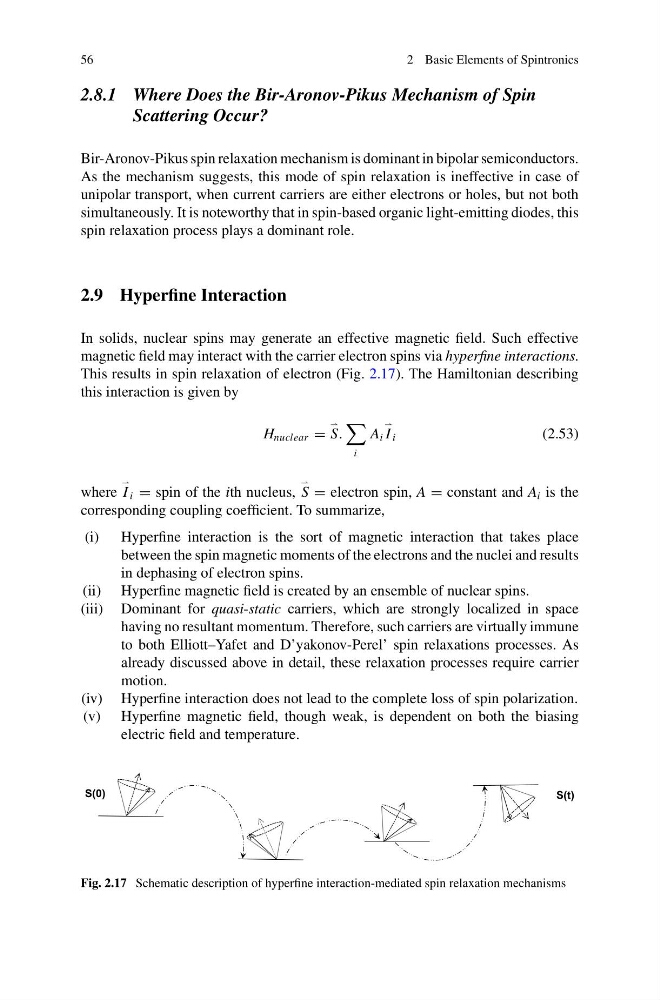
In solids, nuclear spins may generate an effective magnetic field. Such effective
magnetic field may interact with the carrier electron spins via hyperfine interactions.
This results in spin relaxation of electron (Fig. 2.17). The Hamiltonian describing
this interaction is given by
H nuclear =
S.
i
A i
I i
(2.53)
where
I i = spin of the ith nucleus,
S = electron spin, A = constant and A i is the
corresponding coupling coefficient. To summarize,
(i) Hyperfine interaction is the sort of magnetic interaction that takes place
between the spin magnetic moments of the electrons and the nuclei and results
in dephasing of electron spins.
(ii) Hyperfine magnetic field is created by an ensemble of nuclear spins.
(iii) Dominant for quasi-static carriers, which are strongly localized in space
having no resultant momentum. Therefore, such carriers are virtually immune
to both Elliott–Yafet and D’yakonov-Perel’ spin relaxations processes. As
already discussed above in detail, these relaxation processes require carrier
motion.
(iv) Hyperfine interaction does not lead to the complete loss of spin polarization.
(v) Hyperfine magnetic field, though weak, is dependent on both the biasing
electric field and temperature.
S(0)
S(t)
Fig. 2.17 Schematic description of hyperfine interaction-mediated spin relaxation mechanisms
2 Basic Elements of Spintronics
2.8.1 Where Does the Bir-Aronov-Pikus Mechanism of Spin
Scattering Occur?
Bir-Aronov-Pikus spin relaxation mechanism is dominant in bipolar semiconductors.
As the mechanism suggests, this mode of spin relaxation is ineffective in case of
unipolar transport, when current carriers are either electrons or holes, but not both
simultaneously. It is noteworthy that in spin-based organic light-emitting diodes, this
spin relaxation process plays a dominant role.
2.9 Hyperfine Interaction
In solids, nuclear spins may generate an effective magnetic field. Such effective
magnetic field may interact with the carrier electron spins via hyperfine interactions.
This results in spin relaxation of electron (Fig. 2.17). The Hamiltonian describing
this interaction is given by
H nuclear =
S.
i
A i
I i
(2.53)
where
I i = spin of the ith nucleus,
S = electron spin, A = constant and A i is the
corresponding coupling coefficient. To summarize,
(i) Hyperfine interaction is the sort of magnetic interaction that takes place
between the spin magnetic moments of the electrons and the nuclei and results
in dephasing of electron spins.
(ii) Hyperfine magnetic field is created by an ensemble of nuclear spins.
(iii) Dominant for quasi-static carriers, which are strongly localized in space
having no resultant momentum. Therefore, such carriers are virtually immune
to both Elliott–Yafet and D’yakonov-Perel’ spin relaxations processes. As
already discussed above in detail, these relaxation processes require carrier
motion.
(iv) Hyperfine interaction does not lead to the complete loss of spin polarization.
(v) Hyperfine magnetic field, though weak, is dependent on both the biasing
electric field and temperature.
S(0)
S(t)
Fig. 2.17 Schematic description of hyperfine interaction-mediated spin relaxation mechanisms