

2.8 Bir-Aronov-Pikus Mechanism
55
2.8 Bir-Aronov-Pikus Mechanism
Bir-Aronov-Pikus (BAP) mechanism is a spin relaxation mechanism of electrons
in some special kind of semiconductors that have simultaneous existence of both
electrons and holes in significant concentration. Naturally, proximity of electrons
and holes is quite close in this case. This, in turn results in overlapping of their
wavefunctions, which would cause an exchange interaction between them.
Such exchange interaction, involving both electrons and holes, can be written in
terms of Hamiltonian as
H = A
S.
J δ
r
(2.52)
where A is proportional to exchange integral between conduction and valence states,
J is the angular momentum operator for holes,
S is the spin operator for electrons
and
r is the relative position of the electron and the hole. Owing to this exchange
interaction, electron spins are supposed to perform precession motion along some
magnetic field. Noteworthy, such effective magnetic field is determined by hole spins,
J . In this context, we should recall that hole spin and momentum relax very fast in
the valence band because of its strong spin–orbit interaction. Such fluctuations in
the total spins of holes produce a fluctuating effective magnetic field. In the limit
of strong hole spin relaxation, there is random change in the effective magnetic
field even before the electron spin completes a full precession, thereby causing the
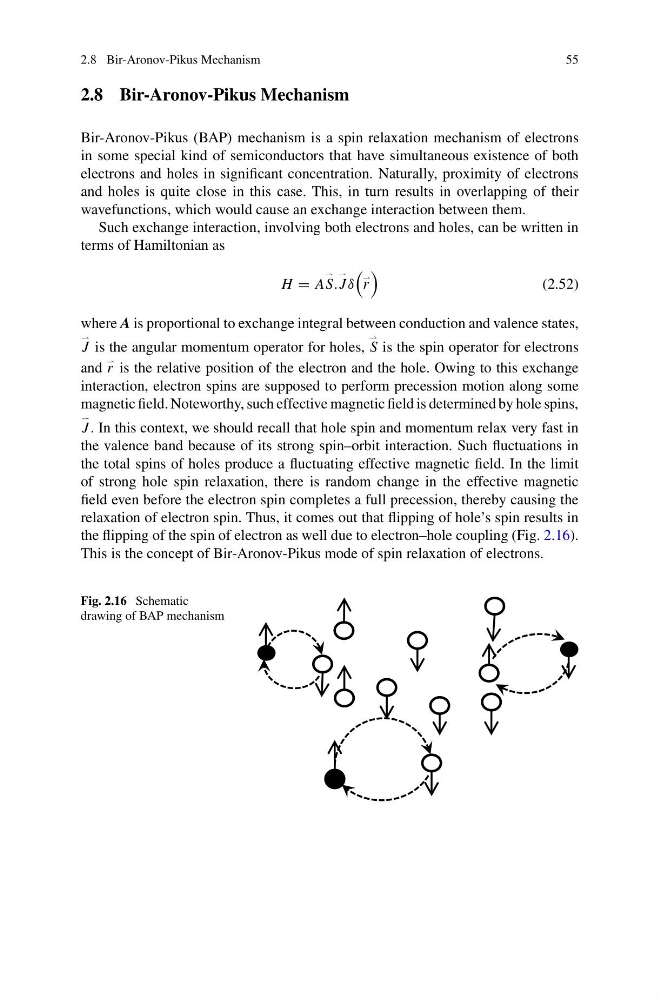
relaxation of electron spin. Thus, it comes out that flipping of hole’s spin results in
the flipping of the spin of electron as well due to electron–hole coupling (Fig. 2.16).
This is the concept of Bir-Aronov-Pikus mode of spin relaxation of electrons.
Fig. 2.16 Schematic
drawing of BAP mechanism
55
2.8 Bir-Aronov-Pikus Mechanism
Bir-Aronov-Pikus (BAP) mechanism is a spin relaxation mechanism of electrons
in some special kind of semiconductors that have simultaneous existence of both
electrons and holes in significant concentration. Naturally, proximity of electrons
and holes is quite close in this case. This, in turn results in overlapping of their
wavefunctions, which would cause an exchange interaction between them.
Such exchange interaction, involving both electrons and holes, can be written in
terms of Hamiltonian as
H = A
S.
J δ
r
(2.52)
where A is proportional to exchange integral between conduction and valence states,
J is the angular momentum operator for holes,
S is the spin operator for electrons
and
r is the relative position of the electron and the hole. Owing to this exchange
interaction, electron spins are supposed to perform precession motion along some
magnetic field. Noteworthy, such effective magnetic field is determined by hole spins,
J . In this context, we should recall that hole spin and momentum relax very fast in
the valence band because of its strong spin–orbit interaction. Such fluctuations in
the total spins of holes produce a fluctuating effective magnetic field. In the limit
of strong hole spin relaxation, there is random change in the effective magnetic
field even before the electron spin completes a full precession, thereby causing the
relaxation of electron spin. Thus, it comes out that flipping of hole’s spin results in
the flipping of the spin of electron as well due to electron–hole coupling (Fig. 2.16).
This is the concept of Bir-Aronov-Pikus mode of spin relaxation of electrons.
Fig. 2.16 Schematic
drawing of BAP mechanism