

46
2 Basic Elements of Spintronics
number and e = elementary charge. Consequently, according to Biot–Savart’s law,
the magnetic flux density at the position of the electron will be given by
B 0 = Ze
r × ×
ν or bit
4π ∈ 0 c 2 r 3
(2.41)
Now, the Coulomb electric field
E seen by the orbiting electron due to the
positively charged nucleus is
E =
Ze r
4π ∈ 0 r 3 ,
(2.42)
Hence, in the rest frame of the electron
B = −
v ×
E
c 2
(2.43)
Since the force related to
E is radial in nature, we can rewrite
E =
E
r
and
momentum of the electron
ρ = m e v. Substituting
E and
ν in Eq. 2.43 and altering
the order of the cross product result in
B =
r ×
P
m e c 2
E
r
.
Again,
E = −∇V
(2.44)
According to central field approximation, electrostatic potential is spherically
symmetric; therefore, V is only a function of radius r. Thus,
E
=
∂ V
∂r
=
1
e
∂U (r )
∂r
(2.45)
where U(= V e) denotes the potential energy of the electron in the central field. From
classical mechanics, angular momentum of a particle is
L = r × p. Putting it all
together we get
B =
1
m e ec 2
1
r
∂U (r )
∂r
L
(2.46)
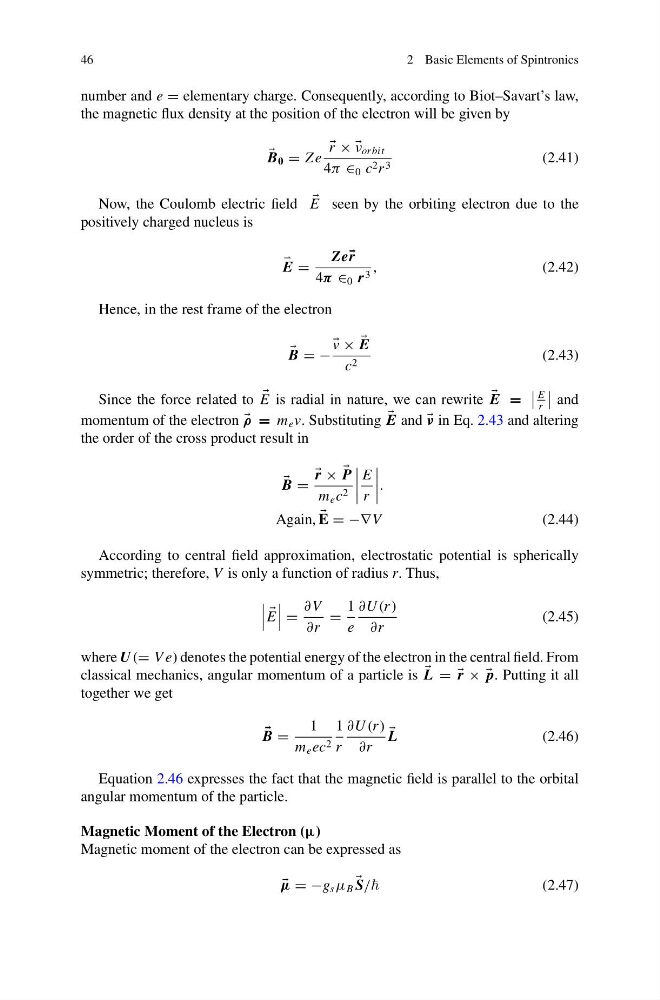
Equation 2.46 expresses the fact that the magnetic field is parallel to the orbital
angular momentum of the particle.
Magnetic Moment of the Electron (µ)
Magnetic moment of the electron can be expressed as
μ = −g s μ B
S/
(2.47)
2 Basic Elements of Spintronics
number and e = elementary charge. Consequently, according to Biot–Savart’s law,
the magnetic flux density at the position of the electron will be given by
B 0 = Ze
r × ×
ν or bit
4π ∈ 0 c 2 r 3
(2.41)
Now, the Coulomb electric field
E seen by the orbiting electron due to the
positively charged nucleus is
E =
Ze r
4π ∈ 0 r 3 ,
(2.42)
Hence, in the rest frame of the electron
B = −
v ×
E
c 2
(2.43)
Since the force related to
E is radial in nature, we can rewrite
E =
E
r
and
momentum of the electron
ρ = m e v. Substituting
E and
ν in Eq. 2.43 and altering
the order of the cross product result in
B =
r ×
P
m e c 2
E
r
.
Again,
E = −∇V
(2.44)
According to central field approximation, electrostatic potential is spherically
symmetric; therefore, V is only a function of radius r. Thus,
E
=
∂ V
∂r
=
1
e
∂U (r )
∂r
(2.45)
where U(= V e) denotes the potential energy of the electron in the central field. From
classical mechanics, angular momentum of a particle is
L = r × p. Putting it all
together we get
B =
1
m e ec 2
1
r
∂U (r )
∂r
L
(2.46)
Equation 2.46 expresses the fact that the magnetic field is parallel to the orbital
angular momentum of the particle.
Magnetic Moment of the Electron (µ)
Magnetic moment of the electron can be expressed as
μ = −g s μ B
S/
(2.47)