

2.5 Spin Relaxation
45
Here, we will describe spin–orbit interaction by simply employing electrodynamics
(semi-classical) and quantum mechanics (non-relativistic) that agree quite well with
the experimental observations. Even more precise results need meticulous derivation
starting from Dirac equation and need to involve quantum electrodynamics.
Following the above discussions, it appears that in general, spin–orbit interaction is
an interaction between spin magnetic moment of a spinning particle and the magnetic
field, generated by the spinning particle’s orbit itself in a strong electric field. Thus,
in order to understand the interaction process, the first question is: what is the energy
of a magnetic moment in a magnetic field?
Energy of a magnetic moment subject to a magnetic field is given by
E = − −
μ ·
B
(2.40)
where
μ is the magnetic moment of the particle and
B is the magnetic field it
experiences. Here, we will concentrate on the spin–orbit interaction experienced by
an electron inside an atom. Let us now find out the expression for
B and
μ in this
case, one by one.
Magnetic field (
B)
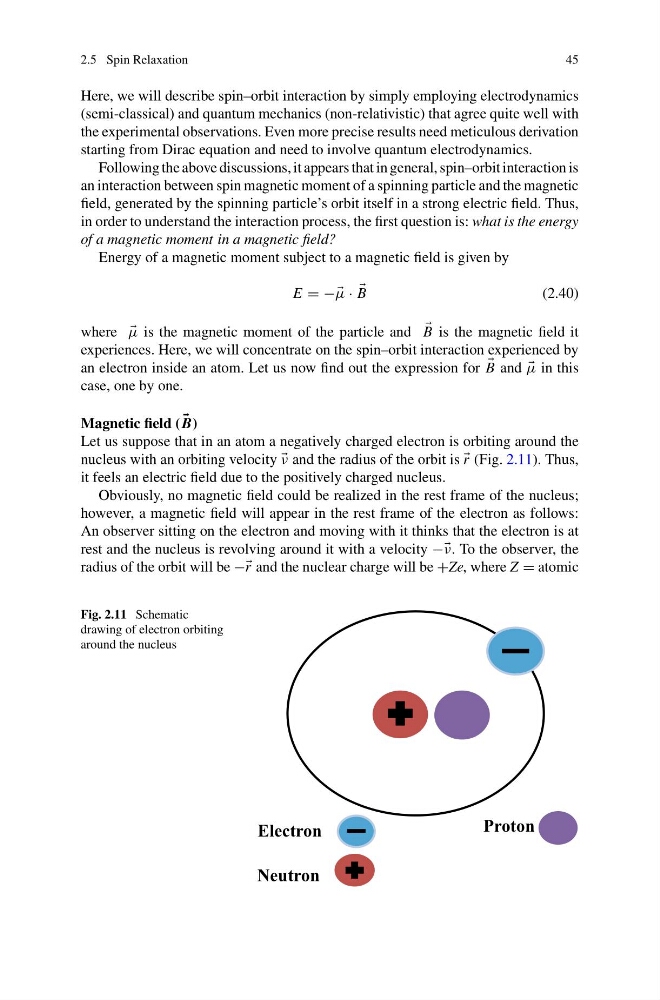
Let us suppose that in an atom a negatively charged electron is orbiting around the
nucleus with an orbiting velocity
ν and the radius of the orbit is
r (Fig. 2.11). Thus,
it feels an electric field due to the positively charged nucleus.
Obviously, no magnetic field could be realized in the rest frame of the nucleus;
however, a magnetic field will appear in the rest frame of the electron as follows:
An observer sitting on the electron and moving with it thinks that the electron is at
rest and the nucleus is revolving around it with a velocity −− ν. To the observer, the
radius of the orbit will be −− r and the nuclear charge will be +Ze, where Z = atomic
Fig. 2.11 Schematic
drawing of electron orbiting
around the nucleus
Electron
Neutron
Proton
45
Here, we will describe spin–orbit interaction by simply employing electrodynamics
(semi-classical) and quantum mechanics (non-relativistic) that agree quite well with
the experimental observations. Even more precise results need meticulous derivation
starting from Dirac equation and need to involve quantum electrodynamics.
Following the above discussions, it appears that in general, spin–orbit interaction is
an interaction between spin magnetic moment of a spinning particle and the magnetic
field, generated by the spinning particle’s orbit itself in a strong electric field. Thus,
in order to understand the interaction process, the first question is: what is the energy
of a magnetic moment in a magnetic field?
Energy of a magnetic moment subject to a magnetic field is given by
E = − −
μ ·
B
(2.40)
where
μ is the magnetic moment of the particle and
B is the magnetic field it
experiences. Here, we will concentrate on the spin–orbit interaction experienced by
an electron inside an atom. Let us now find out the expression for
B and
μ in this
case, one by one.
Magnetic field (
B)
Let us suppose that in an atom a negatively charged electron is orbiting around the
nucleus with an orbiting velocity
ν and the radius of the orbit is
r (Fig. 2.11). Thus,
it feels an electric field due to the positively charged nucleus.
Obviously, no magnetic field could be realized in the rest frame of the nucleus;
however, a magnetic field will appear in the rest frame of the electron as follows:
An observer sitting on the electron and moving with it thinks that the electron is at
rest and the nucleus is revolving around it with a velocity −− ν. To the observer, the
radius of the orbit will be −− r and the nuclear charge will be +Ze, where Z = atomic
Fig. 2.11 Schematic
drawing of electron orbiting
around the nucleus
Electron
Neutron
Proton