

260
10 Spintronics Applications
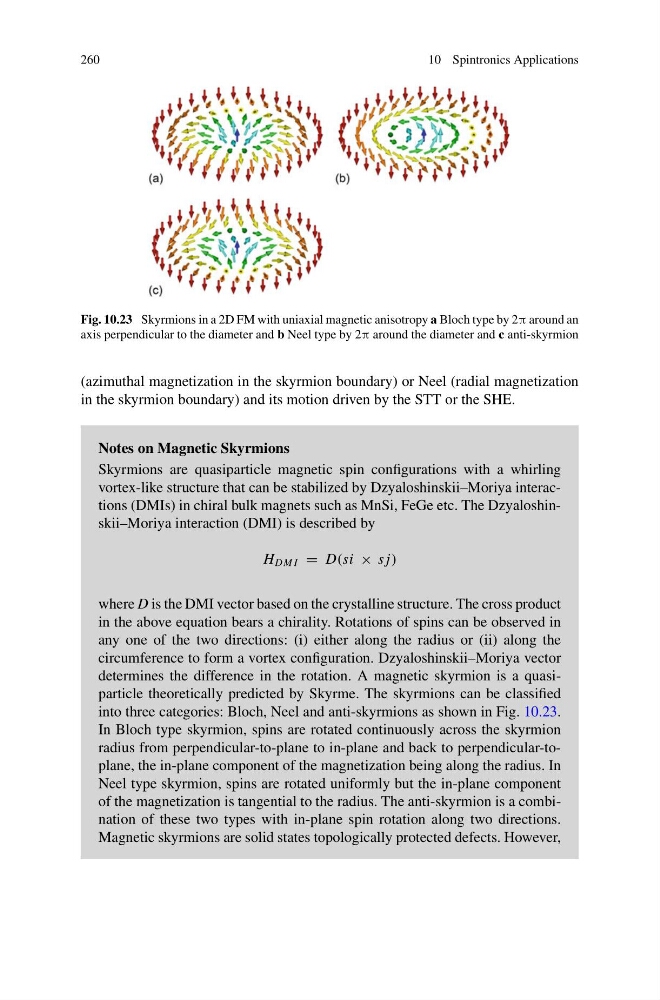
Fig. 10.23 Skyrmions in a 2D FM with uniaxial magnetic anisotropy a Bloch type by 2π around an
axis perpendicular to the diameter and b Neel type by 2π around the diameter and c anti-skyrmion
(azimuthal magnetization in the skyrmion boundary) or Neel (radial magnetization
in the skyrmion boundary) and its motion driven by the STT or the SHE.
Notes on Magnetic Skyrmions
Skyrmions are quasiparticle magnetic spin configurations with a whirling
vortex-like structure that can be stabilized by Dzyaloshinskii–Moriya interactions (DMIs) in chiral bulk magnets such as MnSi, FeGe etc. The Dzyaloshinskii–Moriya interaction (DMI) is described by
H DM I = D(si × s j)
where D is the DMI vector based on the crystalline structure. The cross product
in the above equation bears a chirality. Rotations of spins can be observed in
any one of the two directions: (i) either along the radius or (ii) along the
circumference to form a vortex configuration. Dzyaloshinskii–Moriya vector
determines the difference in the rotation. A magnetic skyrmion is a quasiparticle theoretically predicted by Skyrme. The skyrmions can be classified
into three categories: Bloch, Neel and anti-skyrmions as shown in Fig. 10.23.
In Bloch type skyrmion, spins are rotated continuously across the skyrmion
radius from perpendicular-to-plane to in-plane and back to perpendicular-toplane, the in-plane component of the magnetization being along the radius. In
Neel type skyrmion, spins are rotated uniformly but the in-plane component
of the magnetization is tangential to the radius. The anti-skyrmion is a combination of these two types with in-plane spin rotation along two directions.
Magnetic skyrmions are solid states topologically protected defects. However,
10 Spintronics Applications
Fig. 10.23 Skyrmions in a 2D FM with uniaxial magnetic anisotropy a Bloch type by 2π around an
axis perpendicular to the diameter and b Neel type by 2π around the diameter and c anti-skyrmion
(azimuthal magnetization in the skyrmion boundary) or Neel (radial magnetization
in the skyrmion boundary) and its motion driven by the STT or the SHE.
Notes on Magnetic Skyrmions
Skyrmions are quasiparticle magnetic spin configurations with a whirling
vortex-like structure that can be stabilized by Dzyaloshinskii–Moriya interactions (DMIs) in chiral bulk magnets such as MnSi, FeGe etc. The Dzyaloshinskii–Moriya interaction (DMI) is described by
H DM I = D(si × s j)
where D is the DMI vector based on the crystalline structure. The cross product
in the above equation bears a chirality. Rotations of spins can be observed in
any one of the two directions: (i) either along the radius or (ii) along the
circumference to form a vortex configuration. Dzyaloshinskii–Moriya vector
determines the difference in the rotation. A magnetic skyrmion is a quasiparticle theoretically predicted by Skyrme. The skyrmions can be classified
into three categories: Bloch, Neel and anti-skyrmions as shown in Fig. 10.23.
In Bloch type skyrmion, spins are rotated continuously across the skyrmion
radius from perpendicular-to-plane to in-plane and back to perpendicular-toplane, the in-plane component of the magnetization being along the radius. In
Neel type skyrmion, spins are rotated uniformly but the in-plane component
of the magnetization is tangential to the radius. The anti-skyrmion is a combination of these two types with in-plane spin rotation along two directions.
Magnetic skyrmions are solid states topologically protected defects. However,