

242
10 Spintronics Applications
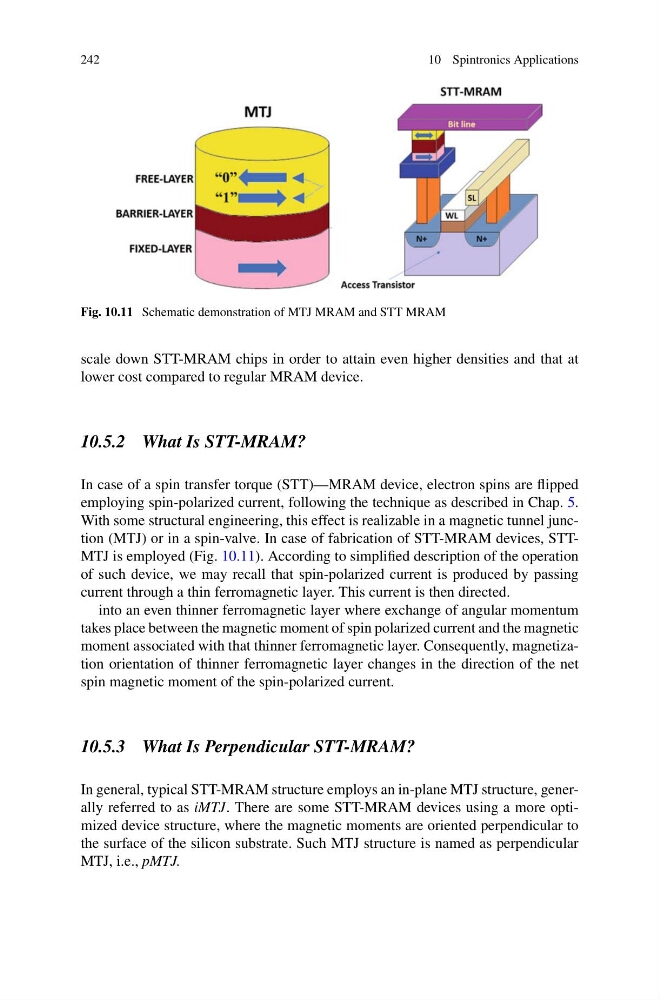
Fig. 10.11 Schematic demonstration of MTJ MRAM and STT MRAM
scale down STT-MRAM chips in order to attain even higher densities and that at
lower cost compared to regular MRAM device.
10.5.2 What Is STT-MRAM?
In case of a spin transfer torque (STT)—MRAM device, electron spins are flipped
employing spin-polarized current, following the technique as described in Chap. 5.
With some structural engineering, this effect is realizable in a magnetic tunnel junction (MTJ) or in a spin-valve. In case of fabrication of STT-MRAM devices, STTMTJ is employed (Fig. 10.11). According to simplified description of the operation
of such device, we may recall that spin-polarized current is produced by passing
current through a thin ferromagnetic layer. This current is then directed.
into an even thinner ferromagnetic layer where exchange of angular momentum
takes place between the magnetic moment of spin polarized current and the magnetic
moment associated with that thinner ferromagnetic layer. Consequently, magnetization orientation of thinner ferromagnetic layer changes in the direction of the net
spin magnetic moment of the spin-polarized current.
10.5.3 What Is Perpendicular STT-MRAM?
In general, typical STT-MRAM structure employs an in-plane MTJ structure, generally referred to as iMTJ. There are some STT-MRAM devices using a more optimized device structure, where the magnetic moments are oriented perpendicular to
the surface of the silicon substrate. Such MTJ structure is named as perpendicular
MTJ, i.e., pMTJ.
10 Spintronics Applications
Fig. 10.11 Schematic demonstration of MTJ MRAM and STT MRAM
scale down STT-MRAM chips in order to attain even higher densities and that at
lower cost compared to regular MRAM device.
10.5.2 What Is STT-MRAM?
In case of a spin transfer torque (STT)—MRAM device, electron spins are flipped
employing spin-polarized current, following the technique as described in Chap. 5.
With some structural engineering, this effect is realizable in a magnetic tunnel junction (MTJ) or in a spin-valve. In case of fabrication of STT-MRAM devices, STTMTJ is employed (Fig. 10.11). According to simplified description of the operation
of such device, we may recall that spin-polarized current is produced by passing
current through a thin ferromagnetic layer. This current is then directed.
into an even thinner ferromagnetic layer where exchange of angular momentum
takes place between the magnetic moment of spin polarized current and the magnetic
moment associated with that thinner ferromagnetic layer. Consequently, magnetization orientation of thinner ferromagnetic layer changes in the direction of the net
spin magnetic moment of the spin-polarized current.
10.5.3 What Is Perpendicular STT-MRAM?
In general, typical STT-MRAM structure employs an in-plane MTJ structure, generally referred to as iMTJ. There are some STT-MRAM devices using a more optimized device structure, where the magnetic moments are oriented perpendicular to
the surface of the silicon substrate. Such MTJ structure is named as perpendicular
MTJ, i.e., pMTJ.