

9.4 Spin-Polarized Semiconductor Devices
211
angle. However, at larger applied fields ( T S 1), the spins go through many
precession cycles before they recombine, resulting effectively in the projection of
the injected spins on the oblique field.
The advantage of the oblique Hanle technique is that it is possible to extract the
loss in polarization during the interval between injection and recombination and
hence to determine the spin polarization of the electrons.
Detection Geometry Considerations:
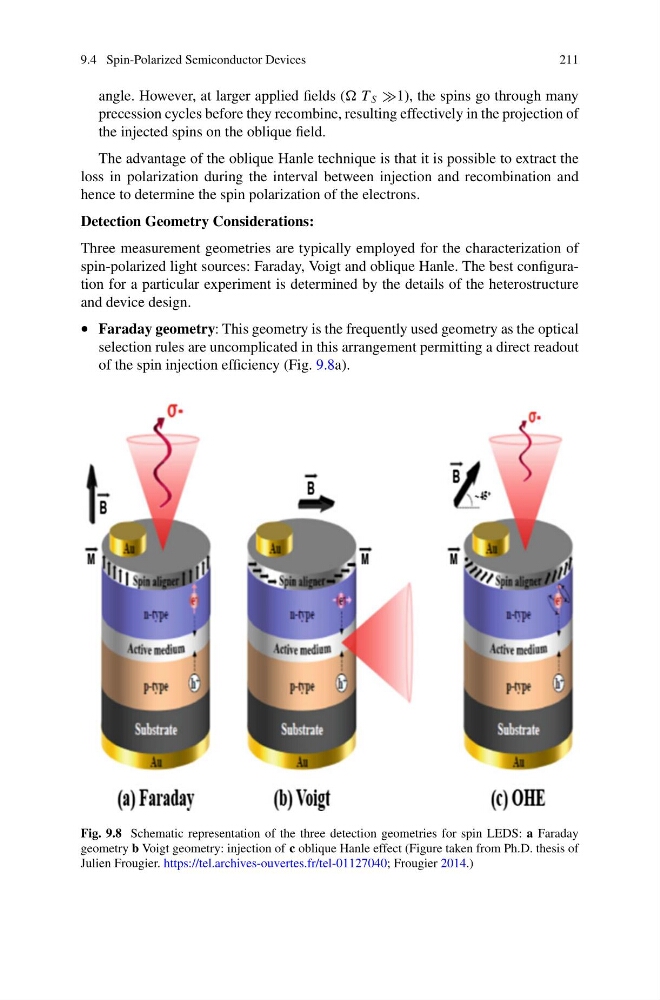
Three measurement geometries are typically employed for the characterization of
spin-polarized light sources: Faraday, Voigt and oblique Hanle. The best configuration for a particular experiment is determined by the details of the heterostructure
and device design.
• Faraday geometry: This geometry is the frequently used geometry as the optical
selection rules are uncomplicated in this arrangement permitting a direct readout
of the spin injection efficiency (Fig. 9.8a).
Fig. 9.8 Schematic representation of the three detection geometries for spin LEDS: a Faraday
geometry b Voigt geometry: injection of c oblique Hanle effect (Figure taken from Ph.D. thesis of
Julien Frougier. https://tel.archives-ouvertes.fr/tel-01127040; Frougier 2014.)
211
angle. However, at larger applied fields ( T S 1), the spins go through many
precession cycles before they recombine, resulting effectively in the projection of
the injected spins on the oblique field.
The advantage of the oblique Hanle technique is that it is possible to extract the
loss in polarization during the interval between injection and recombination and
hence to determine the spin polarization of the electrons.
Detection Geometry Considerations:
Three measurement geometries are typically employed for the characterization of
spin-polarized light sources: Faraday, Voigt and oblique Hanle. The best configuration for a particular experiment is determined by the details of the heterostructure
and device design.
• Faraday geometry: This geometry is the frequently used geometry as the optical
selection rules are uncomplicated in this arrangement permitting a direct readout
of the spin injection efficiency (Fig. 9.8a).
Fig. 9.8 Schematic representation of the three detection geometries for spin LEDS: a Faraday
geometry b Voigt geometry: injection of c oblique Hanle effect (Figure taken from Ph.D. thesis of
Julien Frougier. https://tel.archives-ouvertes.fr/tel-01127040; Frougier 2014.)