

7.9 Antiferromagnetic Opto-spintronics
179
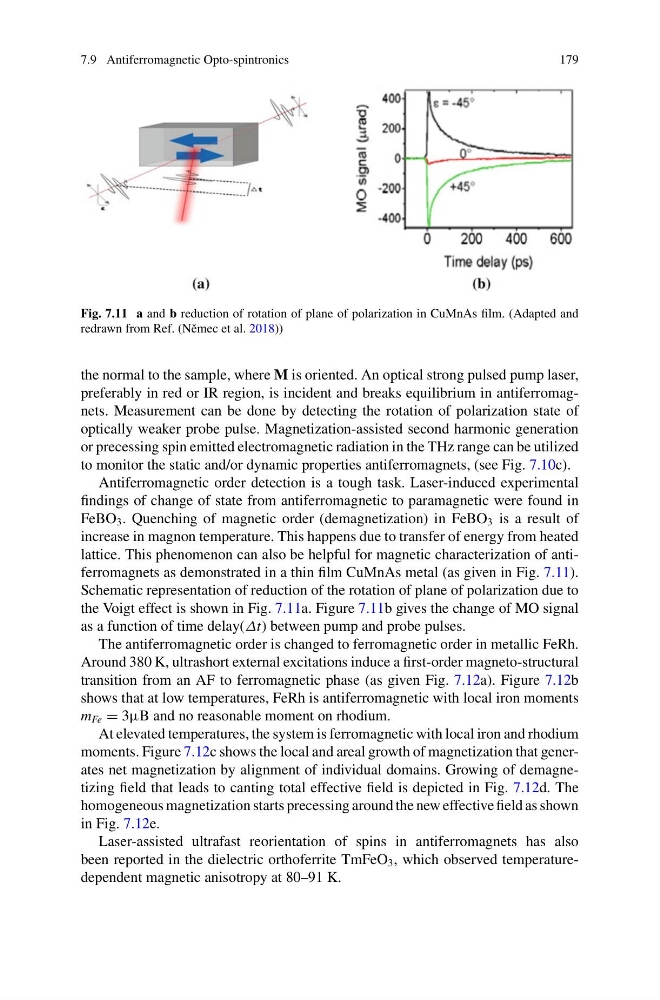
Fig. 7.11 a and b reduction of rotation of plane of polarization in CuMnAs film. (Adapted and
redrawn from Ref. (Nˇ emec et al. 2018))
the normal to the sample, where M is oriented. An optical strong pulsed pump laser,
preferably in red or IR region, is incident and breaks equilibrium in antiferromagnets. Measurement can be done by detecting the rotation of polarization state of
optically weaker probe pulse. Magnetization-assisted second harmonic generation
or precessing spin emitted electromagnetic radiation in the THz range can be utilized
to monitor the static and/or dynamic properties antiferromagnets, (see Fig. 7.10c).
Antiferromagnetic order detection is a tough task. Laser-induced experimental
findings of change of state from antiferromagnetic to paramagnetic were found in
FeBO 3 . Quenching of magnetic order (demagnetization) in FeBO 3 is a result of
increase in magnon temperature. This happens due to transfer of energy from heated
lattice. This phenomenon can also be helpful for magnetic characterization of antiferromagnets as demonstrated in a thin film CuMnAs metal (as given in Fig. 7.11).
Schematic representation of reduction of the rotation of plane of polarization due to
the Voigt effect is shown in Fig. 7.11a. Figure 7.11b gives the change of MO signal
as a function of time delay(Δt) between pump and probe pulses.
The antiferromagnetic order is changed to ferromagnetic order in metallic FeRh.
Around 380 K, ultrashort external excitations induce a first-order magneto-structural
transition from an AF to ferromagnetic phase (as given Fig. 7.12a). Figure 7.12b
shows that at low temperatures, FeRh is antiferromagnetic with local iron moments
m Fe = 3μB and no reasonable moment on rhodium.
At elevated temperatures, the system is ferromagnetic with local iron and rhodium
moments. Figure 7.12c shows the local and areal growth of magnetization that generates net magnetization by alignment of individual domains. Growing of demagnetizing field that leads to canting total effective field is depicted in Fig. 7.12d. The
homogeneous magnetization starts precessing around the new effective field as shown
in Fig. 7.12e.
Laser-assisted ultrafast reorientation of spins in antiferromagnets has also
been reported in the dielectric orthoferrite TmFeO 3 , which observed temperaturedependent magnetic anisotropy at 80–91 K.
179
Fig. 7.11 a and b reduction of rotation of plane of polarization in CuMnAs film. (Adapted and
redrawn from Ref. (Nˇ emec et al. 2018))
the normal to the sample, where M is oriented. An optical strong pulsed pump laser,
preferably in red or IR region, is incident and breaks equilibrium in antiferromagnets. Measurement can be done by detecting the rotation of polarization state of
optically weaker probe pulse. Magnetization-assisted second harmonic generation
or precessing spin emitted electromagnetic radiation in the THz range can be utilized
to monitor the static and/or dynamic properties antiferromagnets, (see Fig. 7.10c).
Antiferromagnetic order detection is a tough task. Laser-induced experimental
findings of change of state from antiferromagnetic to paramagnetic were found in
FeBO 3 . Quenching of magnetic order (demagnetization) in FeBO 3 is a result of
increase in magnon temperature. This happens due to transfer of energy from heated
lattice. This phenomenon can also be helpful for magnetic characterization of antiferromagnets as demonstrated in a thin film CuMnAs metal (as given in Fig. 7.11).
Schematic representation of reduction of the rotation of plane of polarization due to
the Voigt effect is shown in Fig. 7.11a. Figure 7.11b gives the change of MO signal
as a function of time delay(Δt) between pump and probe pulses.
The antiferromagnetic order is changed to ferromagnetic order in metallic FeRh.
Around 380 K, ultrashort external excitations induce a first-order magneto-structural
transition from an AF to ferromagnetic phase (as given Fig. 7.12a). Figure 7.12b
shows that at low temperatures, FeRh is antiferromagnetic with local iron moments
m Fe = 3μB and no reasonable moment on rhodium.
At elevated temperatures, the system is ferromagnetic with local iron and rhodium
moments. Figure 7.12c shows the local and areal growth of magnetization that generates net magnetization by alignment of individual domains. Growing of demagnetizing field that leads to canting total effective field is depicted in Fig. 7.12d. The
homogeneous magnetization starts precessing around the new effective field as shown
in Fig. 7.12e.
Laser-assisted ultrafast reorientation of spins in antiferromagnets has also
been reported in the dielectric orthoferrite TmFeO 3 , which observed temperaturedependent magnetic anisotropy at 80–91 K.