

178
7 Opto-spintronics
laser light has proved him as a powerful tool to control and detect spins and their
ultrafast dynamics in magnetic materials. Based on interaction of AFs with electromagnetic radiation, there are three detection techniques, namely LO studies, NLO
studies and THz spectroscopy.
Magneto-optics (MO) has been established as an efficient probe of magnetic
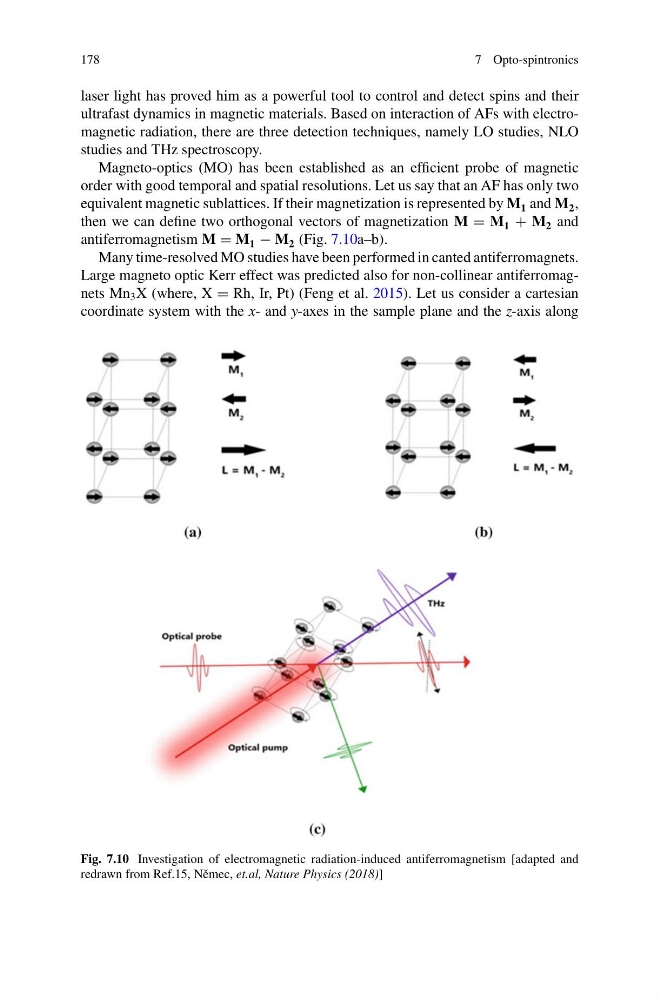
order with good temporal and spatial resolutions. Let us say that an AF has only two
equivalent magnetic sublattices. If their magnetization is represented by M 1 and M 2 ,
then we can define two orthogonal vectors of magnetization M = M 1 + M 2 and
antiferromagnetism M = M 1 − M 2 (Fig. 7.10a–b).
Many time-resolved MO studies have been performed in canted antiferromagnets.
Large magneto optic Kerr effect was predicted also for non-collinear antiferromagnets Mn 3 X (where, X = Rh, Ir, Pt) (Feng et al. 2015). Let us consider a cartesian
coordinate system with the x- and y-axes in the sample plane and the z-axis along
Fig. 7.10 Investigation of electromagnetic radiation-induced antiferromagnetism [adapted and
redrawn from Ref.15, Nˇ emec, et.al, Nature Physics (2018)]
7 Opto-spintronics
laser light has proved him as a powerful tool to control and detect spins and their
ultrafast dynamics in magnetic materials. Based on interaction of AFs with electromagnetic radiation, there are three detection techniques, namely LO studies, NLO
studies and THz spectroscopy.
Magneto-optics (MO) has been established as an efficient probe of magnetic
order with good temporal and spatial resolutions. Let us say that an AF has only two
equivalent magnetic sublattices. If their magnetization is represented by M 1 and M 2 ,
then we can define two orthogonal vectors of magnetization M = M 1 + M 2 and
antiferromagnetism M = M 1 − M 2 (Fig. 7.10a–b).
Many time-resolved MO studies have been performed in canted antiferromagnets.
Large magneto optic Kerr effect was predicted also for non-collinear antiferromagnets Mn 3 X (where, X = Rh, Ir, Pt) (Feng et al. 2015). Let us consider a cartesian
coordinate system with the x- and y-axes in the sample plane and the z-axis along
Fig. 7.10 Investigation of electromagnetic radiation-induced antiferromagnetism [adapted and
redrawn from Ref.15, Nˇ emec, et.al, Nature Physics (2018)]