

176
7 Opto-spintronics
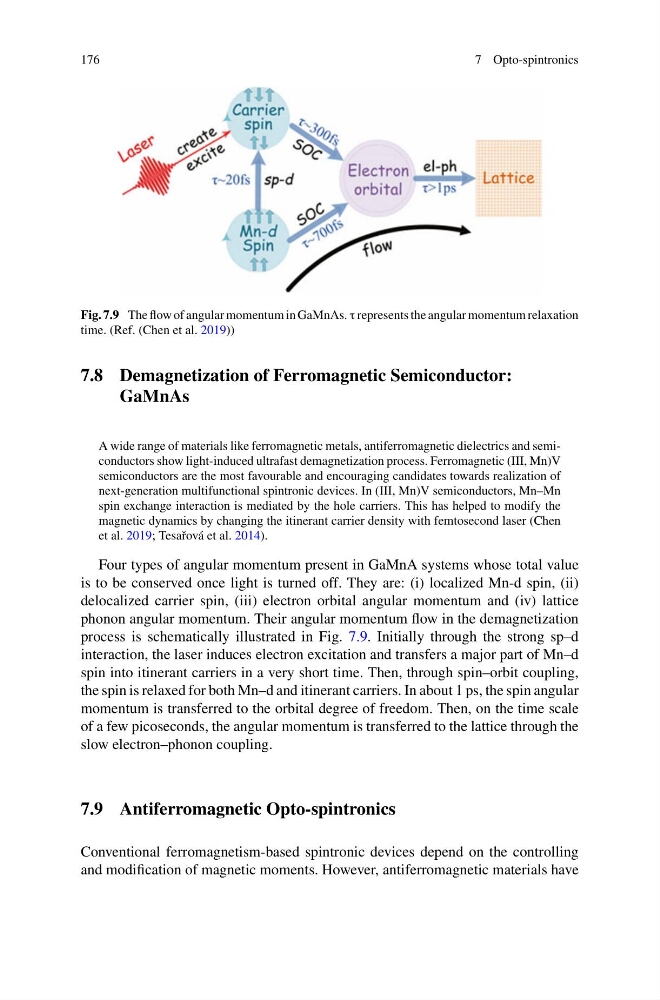
Fig. 7.9 The flow of angular momentum in GaMnAs. τ represents the angular momentum relaxation
time. (Ref. (Chen et al. 2019))
7.8 Demagnetization of Ferromagnetic Semiconductor:
GaMnAs
A wide range of materials like ferromagnetic metals, antiferromagnetic dielectrics and semiconductors show light-induced ultrafast demagnetization process. Ferromagnetic (III, Mn)V
semiconductors are the most favourable and encouraging candidates towards realization of
next-generation multifunctional spintronic devices. In (III, Mn)V semiconductors, Mn–Mn
spin exchange interaction is mediated by the hole carriers. This has helped to modify the
magnetic dynamics by changing the itinerant carrier density with femtosecond laser (Chen
et al. 2019; Tesaˇ rová et al. 2014).
Four types of angular momentum present in GaMnA systems whose total value
is to be conserved once light is turned off. They are: (i) localized Mn-d spin, (ii)
delocalized carrier spin, (iii) electron orbital angular momentum and (iv) lattice
phonon angular momentum. Their angular momentum flow in the demagnetization
process is schematically illustrated in Fig. 7.9. Initially through the strong sp–d
interaction, the laser induces electron excitation and transfers a major part of Mn–d
spin into itinerant carriers in a very short time. Then, through spin–orbit coupling,
the spin is relaxed for both Mn–d and itinerant carriers. In about 1 ps, the spin angular
momentum is transferred to the orbital degree of freedom. Then, on the time scale
of a few picoseconds, the angular momentum is transferred to the lattice through the
slow electron–phonon coupling.
7.9 Antiferromagnetic Opto-spintronics
Conventional ferromagnetism-based spintronic devices depend on the controlling
and modification of magnetic moments. However, antiferromagnetic materials have
7 Opto-spintronics
Fig. 7.9 The flow of angular momentum in GaMnAs. τ represents the angular momentum relaxation
time. (Ref. (Chen et al. 2019))
7.8 Demagnetization of Ferromagnetic Semiconductor:
GaMnAs
A wide range of materials like ferromagnetic metals, antiferromagnetic dielectrics and semiconductors show light-induced ultrafast demagnetization process. Ferromagnetic (III, Mn)V
semiconductors are the most favourable and encouraging candidates towards realization of
next-generation multifunctional spintronic devices. In (III, Mn)V semiconductors, Mn–Mn
spin exchange interaction is mediated by the hole carriers. This has helped to modify the
magnetic dynamics by changing the itinerant carrier density with femtosecond laser (Chen
et al. 2019; Tesaˇ rová et al. 2014).
Four types of angular momentum present in GaMnA systems whose total value
is to be conserved once light is turned off. They are: (i) localized Mn-d spin, (ii)
delocalized carrier spin, (iii) electron orbital angular momentum and (iv) lattice
phonon angular momentum. Their angular momentum flow in the demagnetization
process is schematically illustrated in Fig. 7.9. Initially through the strong sp–d
interaction, the laser induces electron excitation and transfers a major part of Mn–d
spin into itinerant carriers in a very short time. Then, through spin–orbit coupling,
the spin is relaxed for both Mn–d and itinerant carriers. In about 1 ps, the spin angular
momentum is transferred to the orbital degree of freedom. Then, on the time scale
of a few picoseconds, the angular momentum is transferred to the lattice through the
slow electron–phonon coupling.
7.9 Antiferromagnetic Opto-spintronics
Conventional ferromagnetism-based spintronic devices depend on the controlling
and modification of magnetic moments. However, antiferromagnetic materials have