

7.7 Demagnetization of Metallic Ferromagnets: 3TM Model
175
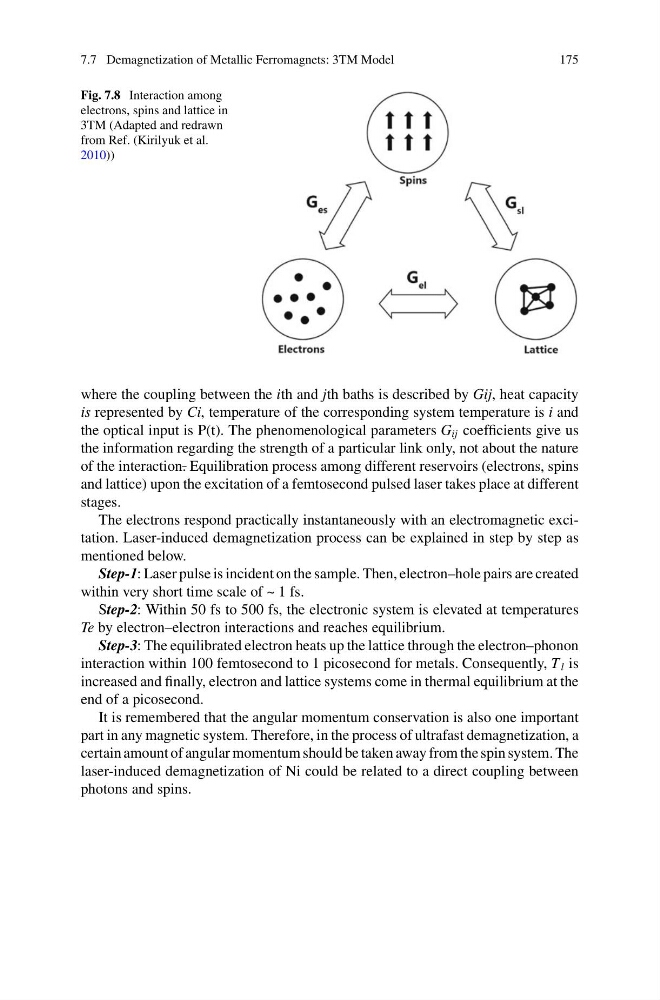
Fig. 7.8 Interaction among
electrons, spins and lattice in
3TM (Adapted and redrawn
from Ref. (Kirilyuk et al.
2010))
where the coupling between the ith and jth baths is described by Gij, heat capacity
is represented by Ci, temperature of the corresponding system temperature is i and
the optical input is P(t). The phenomenological parameters G ij coefficients give us
the information regarding the strength of a particular link only, not about the nature
of the interaction. Equilibration process among different reservoirs (electrons, spins
and lattice) upon the excitation of a femtosecond pulsed laser takes place at different
stages.
The electrons respond practically instantaneously with an electromagnetic excitation. Laser-induced demagnetization process can be explained in step by step as
mentioned below.
Step-1: Laser pulse is incident on the sample. Then, electron–hole pairs are created
within very short time scale of ~ 1 fs.
Step-2: Within 50 fs to 500 fs, the electronic system is elevated at temperatures
Te by electron–electron interactions and reaches equilibrium.
Step-3: The equilibrated electron heats up the lattice through the electron–phonon
interaction within 100 femtosecond to 1 picosecond for metals. Consequently, T l is
increased and finally, electron and lattice systems come in thermal equilibrium at the
end of a picosecond.
It is remembered that the angular momentum conservation is also one important
part in any magnetic system. Therefore, in the process of ultrafast demagnetization, a
certain amount of angular momentum should be taken away from the spin system. The
laser-induced demagnetization of Ni could be related to a direct coupling between
photons and spins.
175
Fig. 7.8 Interaction among
electrons, spins and lattice in
3TM (Adapted and redrawn
from Ref. (Kirilyuk et al.
2010))
where the coupling between the ith and jth baths is described by Gij, heat capacity
is represented by Ci, temperature of the corresponding system temperature is i and
the optical input is P(t). The phenomenological parameters G ij coefficients give us
the information regarding the strength of a particular link only, not about the nature
of the interaction. Equilibration process among different reservoirs (electrons, spins
and lattice) upon the excitation of a femtosecond pulsed laser takes place at different
stages.
The electrons respond practically instantaneously with an electromagnetic excitation. Laser-induced demagnetization process can be explained in step by step as
mentioned below.
Step-1: Laser pulse is incident on the sample. Then, electron–hole pairs are created
within very short time scale of ~ 1 fs.
Step-2: Within 50 fs to 500 fs, the electronic system is elevated at temperatures
Te by electron–electron interactions and reaches equilibrium.
Step-3: The equilibrated electron heats up the lattice through the electron–phonon
interaction within 100 femtosecond to 1 picosecond for metals. Consequently, T l is
increased and finally, electron and lattice systems come in thermal equilibrium at the
end of a picosecond.
It is remembered that the angular momentum conservation is also one important
part in any magnetic system. Therefore, in the process of ultrafast demagnetization, a
certain amount of angular momentum should be taken away from the spin system. The
laser-induced demagnetization of Ni could be related to a direct coupling between
photons and spins.