

7.6 Experimental Techniques
171
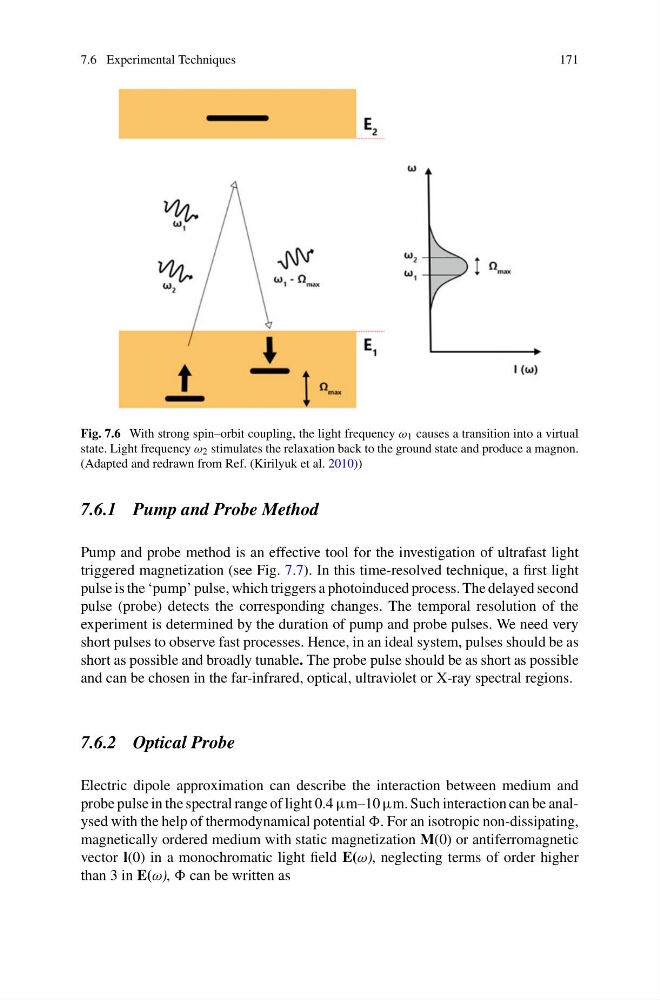
Fig. 7.6 With strong spin–orbit coupling, the light frequency ω 1 causes a transition into a virtual
state. Light frequency ω 2 stimulates the relaxation back to the ground state and produce a magnon.
(Adapted and redrawn from Ref. (Kirilyuk et al. 2010))
7.6.1 Pump and Probe Method
Pump and probe method is an effective tool for the investigation of ultrafast light
triggered magnetization (see Fig. 7.7). In this time-resolved technique, a first light
pulse is the ‘pump’ pulse, which triggers a photoinduced process. The delayed second
pulse (probe) detects the corresponding changes. The temporal resolution of the
experiment is determined by the duration of pump and probe pulses. We need very
short pulses to observe fast processes. Hence, in an ideal system, pulses should be as
short as possible and broadly tunable. The probe pulse should be as short as possible
and can be chosen in the far-infrared, optical, ultraviolet or X-ray spectral regions.
7.6.2 Optical Probe
Electric dipole approximation can describe the interaction between medium and
probe pulse in the spectral range of light 0.4 μm–10 μm. Such interaction can be analysed with the help of thermodynamical potential . For an isotropic non-dissipating,
magnetically ordered medium with static magnetization M(0) or antiferromagnetic
vector l(0) in a monochromatic light field E(ω), neglecting terms of order higher
than 3 in E(ω), can be written as
171
Fig. 7.6 With strong spin–orbit coupling, the light frequency ω 1 causes a transition into a virtual
state. Light frequency ω 2 stimulates the relaxation back to the ground state and produce a magnon.
(Adapted and redrawn from Ref. (Kirilyuk et al. 2010))
7.6.1 Pump and Probe Method
Pump and probe method is an effective tool for the investigation of ultrafast light
triggered magnetization (see Fig. 7.7). In this time-resolved technique, a first light
pulse is the ‘pump’ pulse, which triggers a photoinduced process. The delayed second
pulse (probe) detects the corresponding changes. The temporal resolution of the
experiment is determined by the duration of pump and probe pulses. We need very
short pulses to observe fast processes. Hence, in an ideal system, pulses should be as
short as possible and broadly tunable. The probe pulse should be as short as possible
and can be chosen in the far-infrared, optical, ultraviolet or X-ray spectral regions.
7.6.2 Optical Probe
Electric dipole approximation can describe the interaction between medium and
probe pulse in the spectral range of light 0.4 μm–10 μm. Such interaction can be analysed with the help of thermodynamical potential . For an isotropic non-dissipating,
magnetically ordered medium with static magnetization M(0) or antiferromagnetic
vector l(0) in a monochromatic light field E(ω), neglecting terms of order higher
than 3 in E(ω), can be written as