

168
7 Opto-spintronics
damage in devices. Basically, two types of non-thermal effect are seen: (i) photomagnetic effect and (ii) opto-magnetic effect.
Photo-magnetic Effect: This effect is based on photon absorption and deals with
the direct influence of electromagnetic radiation on magnetic properties. Photomagnetic effects are observed in ferrimagnetic garnet films where the linearly polarized
laser pulses change magnetocrystalline anisotropy via optically induced electron
transfer between non-equivalent crystal sites. The effect is ultrafast and can induce
magnetization to start precessing immediately after the photoexcitation. It can even
switch the magnetization. Though the excitation process appears to be instantaneous,
the relaxation time of the photo-induced anisotropy is several nanoseconds.
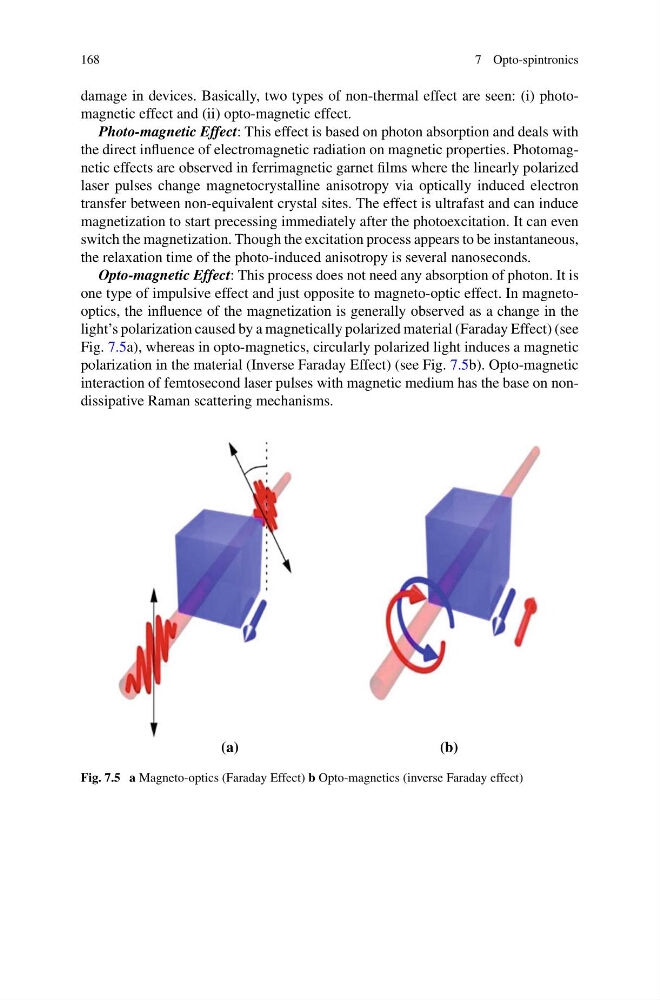
Opto-magnetic Effect: This process does not need any absorption of photon. It is
one type of impulsive effect and just opposite to magneto-optic effect. In magnetooptics, the influence of the magnetization is generally observed as a change in the
light’s polarization caused by a magnetically polarized material (Faraday Effect) (see
Fig. 7.5a), whereas in opto-magnetics, circularly polarized light induces a magnetic
polarization in the material (Inverse Faraday Effect) (see Fig. 7.5b). Opto-magnetic
interaction of femtosecond laser pulses with magnetic medium has the base on nondissipative Raman scattering mechanisms.
(a)
(b)
Fig. 7.5 a Magneto-optics (Faraday Effect) b Opto-magnetics (inverse Faraday effect)
7 Opto-spintronics
damage in devices. Basically, two types of non-thermal effect are seen: (i) photomagnetic effect and (ii) opto-magnetic effect.
Photo-magnetic Effect: This effect is based on photon absorption and deals with
the direct influence of electromagnetic radiation on magnetic properties. Photomagnetic effects are observed in ferrimagnetic garnet films where the linearly polarized
laser pulses change magnetocrystalline anisotropy via optically induced electron
transfer between non-equivalent crystal sites. The effect is ultrafast and can induce
magnetization to start precessing immediately after the photoexcitation. It can even
switch the magnetization. Though the excitation process appears to be instantaneous,
the relaxation time of the photo-induced anisotropy is several nanoseconds.
Opto-magnetic Effect: This process does not need any absorption of photon. It is
one type of impulsive effect and just opposite to magneto-optic effect. In magnetooptics, the influence of the magnetization is generally observed as a change in the
light’s polarization caused by a magnetically polarized material (Faraday Effect) (see
Fig. 7.5a), whereas in opto-magnetics, circularly polarized light induces a magnetic
polarization in the material (Inverse Faraday Effect) (see Fig. 7.5b). Opto-magnetic
interaction of femtosecond laser pulses with magnetic medium has the base on nondissipative Raman scattering mechanisms.
(a)
(b)
Fig. 7.5 a Magneto-optics (Faraday Effect) b Opto-magnetics (inverse Faraday effect)