

7.4 Laser Pulse and Its Impact on a Magnetic System
167
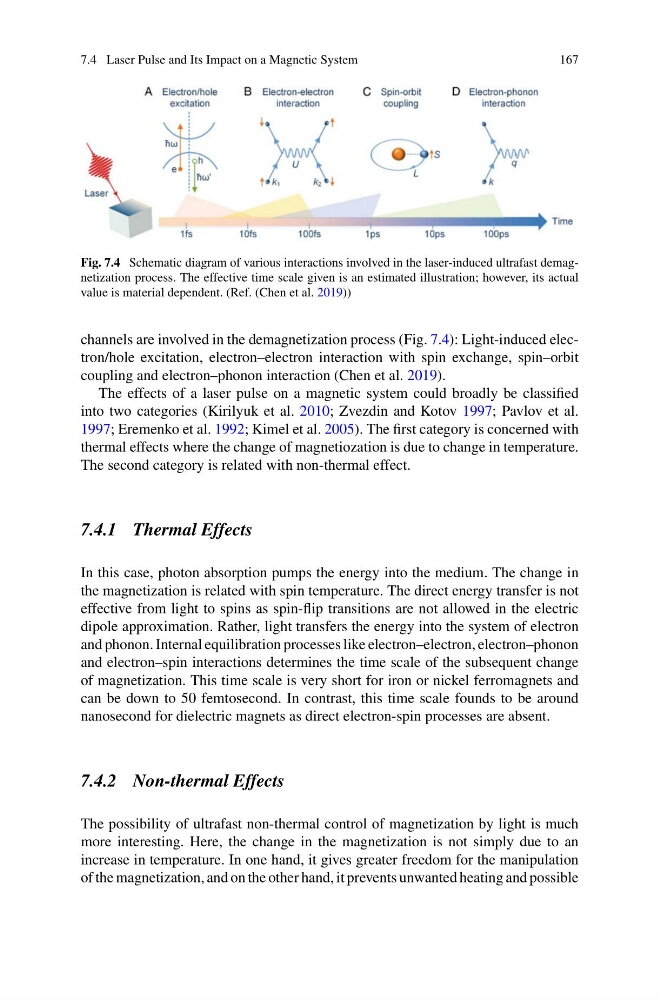
Fig. 7.4 Schematic diagram of various interactions involved in the laser-induced ultrafast demagnetization process. The effective time scale given is an estimated illustration; however, its actual
value is material dependent. (Ref. (Chen et al. 2019))
channels are involved in the demagnetization process (Fig. 7.4): Light-induced electron/hole excitation, electron–electron interaction with spin exchange, spin–orbit
coupling and electron–phonon interaction (Chen et al. 2019).
The effects of a laser pulse on a magnetic system could broadly be classified
into two categories (Kirilyuk et al. 2010; Zvezdin and Kotov 1997; Pavlov et al.
1997; Eremenko et al. 1992; Kimel et al. 2005). The first category is concerned with
thermal effects where the change of magnetiozation is due to change in temperature.
The second category is related with non-thermal effect.
7.4.1 Thermal Effects
In this case, photon absorption pumps the energy into the medium. The change in
the magnetization is related with spin temperature. The direct energy transfer is not
effective from light to spins as spin-flip transitions are not allowed in the electric
dipole approximation. Rather, light transfers the energy into the system of electron
and phonon. Internal equilibration processes like electron–electron, electron–phonon
and electron–spin interactions determines the time scale of the subsequent change
of magnetization. This time scale is very short for iron or nickel ferromagnets and
can be down to 50 femtosecond. In contrast, this time scale founds to be around
nanosecond for dielectric magnets as direct electron-spin processes are absent.
7.4.2 Non-thermal Effects
The possibility of ultrafast non-thermal control of magnetization by light is much
more interesting. Here, the change in the magnetization is not simply due to an
increase in temperature. In one hand, it gives greater freedom for the manipulation
of the magnetization, and on the other hand, it prevents unwanted heating and possible
167
Fig. 7.4 Schematic diagram of various interactions involved in the laser-induced ultrafast demagnetization process. The effective time scale given is an estimated illustration; however, its actual
value is material dependent. (Ref. (Chen et al. 2019))
channels are involved in the demagnetization process (Fig. 7.4): Light-induced electron/hole excitation, electron–electron interaction with spin exchange, spin–orbit
coupling and electron–phonon interaction (Chen et al. 2019).
The effects of a laser pulse on a magnetic system could broadly be classified
into two categories (Kirilyuk et al. 2010; Zvezdin and Kotov 1997; Pavlov et al.
1997; Eremenko et al. 1992; Kimel et al. 2005). The first category is concerned with
thermal effects where the change of magnetiozation is due to change in temperature.
The second category is related with non-thermal effect.
7.4.1 Thermal Effects
In this case, photon absorption pumps the energy into the medium. The change in
the magnetization is related with spin temperature. The direct energy transfer is not
effective from light to spins as spin-flip transitions are not allowed in the electric
dipole approximation. Rather, light transfers the energy into the system of electron
and phonon. Internal equilibration processes like electron–electron, electron–phonon
and electron–spin interactions determines the time scale of the subsequent change
of magnetization. This time scale is very short for iron or nickel ferromagnets and
can be down to 50 femtosecond. In contrast, this time scale founds to be around
nanosecond for dielectric magnets as direct electron-spin processes are absent.
7.4.2 Non-thermal Effects
The possibility of ultrafast non-thermal control of magnetization by light is much
more interesting. Here, the change in the magnetization is not simply due to an
increase in temperature. In one hand, it gives greater freedom for the manipulation
of the magnetization, and on the other hand, it prevents unwanted heating and possible