

158
6 Magnetic Domain Wall Motion
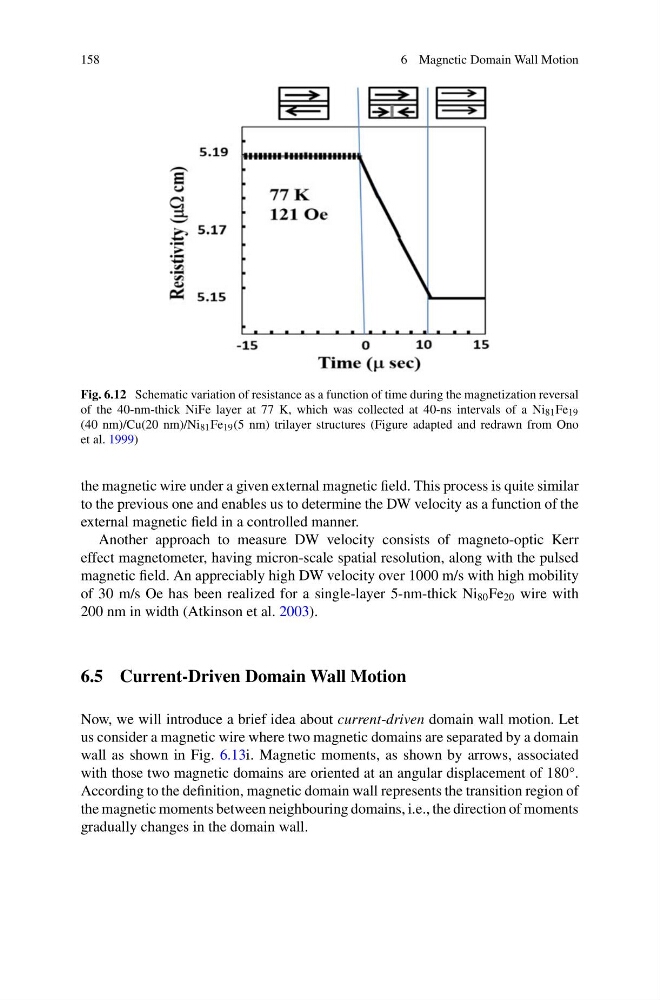
Fig. 6.12 Schematic variation of resistance as a function of time during the magnetization reversal
of the 40-nm-thick NiFe layer at 77 K, which was collected at 40-ns intervals of a Ni 81 Fe 19
(40 nm)/Cu(20 nm)/Ni 81 Fe 19 (5 nm) trilayer structures (Figure adapted and redrawn from Ono
et al. 1999)
the magnetic wire under a given external magnetic field. This process is quite similar
to the previous one and enables us to determine the DW velocity as a function of the
external magnetic field in a controlled manner.
Another approach to measure DW velocity consists of magneto-optic Kerr
effect magnetometer, having micron-scale spatial resolution, along with the pulsed
magnetic field. An appreciably high DW velocity over 1000 m/s with high mobility
of 30 m/s Oe has been realized for a single-layer 5-nm-thick Ni 80 Fe 20 wire with
200 nm in width (Atkinson et al. 2003).
6.5 Current-Driven Domain Wall Motion
Now, we will introduce a brief idea about current-driven domain wall motion. Let
us consider a magnetic wire where two magnetic domains are separated by a domain
wall as shown in Fig. 6.13i. Magnetic moments, as shown by arrows, associated
with those two magnetic domains are oriented at an angular displacement of 180°.
According to the definition, magnetic domain wall represents the transition region of
the magnetic moments between neighbouring domains, i.e., the direction of moments
gradually changes in the domain wall.
6 Magnetic Domain Wall Motion
Fig. 6.12 Schematic variation of resistance as a function of time during the magnetization reversal
of the 40-nm-thick NiFe layer at 77 K, which was collected at 40-ns intervals of a Ni 81 Fe 19
(40 nm)/Cu(20 nm)/Ni 81 Fe 19 (5 nm) trilayer structures (Figure adapted and redrawn from Ono
et al. 1999)
the magnetic wire under a given external magnetic field. This process is quite similar
to the previous one and enables us to determine the DW velocity as a function of the
external magnetic field in a controlled manner.
Another approach to measure DW velocity consists of magneto-optic Kerr
effect magnetometer, having micron-scale spatial resolution, along with the pulsed
magnetic field. An appreciably high DW velocity over 1000 m/s with high mobility
of 30 m/s Oe has been realized for a single-layer 5-nm-thick Ni 80 Fe 20 wire with
200 nm in width (Atkinson et al. 2003).
6.5 Current-Driven Domain Wall Motion
Now, we will introduce a brief idea about current-driven domain wall motion. Let
us consider a magnetic wire where two magnetic domains are separated by a domain
wall as shown in Fig. 6.13i. Magnetic moments, as shown by arrows, associated
with those two magnetic domains are oriented at an angular displacement of 180°.
According to the definition, magnetic domain wall represents the transition region of
the magnetic moments between neighbouring domains, i.e., the direction of moments
gradually changes in the domain wall.