

6.4 Domain Wall Motion Velocity Measurements
157
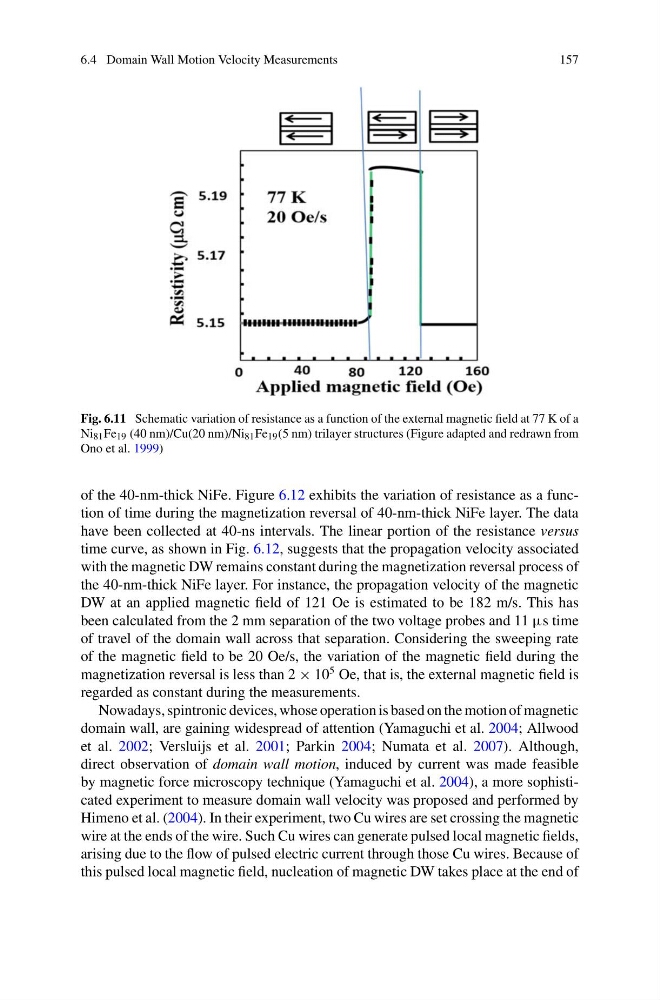
Fig. 6.11 Schematic variation of resistance as a function of the external magnetic field at 77 K of a
Ni 81 Fe 19 (40 nm)/Cu(20 nm)/Ni 81 Fe 19 (5 nm) trilayer structures (Figure adapted and redrawn from
Ono et al. 1999)
of the 40-nm-thick NiFe. Figure 6.12 exhibits the variation of resistance as a function of time during the magnetization reversal of 40-nm-thick NiFe layer. The data
have been collected at 40-ns intervals. The linear portion of the resistance versus
time curve, as shown in Fig. 6.12, suggests that the propagation velocity associated
with the magnetic DW remains constant during the magnetization reversal process of
the 40-nm-thick NiFe layer. For instance, the propagation velocity of the magnetic
DW at an applied magnetic field of 121 Oe is estimated to be 182 m/s. This has
been calculated from the 2 mm separation of the two voltage probes and 11 µs time
of travel of the domain wall across that separation. Considering the sweeping rate
of the magnetic field to be 20 Oe/s, the variation of the magnetic field during the
magnetization reversal is less than 2 × 10
5 Oe, that is, the external magnetic field is
regarded as constant during the measurements.
Nowadays, spintronic devices, whose operation is based on the motion of magnetic
domain wall, are gaining widespread of attention (Yamaguchi et al. 2004; Allwood
et al. 2002; Versluijs et al. 2001; Parkin 2004; Numata et al. 2007). Although,
direct observation of domain wall motion, induced by current was made feasible
by magnetic force microscopy technique (Yamaguchi et al. 2004), a more sophisticated experiment to measure domain wall velocity was proposed and performed by
Himeno et al. (2004). In their experiment, two Cu wires are set crossing the magnetic
wire at the ends of the wire. Such Cu wires can generate pulsed local magnetic fields,
arising due to the flow of pulsed electric current through those Cu wires. Because of
this pulsed local magnetic field, nucleation of magnetic DW takes place at the end of
157
Fig. 6.11 Schematic variation of resistance as a function of the external magnetic field at 77 K of a
Ni 81 Fe 19 (40 nm)/Cu(20 nm)/Ni 81 Fe 19 (5 nm) trilayer structures (Figure adapted and redrawn from
Ono et al. 1999)
of the 40-nm-thick NiFe. Figure 6.12 exhibits the variation of resistance as a function of time during the magnetization reversal of 40-nm-thick NiFe layer. The data
have been collected at 40-ns intervals. The linear portion of the resistance versus
time curve, as shown in Fig. 6.12, suggests that the propagation velocity associated
with the magnetic DW remains constant during the magnetization reversal process of
the 40-nm-thick NiFe layer. For instance, the propagation velocity of the magnetic
DW at an applied magnetic field of 121 Oe is estimated to be 182 m/s. This has
been calculated from the 2 mm separation of the two voltage probes and 11 µs time
of travel of the domain wall across that separation. Considering the sweeping rate
of the magnetic field to be 20 Oe/s, the variation of the magnetic field during the
magnetization reversal is less than 2 × 10
5 Oe, that is, the external magnetic field is
regarded as constant during the measurements.
Nowadays, spintronic devices, whose operation is based on the motion of magnetic
domain wall, are gaining widespread of attention (Yamaguchi et al. 2004; Allwood
et al. 2002; Versluijs et al. 2001; Parkin 2004; Numata et al. 2007). Although,
direct observation of domain wall motion, induced by current was made feasible
by magnetic force microscopy technique (Yamaguchi et al. 2004), a more sophisticated experiment to measure domain wall velocity was proposed and performed by
Himeno et al. (2004). In their experiment, two Cu wires are set crossing the magnetic
wire at the ends of the wire. Such Cu wires can generate pulsed local magnetic fields,
arising due to the flow of pulsed electric current through those Cu wires. Because of
this pulsed local magnetic field, nucleation of magnetic DW takes place at the end of