

5.4 Experimental Results
135
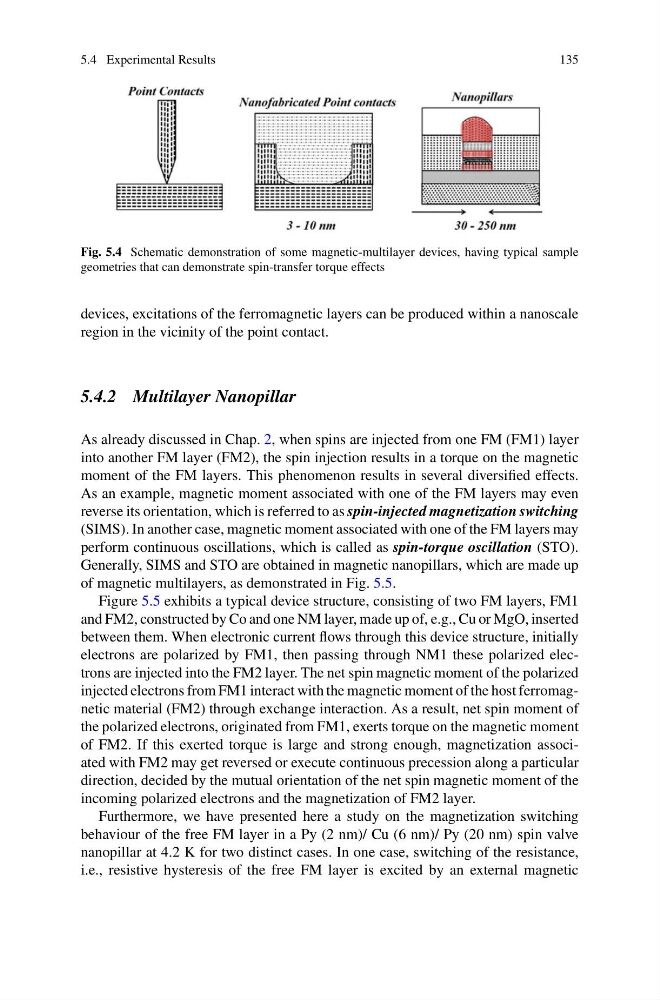
Fig. 5.4 Schematic demonstration of some magnetic-multilayer devices, having typical sample
geometries that can demonstrate spin-transfer torque effects
devices, excitations of the ferromagnetic layers can be produced within a nanoscale
region in the vicinity of the point contact.
5.4.2 Multilayer Nanopillar
As already discussed in Chap. 2, when spins are injected from one FM (FM1) layer
into another FM layer (FM2), the spin injection results in a torque on the magnetic
moment of the FM layers. This phenomenon results in several diversified effects.
As an example, magnetic moment associated with one of the FM layers may even
reverse its orientation, which is referred to as spin-injected magnetization switching
(SIMS). In another case, magnetic moment associated with one of the FM layers may
perform continuous oscillations, which is called as spin-torque oscillation (STO).
Generally, SIMS and STO are obtained in magnetic nanopillars, which are made up
of magnetic multilayers, as demonstrated in Fig. 5.5.
Figure 5.5 exhibits a typical device structure, consisting of two FM layers, FM1
and FM2, constructed by Co and one NM layer, made up of, e.g., Cu or MgO, inserted
between them. When electronic current flows through this device structure, initially
electrons are polarized by FM1, then passing through NM1 these polarized electrons are injected into the FM2 layer. The net spin magnetic moment of the polarized
injected electrons from FM1 interact with the magnetic moment of the host ferromagnetic material (FM2) through exchange interaction. As a result, net spin moment of
the polarized electrons, originated from FM1, exerts torque on the magnetic moment
of FM2. If this exerted torque is large and strong enough, magnetization associated with FM2 may get reversed or execute continuous precession along a particular
direction, decided by the mutual orientation of the net spin magnetic moment of the
incoming polarized electrons and the magnetization of FM2 layer.
Furthermore, we have presented here a study on the magnetization switching
behaviour of the free FM layer in a Py (2 nm)/ Cu (6 nm)/ Py (20 nm) spin valve
nanopillar at 4.2 K for two distinct cases. In one case, switching of the resistance,
i.e., resistive hysteresis of the free FM layer is excited by an external magnetic
135
Fig. 5.4 Schematic demonstration of some magnetic-multilayer devices, having typical sample
geometries that can demonstrate spin-transfer torque effects
devices, excitations of the ferromagnetic layers can be produced within a nanoscale
region in the vicinity of the point contact.
5.4.2 Multilayer Nanopillar
As already discussed in Chap. 2, when spins are injected from one FM (FM1) layer
into another FM layer (FM2), the spin injection results in a torque on the magnetic
moment of the FM layers. This phenomenon results in several diversified effects.
As an example, magnetic moment associated with one of the FM layers may even
reverse its orientation, which is referred to as spin-injected magnetization switching
(SIMS). In another case, magnetic moment associated with one of the FM layers may
perform continuous oscillations, which is called as spin-torque oscillation (STO).
Generally, SIMS and STO are obtained in magnetic nanopillars, which are made up
of magnetic multilayers, as demonstrated in Fig. 5.5.
Figure 5.5 exhibits a typical device structure, consisting of two FM layers, FM1
and FM2, constructed by Co and one NM layer, made up of, e.g., Cu or MgO, inserted
between them. When electronic current flows through this device structure, initially
electrons are polarized by FM1, then passing through NM1 these polarized electrons are injected into the FM2 layer. The net spin magnetic moment of the polarized
injected electrons from FM1 interact with the magnetic moment of the host ferromagnetic material (FM2) through exchange interaction. As a result, net spin moment of
the polarized electrons, originated from FM1, exerts torque on the magnetic moment
of FM2. If this exerted torque is large and strong enough, magnetization associated with FM2 may get reversed or execute continuous precession along a particular
direction, decided by the mutual orientation of the net spin magnetic moment of the
incoming polarized electrons and the magnetization of FM2 layer.
Furthermore, we have presented here a study on the magnetization switching
behaviour of the free FM layer in a Py (2 nm)/ Cu (6 nm)/ Py (20 nm) spin valve
nanopillar at 4.2 K for two distinct cases. In one case, switching of the resistance,
i.e., resistive hysteresis of the free FM layer is excited by an external magnetic