

122
4 Tunnelling Magnetoresistance (TMR)
electrons is P 1 , which can be determined exactly by the Meservey-Tedrow technique. After entering the paramagnetic spacer layer, these spin-polarized electrons
will undergo drift and diffusion (or hop) and thereby proceeding towards the ferromagnetic detector electrode, under the influence of a transport-driving electric field.
The spin polarization of the injected spin-polarized electrons (P) has been found
to decrease with distance x, measured from the point of injection. Such relaxation
process of spin polarization can be modelled as
P(x) = P 1 exp(−x/L s ),
(4.33)
where L S is referred to as the spin relaxation or spin diffusion length. There is
also experimental confirmation for such exponential decay of spin polarization
with distance (Shim et al. 2008). Therefore, when those electrons arrive at the
ferromagnetic detector interface, their spin polarization becomes
P(d) = P 1 exp(−d/L s ).
(4.34)
where d is the distance between the interfaces of the injector/paramagnetic spacer
layer and the detector/paramagnetic spacer layer of the spin valve, i.e., between
the injection and the detection point. Let us apply Jullière formula on the tunnel
barrier of detector/paramagnetic spacer layer interface, which separates the two spin
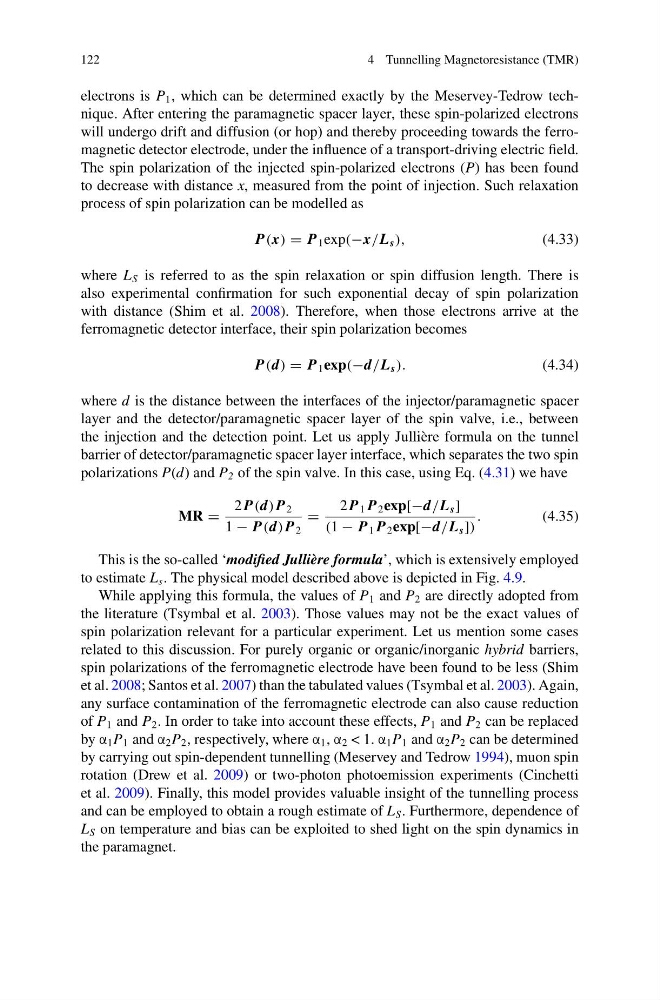
polarizations P(d) and P 2 of the spin valve. In this case, using Eq. (4.31) we have
MR =
2 P(d) P 2
1 − P(d) P 2
=
2 P 1 P 2 exp[−d/L s ]
(1 − P 1 P 2 exp[−d/L s ])
.
(4.35)
This is the so-called ‘modified Jullière formula’, which is extensively employed
to estimate L s . The physical model described above is depicted in Fig. 4.9.
While applying this formula, the values of P 1 and P 2 are directly adopted from
the literature (Tsymbal et al. 2003). Those values may not be the exact values of
spin polarization relevant for a particular experiment. Let us mention some cases
related to this discussion. For purely organic or organic/inorganic hybrid barriers,
spin polarizations of the ferromagnetic electrode have been found to be less (Shim
et al. 2008; Santos et al. 2007) than the tabulated values (Tsymbal et al. 2003). Again,
any surface contamination of the ferromagnetic electrode can also cause reduction
of P 1 and P 2 . In order to take into account these effects, P 1 and P 2 can be replaced
by α 1 P 1 and α 2 P 2 , respectively, where α 1 , α 2 < 1. α 1 P 1 and α 2 P 2 can be determined
by carrying out spin-dependent tunnelling (Meservey and Tedrow 1994), muon spin
rotation (Drew et al. 2009) or two-photon photoemission experiments (Cinchetti
et al. 2009). Finally, this model provides valuable insight of the tunnelling process
and can be employed to obtain a rough estimate of L S . Furthermore, dependence of
L S on temperature and bias can be exploited to shed light on the spin dynamics in
the paramagnet.
4 Tunnelling Magnetoresistance (TMR)
electrons is P 1 , which can be determined exactly by the Meservey-Tedrow technique. After entering the paramagnetic spacer layer, these spin-polarized electrons
will undergo drift and diffusion (or hop) and thereby proceeding towards the ferromagnetic detector electrode, under the influence of a transport-driving electric field.
The spin polarization of the injected spin-polarized electrons (P) has been found
to decrease with distance x, measured from the point of injection. Such relaxation
process of spin polarization can be modelled as
P(x) = P 1 exp(−x/L s ),
(4.33)
where L S is referred to as the spin relaxation or spin diffusion length. There is
also experimental confirmation for such exponential decay of spin polarization
with distance (Shim et al. 2008). Therefore, when those electrons arrive at the
ferromagnetic detector interface, their spin polarization becomes
P(d) = P 1 exp(−d/L s ).
(4.34)
where d is the distance between the interfaces of the injector/paramagnetic spacer
layer and the detector/paramagnetic spacer layer of the spin valve, i.e., between
the injection and the detection point. Let us apply Jullière formula on the tunnel
barrier of detector/paramagnetic spacer layer interface, which separates the two spin
polarizations P(d) and P 2 of the spin valve. In this case, using Eq. (4.31) we have
MR =
2 P(d) P 2
1 − P(d) P 2
=
2 P 1 P 2 exp[−d/L s ]
(1 − P 1 P 2 exp[−d/L s ])
.
(4.35)
This is the so-called ‘modified Jullière formula’, which is extensively employed
to estimate L s . The physical model described above is depicted in Fig. 4.9.
While applying this formula, the values of P 1 and P 2 are directly adopted from
the literature (Tsymbal et al. 2003). Those values may not be the exact values of
spin polarization relevant for a particular experiment. Let us mention some cases
related to this discussion. For purely organic or organic/inorganic hybrid barriers,
spin polarizations of the ferromagnetic electrode have been found to be less (Shim
et al. 2008; Santos et al. 2007) than the tabulated values (Tsymbal et al. 2003). Again,
any surface contamination of the ferromagnetic electrode can also cause reduction
of P 1 and P 2 . In order to take into account these effects, P 1 and P 2 can be replaced
by α 1 P 1 and α 2 P 2 , respectively, where α 1 , α 2 < 1. α 1 P 1 and α 2 P 2 can be determined
by carrying out spin-dependent tunnelling (Meservey and Tedrow 1994), muon spin
rotation (Drew et al. 2009) or two-photon photoemission experiments (Cinchetti
et al. 2009). Finally, this model provides valuable insight of the tunnelling process
and can be employed to obtain a rough estimate of L S . Furthermore, dependence of
L S on temperature and bias can be exploited to shed light on the spin dynamics in
the paramagnet.