

4.4 Effect of Various Parameters on Tunnel Magnetoresistance
121
of the surrounding material. In case of a larger electrostatic energy than the thermal
energy, k B T, tunnelling phenomenon gets suppressed. This is referred to as Coulomb
blockade (Devoret and Grabert 1992).
In this context, we may mention that the interplay of charging effects and
magnetism results in a wide variety of phenomena. For instance, the resistance
of granular materials exhibits an upturn at low temperatures. This feature can be
explained considering average charging energy, assuming a given grain sizes and
barrier heights distribution (Coey et al. 1998; Balcells et al. 1998; Helman and Abeles
1976). Now, application of a magnetic field causes decrease in the effective charging
energy due to increase in intergrain conductance. Obviously, tunnelling between
grains would be more efficient during parallel alignment of magnetization of the
grains.
4.5 Measurement of Spin Relaxation Length and Time
in the Spacer Layer
In an attempt to extract spin relaxation length (L S ) and spin relaxation time (τ s )
in a paramagnetic material, a standard method is to carry out spin valve experiment (discussed earlier). The change in resistance with the corresponding change in
magnetization alignment from parallel to antiparallel configurations enable one to
find out the spin relaxation length and time in the paramagnetic spacer layer. As we
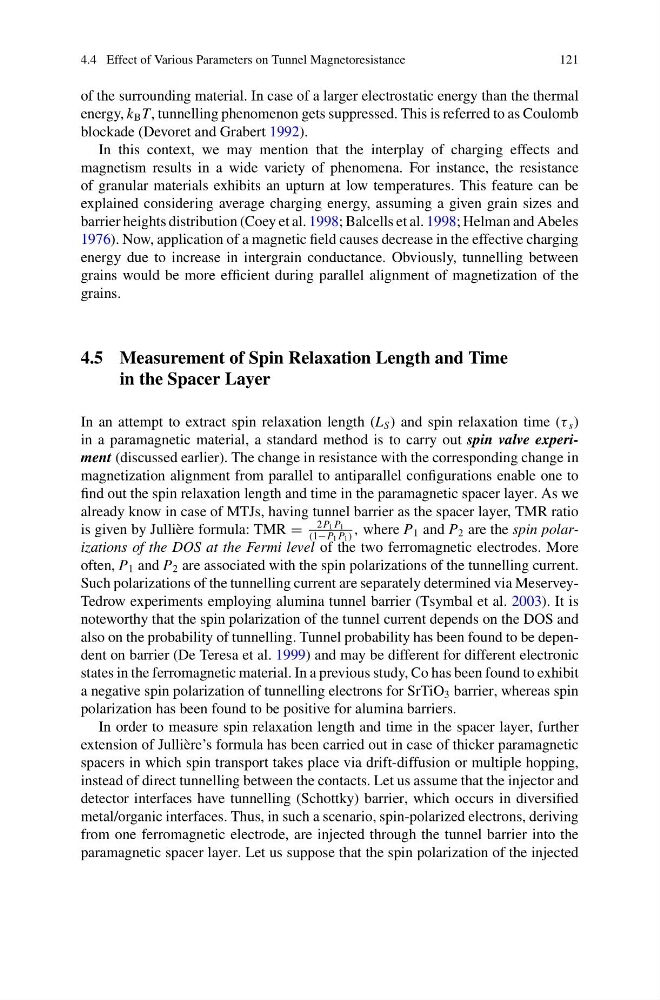
already know in case of MTJs, having tunnel barrier as the spacer layer, TMR ratio
is given by Jullière formula: TMR =
2P 1 P 1
(1−P1 P 1)
, where P 1 and P 2 are the spin polarizations of the DOS at the Fermi level of the two ferromagnetic electrodes. More
often, P 1 and P 2 are associated with the spin polarizations of the tunnelling current.
Such polarizations of the tunnelling current are separately determined via MeserveyTedrow experiments employing alumina tunnel barrier (Tsymbal et al. 2003). It is
noteworthy that the spin polarization of the tunnel current depends on the DOS and
also on the probability of tunnelling. Tunnel probability has been found to be dependent on barrier (De Teresa et al. 1999) and may be different for different electronic
states in the ferromagnetic material. In a previous study, Co has been found to exhibit
a negative spin polarization of tunnelling electrons for SrTiO 3 barrier, whereas spin
polarization has been found to be positive for alumina barriers.
In order to measure spin relaxation length and time in the spacer layer, further
extension of Jullière’s formula has been carried out in case of thicker paramagnetic
spacers in which spin transport takes place via drift-diffusion or multiple hopping,
instead of direct tunnelling between the contacts. Let us assume that the injector and
detector interfaces have tunnelling (Schottky) barrier, which occurs in diversified
metal/organic interfaces. Thus, in such a scenario, spin-polarized electrons, deriving
from one ferromagnetic electrode, are injected through the tunnel barrier into the
paramagnetic spacer layer. Let us suppose that the spin polarization of the injected
121
of the surrounding material. In case of a larger electrostatic energy than the thermal
energy, k B T, tunnelling phenomenon gets suppressed. This is referred to as Coulomb
blockade (Devoret and Grabert 1992).
In this context, we may mention that the interplay of charging effects and
magnetism results in a wide variety of phenomena. For instance, the resistance
of granular materials exhibits an upturn at low temperatures. This feature can be
explained considering average charging energy, assuming a given grain sizes and
barrier heights distribution (Coey et al. 1998; Balcells et al. 1998; Helman and Abeles
1976). Now, application of a magnetic field causes decrease in the effective charging
energy due to increase in intergrain conductance. Obviously, tunnelling between
grains would be more efficient during parallel alignment of magnetization of the
grains.
4.5 Measurement of Spin Relaxation Length and Time
in the Spacer Layer
In an attempt to extract spin relaxation length (L S ) and spin relaxation time (τ s )
in a paramagnetic material, a standard method is to carry out spin valve experiment (discussed earlier). The change in resistance with the corresponding change in
magnetization alignment from parallel to antiparallel configurations enable one to
find out the spin relaxation length and time in the paramagnetic spacer layer. As we
already know in case of MTJs, having tunnel barrier as the spacer layer, TMR ratio
is given by Jullière formula: TMR =
2P 1 P 1
(1−P1 P 1)
, where P 1 and P 2 are the spin polarizations of the DOS at the Fermi level of the two ferromagnetic electrodes. More
often, P 1 and P 2 are associated with the spin polarizations of the tunnelling current.
Such polarizations of the tunnelling current are separately determined via MeserveyTedrow experiments employing alumina tunnel barrier (Tsymbal et al. 2003). It is
noteworthy that the spin polarization of the tunnel current depends on the DOS and
also on the probability of tunnelling. Tunnel probability has been found to be dependent on barrier (De Teresa et al. 1999) and may be different for different electronic
states in the ferromagnetic material. In a previous study, Co has been found to exhibit
a negative spin polarization of tunnelling electrons for SrTiO 3 barrier, whereas spin
polarization has been found to be positive for alumina barriers.
In order to measure spin relaxation length and time in the spacer layer, further
extension of Jullière’s formula has been carried out in case of thicker paramagnetic
spacers in which spin transport takes place via drift-diffusion or multiple hopping,
instead of direct tunnelling between the contacts. Let us assume that the injector and
detector interfaces have tunnelling (Schottky) barrier, which occurs in diversified
metal/organic interfaces. Thus, in such a scenario, spin-polarized electrons, deriving
from one ferromagnetic electrode, are injected through the tunnel barrier into the
paramagnetic spacer layer. Let us suppose that the spin polarization of the injected