

86
3 Giant Magnetoresistance (GMR)
3.5 Physical Origin of GMR: Qualitative Explanation
It is clear from the above-made discussion that the GMR effect is a very basic
phenomenon occurring in magnetic materials ranging from nanoparticles over multilayered thin films to permanent magnets. In this contribution, we first focus on the
links between the effect characteristic and underlying microstructure.
GMR effect can be qualitatively explained by adopting the well-known Mott model
The model was introduced in early 1936 to explain the sudden increase in resistivity of
ferromagnetic metals when they are heated above their respective Curie temperature.
Electron conduction in two separate channels
At the onset, we should mention that the electron spin should remain conserved
up to distances spanned over several tens of nanometres. It should be noted that
such distances are much larger than the thickness of a typical multilayer, where the
thickness of the layer is generally kept on the order of few Angstroms. Therefore,
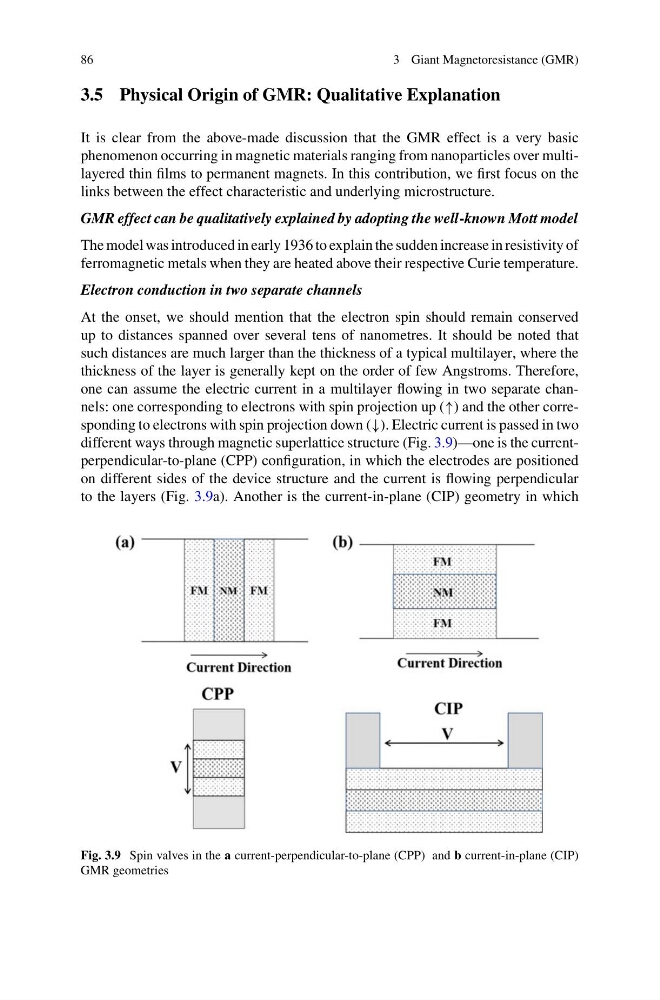
one can assume the electric current in a multilayer flowing in two separate channels: one corresponding to electrons with spin projection up (↑) and the other corresponding to electrons with spin projection down (↓). Electric current is passed in two
different ways through magnetic superlattice structure (Fig. 3.9)—one is the currentperpendicular-to-plane (CPP) configuration, in which the electrodes are positioned
on different sides of the device structure and the current is flowing perpendicular
to the layers (Fig. 3.9a). Another is the current-in-plane (CIP) geometry in which
Fig. 3.9 Spin valves in the a current-perpendicular-to-plane (CPP) and b current-in-plane (CIP)
GMR geometries
3 Giant Magnetoresistance (GMR)
3.5 Physical Origin of GMR: Qualitative Explanation
It is clear from the above-made discussion that the GMR effect is a very basic
phenomenon occurring in magnetic materials ranging from nanoparticles over multilayered thin films to permanent magnets. In this contribution, we first focus on the
links between the effect characteristic and underlying microstructure.
GMR effect can be qualitatively explained by adopting the well-known Mott model
The model was introduced in early 1936 to explain the sudden increase in resistivity of
ferromagnetic metals when they are heated above their respective Curie temperature.
Electron conduction in two separate channels
At the onset, we should mention that the electron spin should remain conserved
up to distances spanned over several tens of nanometres. It should be noted that
such distances are much larger than the thickness of a typical multilayer, where the
thickness of the layer is generally kept on the order of few Angstroms. Therefore,
one can assume the electric current in a multilayer flowing in two separate channels: one corresponding to electrons with spin projection up (↑) and the other corresponding to electrons with spin projection down (↓). Electric current is passed in two
different ways through magnetic superlattice structure (Fig. 3.9)—one is the currentperpendicular-to-plane (CPP) configuration, in which the electrodes are positioned
on different sides of the device structure and the current is flowing perpendicular
to the layers (Fig. 3.9a). Another is the current-in-plane (CIP) geometry in which
Fig. 3.9 Spin valves in the a current-perpendicular-to-plane (CPP) and b current-in-plane (CIP)
GMR geometries