

64
2 Worldsheet Path Integral: Vacuum Amplitudes
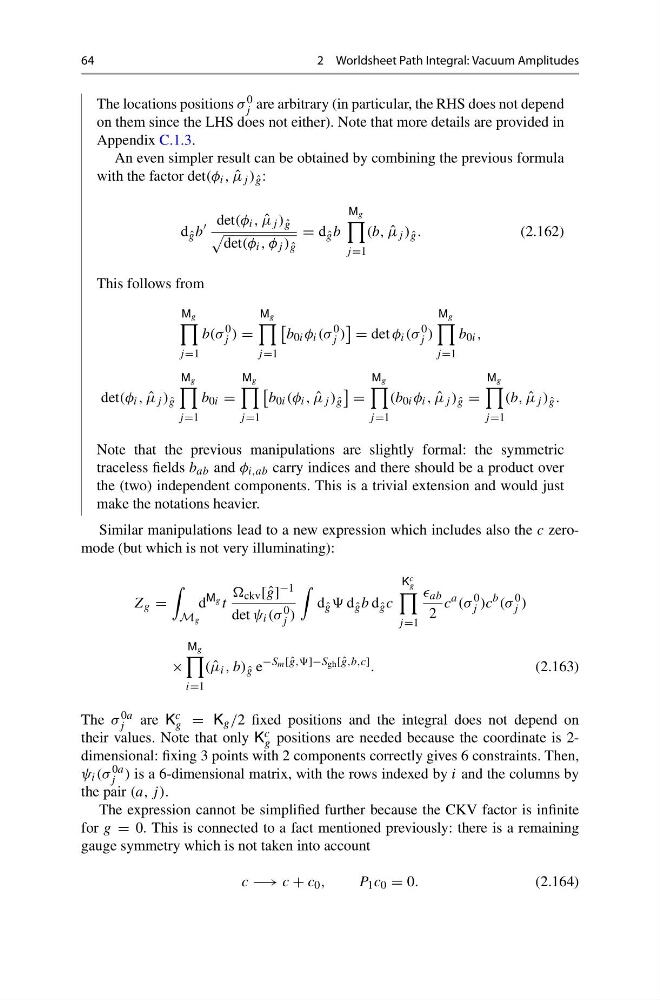
The locations positions σ 0
j are arbitrary (in particular, the RHS does not depend
on them since the LHS does not either). Note that more details are provided in
Appendix C.1.3.
An even simpler result can be obtained by combining the previous formula
with the factor det(φ i , ˆ
μ j ) ˆ
g :
d ˆ
g b
det(φ i , ˆ
μ j ) ˆ
g
det(φ i , φ j ) ˆ
g
= d ˆ
g b
M g
j =1
(b, ˆ
μ j ) ˆ
g .
(2.162)
This follows from
M g
j =1
b(σ
0
j ) =
M g
j =1
b 0i φ i (σ
0
j )
= det φ i (σ
0
j )
M g
j =1
b 0i ,
det(φ i , ˆ
μ j ) ˆ
g
M g
j =1
b 0i =
M g
j =1
b 0i (φ i , ˆ
μ j ) ˆ
g
=
M g
j =1
(b 0i φ i , ˆ
μ j ) ˆ
g =
M g
j =1
(b, ˆ
μ j ) ˆ
g .
Note that the previous manipulations are slightly formal: the symmetric
traceless fields b ab and φ i,ab carry indices and there should be a product over
the (two) independent components. This is a trivial extension and would just
make the notations heavier.
Similar manipulations lead to a new expression which includes also the c zeromode (but which is not very illuminating):
Z g =
M g
d
M g t
ckv [ ˆ
g] −1
det ψ i (σ 0
j )
d ˆ
g d ˆ
g b d ˆ
g c
K c
g
j =1
ab
2
c
a (σ
0
j )c
b (σ
0
j )
×
M g
i=1
( ˆ
μ i , b) ˆ
g e
−S m [ ˆ
g,,]−S gh [ ˆ
g,b,c] .
(2.163)
The σ 0a
j are K c
g = K g /2 fixed positions and the integral does not depend on
their values. Note that only K c
g positions are needed because the coordinate is 2dimensional: fixing 3 points with 2 components correctly gives 6 constraints. Then,
ψ i (σ 0a
j ) is a 6-dimensional matrix, with the rows indexed by i and the columns by
the pair (a, j ).
The expression cannot be simplified further because the CKV factor is infinite
for g = 0. This is connected to a fact mentioned previously: there is a remaining
gauge symmetry which is not taken into account
c −→ c + c 0 ,
P 1 c 0 = 0.
(2.164)
2 Worldsheet Path Integral: Vacuum Amplitudes
The locations positions σ 0
j are arbitrary (in particular, the RHS does not depend
on them since the LHS does not either). Note that more details are provided in
Appendix C.1.3.
An even simpler result can be obtained by combining the previous formula
with the factor det(φ i , ˆ
μ j ) ˆ
g :
d ˆ
g b
det(φ i , ˆ
μ j ) ˆ
g
det(φ i , φ j ) ˆ
g
= d ˆ
g b
M g
j =1
(b, ˆ
μ j ) ˆ
g .
(2.162)
This follows from
M g
j =1
b(σ
0
j ) =
M g
j =1
b 0i φ i (σ
0
j )
= det φ i (σ
0
j )
M g
j =1
b 0i ,
det(φ i , ˆ
μ j ) ˆ
g
M g
j =1
b 0i =
M g
j =1
b 0i (φ i , ˆ
μ j ) ˆ
g
=
M g
j =1
(b 0i φ i , ˆ
μ j ) ˆ
g =
M g
j =1
(b, ˆ
μ j ) ˆ
g .
Note that the previous manipulations are slightly formal: the symmetric
traceless fields b ab and φ i,ab carry indices and there should be a product over
the (two) independent components. This is a trivial extension and would just
make the notations heavier.
Similar manipulations lead to a new expression which includes also the c zeromode (but which is not very illuminating):
Z g =
M g
d
M g t
ckv [ ˆ
g] −1
det ψ i (σ 0
j )
d ˆ
g d ˆ
g b d ˆ
g c
K c
g
j =1
ab
2
c
a (σ
0
j )c
b (σ
0
j )
×
M g
i=1
( ˆ
μ i , b) ˆ
g e
−S m [ ˆ
g,,]−S gh [ ˆ
g,b,c] .
(2.163)
The σ 0a
j are K c
g = K g /2 fixed positions and the integral does not depend on
their values. Note that only K c
g positions are needed because the coordinate is 2dimensional: fixing 3 points with 2 components correctly gives 6 constraints. Then,
ψ i (σ 0a
j ) is a 6-dimensional matrix, with the rows indexed by i and the columns by
the pair (a, j ).
The expression cannot be simplified further because the CKV factor is infinite
for g = 0. This is connected to a fact mentioned previously: there is a remaining
gauge symmetry which is not taken into account
c −→ c + c 0 ,
P 1 c 0 = 0.
(2.164)