

48
2 Worldsheet Path Integral: Vacuum Amplitudes
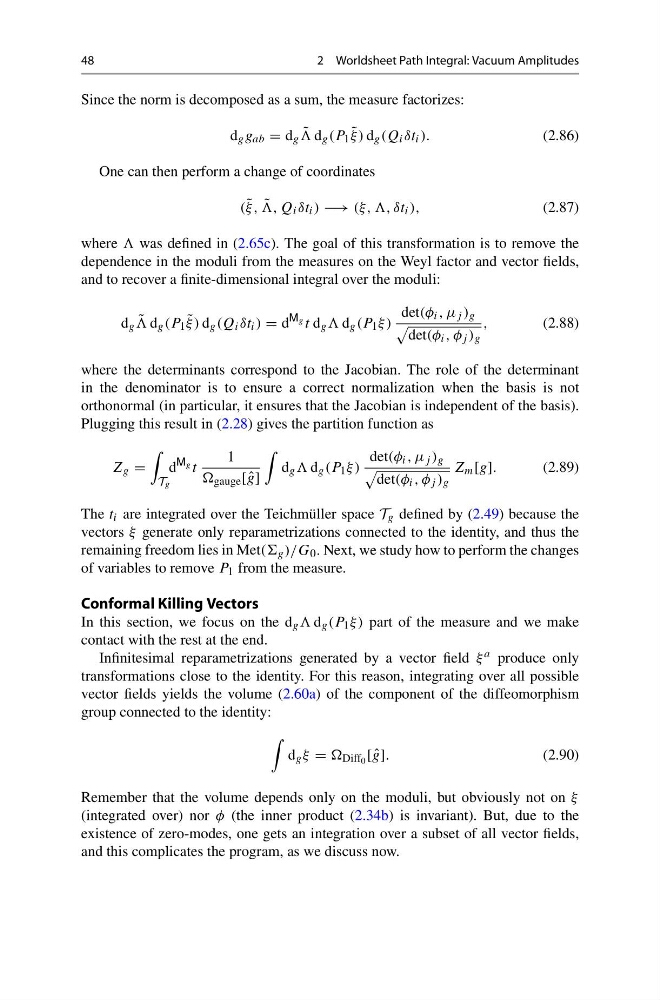
Since the norm is decomposed as a sum, the measure factorizes:
d g g ab = d g ˜
d g (P 1 ˜
ξ) d g (Q i δt i ).
(2.86)
One can then perform a change of coordinates
( ˜
ξ, ˜
Q i δt i ) −→ (ξ, ,, δt i ),
(2.87)
where was defined in (2.65c). The goal of this transformation is to remove the
dependence in the moduli from the measures on the Weyl factor and vector fields,
and to recover a finite-dimensional integral over the moduli:
d g ˜
d g (P 1 ˜
ξ) d g (Q i δt i ) = d
M g t d g d g (P 1 ξ)
det(φ i , μ j ) g
det(φ i , φ j ) g
,
(2.88)
where the determinants correspond to the Jacobian. The role of the determinant
in the denominator is to ensure a correct normalization when the basis is not
orthonormal (in particular, it ensures that the Jacobian is independent of the basis).
Plugging this result in (2.28) gives the partition function as
Z g =
T g
d
M g t
1
gauge [ ˆ
g]
d g d g (P 1 ξ)
det(φ i , μ j ) g
det(φ i , φ j ) g
Z m [g].
(2.89)
The t i are integrated over the Teichmüller space T g defined by (2.49) because the
vectors ξ generate only reparametrizations connected to the identity, and thus the
remaining freedom lies in Met(( g )/G 0 . Next, we study how to perform the changes
of variables to remove P 1 from the measure.
Conformal Killing Vectors
In this section, we focus on the d g d g (P 1 ξ) part of the measure and we make
contact with the rest at the end.
Infinitesimal reparametrizations generated by a vector field ξ a produce only
transformations close to the identity. For this reason, integrating over all possible
vector fields yields the volume (2.60a) of the component of the diffeomorphism
group connected to the identity:
d g ξ = Diff 0 [ ˆ
g].
(2.90)
Remember that the volume depends only on the moduli, but obviously not on ξ
(integrated over) nor φ (the inner product (2.34b) is invariant). But, due to the
existence of zero-modes, one gets an integration over a subset of all vector fields,
and this complicates the program, as we discuss now.
2 Worldsheet Path Integral: Vacuum Amplitudes
Since the norm is decomposed as a sum, the measure factorizes:
d g g ab = d g ˜
d g (P 1 ˜
ξ) d g (Q i δt i ).
(2.86)
One can then perform a change of coordinates
( ˜
ξ, ˜
Q i δt i ) −→ (ξ, ,, δt i ),
(2.87)
where was defined in (2.65c). The goal of this transformation is to remove the
dependence in the moduli from the measures on the Weyl factor and vector fields,
and to recover a finite-dimensional integral over the moduli:
d g ˜
d g (P 1 ˜
ξ) d g (Q i δt i ) = d
M g t d g d g (P 1 ξ)
det(φ i , μ j ) g
det(φ i , φ j ) g
,
(2.88)
where the determinants correspond to the Jacobian. The role of the determinant
in the denominator is to ensure a correct normalization when the basis is not
orthonormal (in particular, it ensures that the Jacobian is independent of the basis).
Plugging this result in (2.28) gives the partition function as
Z g =
T g
d
M g t
1
gauge [ ˆ
g]
d g d g (P 1 ξ)
det(φ i , μ j ) g
det(φ i , φ j ) g
Z m [g].
(2.89)
The t i are integrated over the Teichmüller space T g defined by (2.49) because the
vectors ξ generate only reparametrizations connected to the identity, and thus the
remaining freedom lies in Met(( g )/G 0 . Next, we study how to perform the changes
of variables to remove P 1 from the measure.
Conformal Killing Vectors
In this section, we focus on the d g d g (P 1 ξ) part of the measure and we make
contact with the rest at the end.
Infinitesimal reparametrizations generated by a vector field ξ a produce only
transformations close to the identity. For this reason, integrating over all possible
vector fields yields the volume (2.60a) of the component of the diffeomorphism
group connected to the identity:
d g ξ = Diff 0 [ ˆ
g].
(2.90)
Remember that the volume depends only on the moduli, but obviously not on ξ
(integrated over) nor φ (the inner product (2.34b) is invariant). But, due to the
existence of zero-modes, one gets an integration over a subset of all vector fields,
and this complicates the program, as we discuss now.