

2.2 Path Integral
37
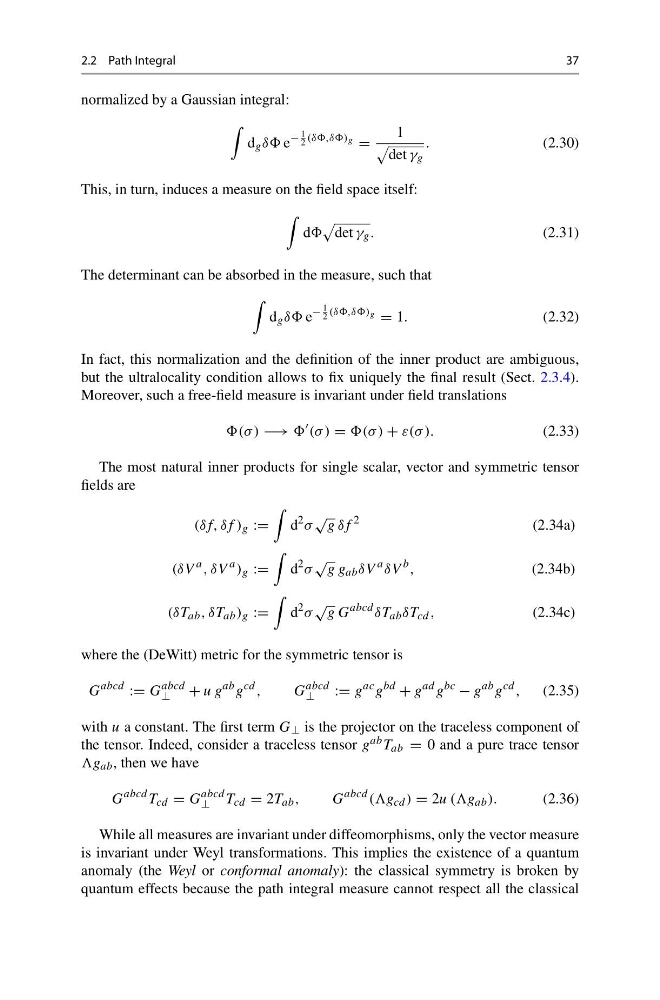
normalized by a Gaussian integral:
d g δδ e
−
1
2 (δδ,δδ) g =
1
det γ g
.
(2.30)
This, in turn, induces a measure on the field space itself:
d
det γ g .
(2.31)
The determinant can be absorbed in the measure, such that
d g δδ e
−
1
2 (δδ,δδ) g = 1.
(2.32)
In fact, this normalization and the definition of the inner product are ambiguous,
but the ultralocality condition allows to fix uniquely the final result (Sect. 2.3.4).
Moreover, such a free-field measure is invariant under field translations
) −→
(σ ) = ) + ε(σ ).
(2.33)
The most natural inner products for single scalar, vector and symmetric tensor
fields are
(δf, δf ) g :=
d
2 σ
√
g δf
2
(2.34a)
(δV
a , δV
a ) g :=
d
2 σ
√
g g ab δV
a δV
b ,
(2.34b)
(δT ab , δT ab ) g :=
d
2 σ
√
g G
abcd δT ab δT cd ,
(2.34c)
where the (DeWitt) metric for the symmetric tensor is
G
abcd
:= G
abcd
⊥
+ u g
ab g
cd ,
G
abcd
⊥
:= g
ac g
bd
+ g
ad g
bc
− g
ab g
cd ,
(2.35)
with u a constant. The first term G ⊥ is the projector on the traceless component of
the tensor. Indeed, consider a traceless tensor g ab T ab = 0 and a pure trace tensor
g ab , then we have
G
abcd T cd = G
abcd
⊥ T cd = 2T ab ,
G
abcd ((g cd ) = 2u ((g ab ).
(2.36)
While all measures are invariant under diffeomorphisms, only the vector measure
is invariant under Weyl transformations. This implies the existence of a quantum
anomaly (the Weyl or conformal anomaly): the classical symmetry is broken by
quantum effects because the path integral measure cannot respect all the classical
37
normalized by a Gaussian integral:
d g δδ e
−
1
2 (δδ,δδ) g =
1
det γ g
.
(2.30)
This, in turn, induces a measure on the field space itself:
d
det γ g .
(2.31)
The determinant can be absorbed in the measure, such that
d g δδ e
−
1
2 (δδ,δδ) g = 1.
(2.32)
In fact, this normalization and the definition of the inner product are ambiguous,
but the ultralocality condition allows to fix uniquely the final result (Sect. 2.3.4).
Moreover, such a free-field measure is invariant under field translations
) −→
(σ ) = ) + ε(σ ).
(2.33)
The most natural inner products for single scalar, vector and symmetric tensor
fields are
(δf, δf ) g :=
d
2 σ
√
g δf
2
(2.34a)
(δV
a , δV
a ) g :=
d
2 σ
√
g g ab δV
a δV
b ,
(2.34b)
(δT ab , δT ab ) g :=
d
2 σ
√
g G
abcd δT ab δT cd ,
(2.34c)
where the (DeWitt) metric for the symmetric tensor is
G
abcd
:= G
abcd
⊥
+ u g
ab g
cd ,
G
abcd
⊥
:= g
ac g
bd
+ g
ad g
bc
− g
ab g
cd ,
(2.35)
with u a constant. The first term G ⊥ is the projector on the traceless component of
the tensor. Indeed, consider a traceless tensor g ab T ab = 0 and a pure trace tensor
g ab , then we have
G
abcd T cd = G
abcd
⊥ T cd = 2T ab ,
G
abcd ((g cd ) = 2u ((g ab ).
(2.36)
While all measures are invariant under diffeomorphisms, only the vector measure
is invariant under Weyl transformations. This implies the existence of a quantum
anomaly (the Weyl or conformal anomaly): the classical symmetry is broken by
quantum effects because the path integral measure cannot respect all the classical