

36
2 Worldsheet Path Integral: Vacuum Amplitudes
corresponds to the g-loop vacuum amplitude: interactions and their associated
scattering amplitudes are discussed in Sect. 3.1.
In order to perform the gauge fixing and to manipulate the path integral (2.28), it
is necessary to define the integration measure over the fields. Because the space
is infinite-dimensional, this is a difficult task. One possibility is to define the
measure implicitly through Gaussian integration over the field tangent space (see
also Appendix C.1). A Gaussian integral involves a quadratic form, that is, an inner
product (or equivalently a metric) on the field space. The explanation is that a metric
also defines a volume form, and thus a measure. To reduce the freedom in the
definition of the inner product, it is useful to introduce three natural assumptions:
1. ultralocality: the measure is invariant under reparametrizations and defined
point-wise, which implies that it can depend on the fields but not on their
derivatives;
2. invariant measure: the measure for the matter transforms trivially under any
symmetry of the matter theory by contracting indices with appropriate tensors;
3. free-field measure: for fields other than the worldsheet metric and matter (like
ghosts, Killing vectors, etc.), the measure is the one of a free field.
This means that the inner product is obtained by contracting the worldsheet indices
of the fields with a tensor built only from the worldsheet metric, by contracting other
indices (like spacetime) with some invariant tensor (like the spacetime metric), and
finally by integrating over the worldsheet.
We need to distinguish the matter fields from those appearing in the gauge fixing
procedure. The matter fields live in the representation of some group under which
the inner product is invariant: this means that it is not possible to define each field
measure independently if the exponential of inner products does not factorize. As
an example, on a curved background: dX =
μ dX μ . However, we will not need to
write explicitly the partition function for performing the gauge fixing: it is sufficient
to know that the matter is a CFT. In the gauge fixing procedure, different types
of fields (including the metric) appear which do not carry indices (beyond the
worldsheet indices). Below, we focus on defining a measure for each of those single
fields (and use free-field measures according to the third condition).
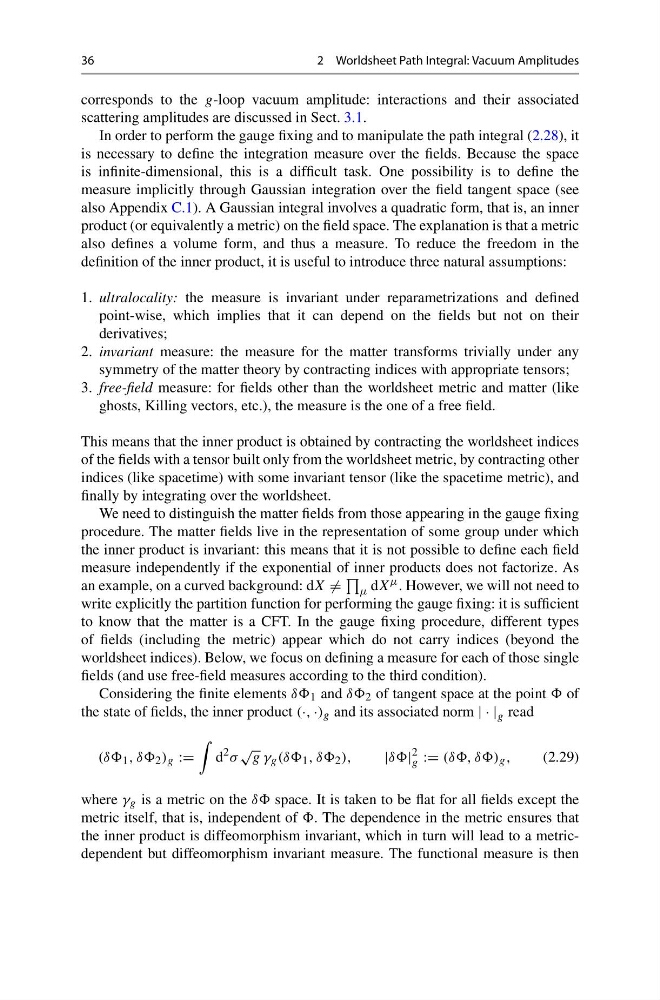
Considering the finite elements δδ 1 and δδ 2 of tangent space at the point of
the state of fields, the inner product (·, ·) g and its associated norm | · | g read
(δδ 1 , δδ 2 ) g :=
d
2 σ
√
g γ g (δδ 1 , δδ 2 ),
|δδ|
2
g := (δδ, δδ) g ,
(2.29)
where γ g is a metric on the δδ space. It is taken to be flat for all fields except the
metric itself, that is, independent of . The dependence in the metric ensures that
the inner product is diffeomorphism invariant, which in turn will lead to a metricdependent but diffeomorphism invariant measure. The functional measure is then
2 Worldsheet Path Integral: Vacuum Amplitudes
corresponds to the g-loop vacuum amplitude: interactions and their associated
scattering amplitudes are discussed in Sect. 3.1.
In order to perform the gauge fixing and to manipulate the path integral (2.28), it
is necessary to define the integration measure over the fields. Because the space
is infinite-dimensional, this is a difficult task. One possibility is to define the
measure implicitly through Gaussian integration over the field tangent space (see
also Appendix C.1). A Gaussian integral involves a quadratic form, that is, an inner
product (or equivalently a metric) on the field space. The explanation is that a metric
also defines a volume form, and thus a measure. To reduce the freedom in the
definition of the inner product, it is useful to introduce three natural assumptions:
1. ultralocality: the measure is invariant under reparametrizations and defined
point-wise, which implies that it can depend on the fields but not on their
derivatives;
2. invariant measure: the measure for the matter transforms trivially under any
symmetry of the matter theory by contracting indices with appropriate tensors;
3. free-field measure: for fields other than the worldsheet metric and matter (like
ghosts, Killing vectors, etc.), the measure is the one of a free field.
This means that the inner product is obtained by contracting the worldsheet indices
of the fields with a tensor built only from the worldsheet metric, by contracting other
indices (like spacetime) with some invariant tensor (like the spacetime metric), and
finally by integrating over the worldsheet.
We need to distinguish the matter fields from those appearing in the gauge fixing
procedure. The matter fields live in the representation of some group under which
the inner product is invariant: this means that it is not possible to define each field
measure independently if the exponential of inner products does not factorize. As
an example, on a curved background: dX =
μ dX μ . However, we will not need to
write explicitly the partition function for performing the gauge fixing: it is sufficient
to know that the matter is a CFT. In the gauge fixing procedure, different types
of fields (including the metric) appear which do not carry indices (beyond the
worldsheet indices). Below, we focus on defining a measure for each of those single
fields (and use free-field measures according to the third condition).
Considering the finite elements δδ 1 and δδ 2 of tangent space at the point of
the state of fields, the inner product (·, ·) g and its associated norm | · | g read
(δδ 1 , δδ 2 ) g :=
d
2 σ
√
g γ g (δδ 1 , δδ 2 ),
|δδ|
2
g := (δδ, δδ) g ,
(2.29)
where γ g is a metric on the δδ space. It is taken to be flat for all fields except the
metric itself, that is, independent of . The dependence in the metric ensures that
the inner product is diffeomorphism invariant, which in turn will lead to a metricdependent but diffeomorphism invariant measure. The functional measure is then