

32
2 Worldsheet Path Integral: Vacuum Amplitudes
It depends only on the genus g of the Riemann surface, but not on the metric. It is
an infinite discrete group for genus g ≥ 1 surfaces; in particular, 1 = SL(2, Z).
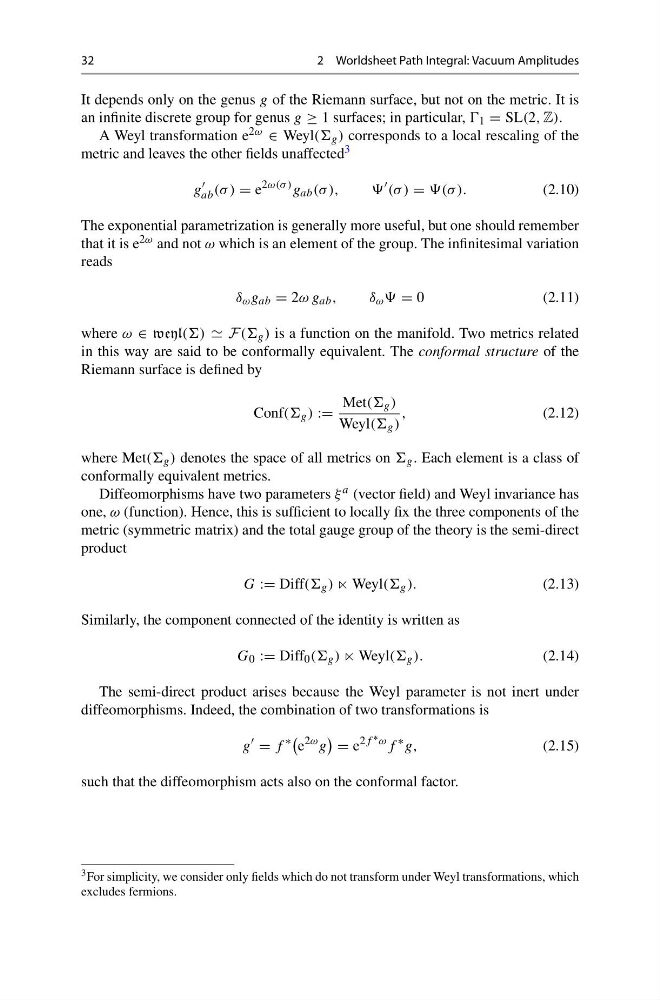
A Weyl transformation e 2ω ∈ Weyl(( g ) corresponds to a local rescaling of the
metric and leaves the other fields unaffected 3
g
ab (σ ) = e
2ω(σ ) g ab (σ ),
,
(σ ) = (σ ).
(2.10)
The exponential parametrization is generally more useful, but one should remember
that it is e 2ω and not ω which is an element of the group. The infinitesimal variation
reads
δ ω g ab = 2ω g ab ,
δ ω = 0
(2.11)
where ω ∈ weyl(() F(( g ) is a function on the manifold. Two metrics related
in this way are said to be conformally equivalent. The conformal structure of the
Riemann surface is defined by
Conf(( g ) :=
Met(( g )
Weyl(( g )
,
(2.12)
where Met(( g ) denotes the space of all metrics on g . Each element is a class of
conformally equivalent metrics.
Diffeomorphisms have two parameters ξ a (vector field) and Weyl invariance has
one, ω (function). Hence, this is sufficient to locally fix the three components of the
metric (symmetric matrix) and the total gauge group of the theory is the semi-direct
product
G := Diff(( g ) Weyl(( g ).
(2.13)
Similarly, the component connected of the identity is written as
G 0 := Diff 0 (( g ) Weyl(( g ).
(2.14)
The semi-direct product arises because the Weyl parameter is not inert under
diffeomorphisms. Indeed, the combination of two transformations is
g
= f
∗
e
2ω g
= e
2f ∗ ω f
∗ g,
(2.15)
such that the diffeomorphism acts also on the conformal factor.
3 For simplicity, we consider only fields which do not transform under Weyl transformations, which
excludes fermions.
2 Worldsheet Path Integral: Vacuum Amplitudes
It depends only on the genus g of the Riemann surface, but not on the metric. It is
an infinite discrete group for genus g ≥ 1 surfaces; in particular, 1 = SL(2, Z).
A Weyl transformation e 2ω ∈ Weyl(( g ) corresponds to a local rescaling of the
metric and leaves the other fields unaffected 3
g
ab (σ ) = e
2ω(σ ) g ab (σ ),
,
(σ ) = (σ ).
(2.10)
The exponential parametrization is generally more useful, but one should remember
that it is e 2ω and not ω which is an element of the group. The infinitesimal variation
reads
δ ω g ab = 2ω g ab ,
δ ω = 0
(2.11)
where ω ∈ weyl(() F(( g ) is a function on the manifold. Two metrics related
in this way are said to be conformally equivalent. The conformal structure of the
Riemann surface is defined by
Conf(( g ) :=
Met(( g )
Weyl(( g )
,
(2.12)
where Met(( g ) denotes the space of all metrics on g . Each element is a class of
conformally equivalent metrics.
Diffeomorphisms have two parameters ξ a (vector field) and Weyl invariance has
one, ω (function). Hence, this is sufficient to locally fix the three components of the
metric (symmetric matrix) and the total gauge group of the theory is the semi-direct
product
G := Diff(( g ) Weyl(( g ).
(2.13)
Similarly, the component connected of the identity is written as
G 0 := Diff 0 (( g ) Weyl(( g ).
(2.14)
The semi-direct product arises because the Weyl parameter is not inert under
diffeomorphisms. Indeed, the combination of two transformations is
g
= f
∗
e
2ω g
= e
2f ∗ ω f
∗ g,
(2.15)
such that the diffeomorphism acts also on the conformal factor.
3 For simplicity, we consider only fields which do not transform under Weyl transformations, which
excludes fermions.