

C Quantum Field Theory
409
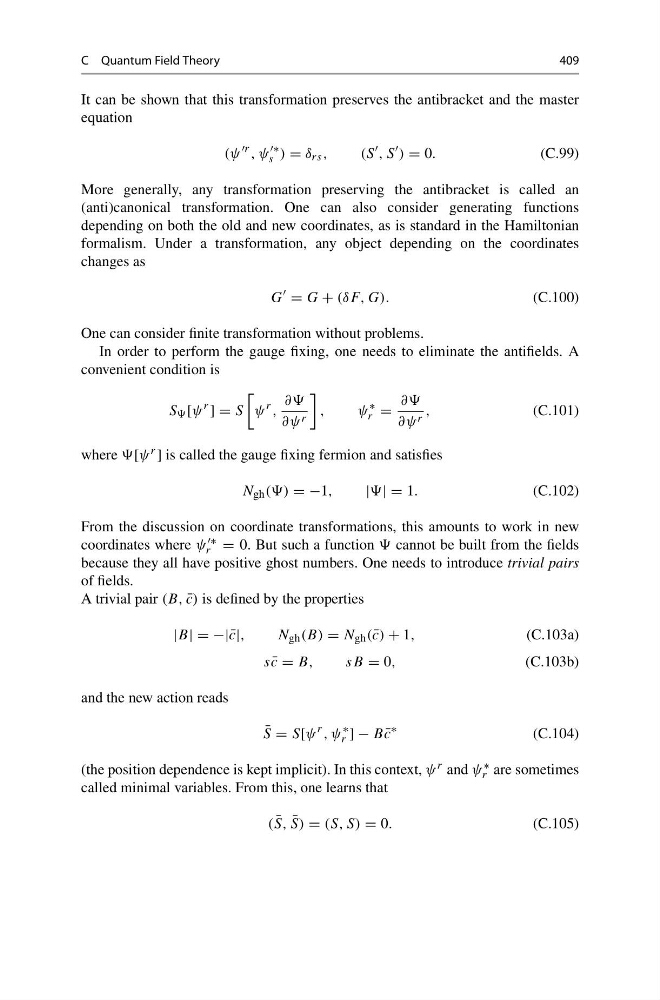
It can be shown that this transformation preserves the antibracket and the master
equation
(ψ
r , ψ
∗
s ) = δ rs ,
(S
, S
) = 0.
(C.99)
More generally, any transformation preserving the antibracket is called an
(anti)canonical transformation. One can also consider generating functions
depending on both the old and new coordinates, as is standard in the Hamiltonian
formalism. Under a transformation, any object depending on the coordinates
changes as
G
= G + (δF, G).
(C.100)
One can consider finite transformation without problems.
In order to perform the gauge fixing, one needs to eliminate the antifields. A
convenient condition is
S [ψ
r
] = S
ψ
r ,
∂∂
∂ψ r
,
ψ
∗
r =
∂∂
∂ψ r ,
(C.101)
where [ψ r ] is called the gauge fixing fermion and satisfies
N gh (() = −1,
|| = 1.
(C.102)
From the discussion on coordinate transformations, this amounts to work in new
coordinates where ψ ∗
r = 0. But such a function cannot be built from the fields
because they all have positive ghost numbers. One needs to introduce trivial pairs
of fields.
A trivial pair (B, ¯
c) is defined by the properties
|B| = −|¯ c|,
N gh (B) = N gh ( ¯
c) + 1,
(C.103a)
s ¯
c = B,
sB = 0,
(C.103b)
and the new action reads
¯
S = S[ψ
r , ψ
∗
r ] − B ¯
c
∗
(C.104)
(the position dependence is kept implicit). In this context, ψ r and ψ ∗
r are sometimes
called minimal variables. From this, one learns that
( ¯
S, ¯
S) = (S, S) = 0.
(C.105)
409
It can be shown that this transformation preserves the antibracket and the master
equation
(ψ
r , ψ
∗
s ) = δ rs ,
(S
, S
) = 0.
(C.99)
More generally, any transformation preserving the antibracket is called an
(anti)canonical transformation. One can also consider generating functions
depending on both the old and new coordinates, as is standard in the Hamiltonian
formalism. Under a transformation, any object depending on the coordinates
changes as
G
= G + (δF, G).
(C.100)
One can consider finite transformation without problems.
In order to perform the gauge fixing, one needs to eliminate the antifields. A
convenient condition is
S [ψ
r
] = S
ψ
r ,
∂∂
∂ψ r
,
ψ
∗
r =
∂∂
∂ψ r ,
(C.101)
where [ψ r ] is called the gauge fixing fermion and satisfies
N gh (() = −1,
|| = 1.
(C.102)
From the discussion on coordinate transformations, this amounts to work in new
coordinates where ψ ∗
r = 0. But such a function cannot be built from the fields
because they all have positive ghost numbers. One needs to introduce trivial pairs
of fields.
A trivial pair (B, ¯
c) is defined by the properties
|B| = −|¯ c|,
N gh (B) = N gh ( ¯
c) + 1,
(C.103a)
s ¯
c = B,
sB = 0,
(C.103b)
and the new action reads
¯
S = S[ψ
r , ψ
∗
r ] − B ¯
c
∗
(C.104)
(the position dependence is kept implicit). In this context, ψ r and ψ ∗
r are sometimes
called minimal variables. From this, one learns that
( ¯
S, ¯
S) = (S, S) = 0.
(C.105)