

398
C Quantum Field Theory
We will see that this is exactly what happens for the ghosts and super-ghosts in
(super)string theories.
Since ker D is generally finite-dimensional, it is interesting to decompose the
zero-mode on a basis and integrate over the coefficients in order to obtain a finitedimensional integral. Writing the zero-mode as
θ 0 (x) = θ 0i ψ i (x),
ker D = Span{ψ i },
(C.31)
where the coefficients θ 0i are constant Grassmann numbers, the change of variables
θ → (θ 0i , θ ) implies
dθ =
1
det(ψ i , ψ j )
dθ
n
i=1
dθ 0i ,
(C.32)
where n = dim ker D.
Next, according to the discussion above, one can ask if it is possible to rewrite
an integration over dθ in terms of an integration over dθ together with zero-mode
insertions. This is indeed possible, and one finds
dθ
n
i=1
θ(x i ) =
det ψ i (x j )
det(ψ i , ψ j )
dθ
.
(C.33)
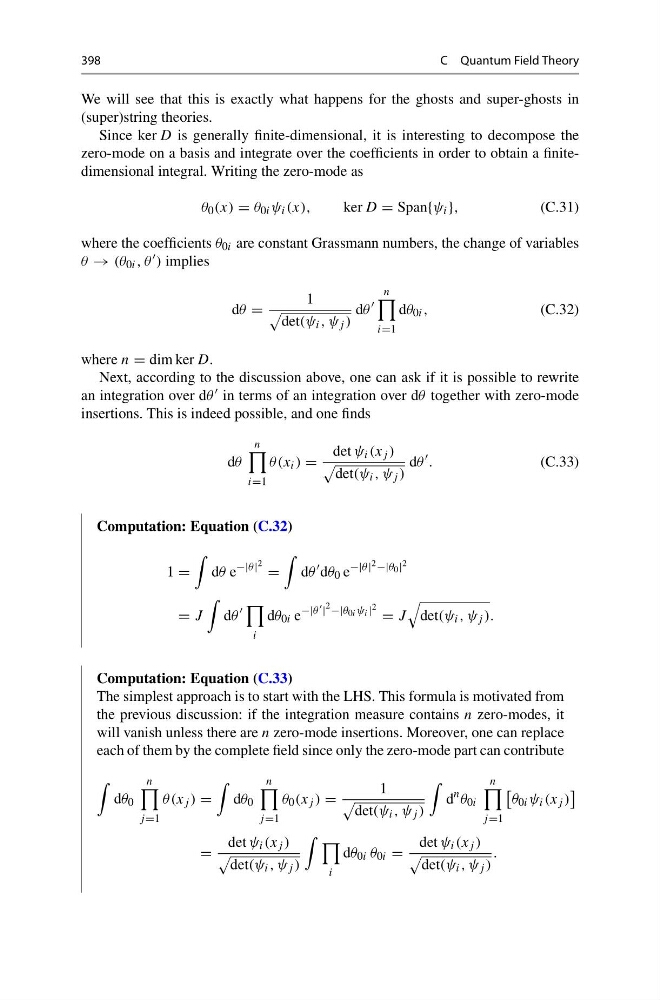
Computation: Equation (C.32)
1 =
dθ e
−|θ| 2 =
dθ
dθ 0 e
−|θ| 2 −|θ 0 | 2
= J
dθ
i
dθ 0i e
−|θ |
2 −|θ 0i ψ i | 2 = J
det(ψ i , ψ j ).
Computation: Equation (C.33)
The simplest approach is to start with the LHS. This formula is motivated from
the previous discussion: if the integration measure contains n zero-modes, it
will vanish unless there are n zero-mode insertions. Moreover, one can replace
each of them by the complete field since only the zero-mode part can contribute
dθ 0
n
j =1
θ(x j ) =
dθ 0
n
j =1
θ 0 (x j ) =
1
det(ψ i , ψ j )
d
n θ 0i
n
j =1
θ 0i ψ i (x j )
=
det ψ i (x j )
det(ψ i , ψ j )
i
dθ 0i θ 0i =
det ψ i (x j )
det(ψ i , ψ j )
.
C Quantum Field Theory
We will see that this is exactly what happens for the ghosts and super-ghosts in
(super)string theories.
Since ker D is generally finite-dimensional, it is interesting to decompose the
zero-mode on a basis and integrate over the coefficients in order to obtain a finitedimensional integral. Writing the zero-mode as
θ 0 (x) = θ 0i ψ i (x),
ker D = Span{ψ i },
(C.31)
where the coefficients θ 0i are constant Grassmann numbers, the change of variables
θ → (θ 0i , θ ) implies
dθ =
1
det(ψ i , ψ j )
dθ
n
i=1
dθ 0i ,
(C.32)
where n = dim ker D.
Next, according to the discussion above, one can ask if it is possible to rewrite
an integration over dθ in terms of an integration over dθ together with zero-mode
insertions. This is indeed possible, and one finds
dθ
n
i=1
θ(x i ) =
det ψ i (x j )
det(ψ i , ψ j )
dθ
.
(C.33)
Computation: Equation (C.32)
1 =
dθ e
−|θ| 2 =
dθ
dθ 0 e
−|θ| 2 −|θ 0 | 2
= J
dθ
i
dθ 0i e
−|θ |
2 −|θ 0i ψ i | 2 = J
det(ψ i , ψ j ).
Computation: Equation (C.33)
The simplest approach is to start with the LHS. This formula is motivated from
the previous discussion: if the integration measure contains n zero-modes, it
will vanish unless there are n zero-mode insertions. Moreover, one can replace
each of them by the complete field since only the zero-mode part can contribute
dθ 0
n
j =1
θ(x j ) =
dθ 0
n
j =1
θ 0 (x j ) =
1
det(ψ i , ψ j )
d
n θ 0i
n
j =1
θ 0i ψ i (x j )
=
det ψ i (x j )
det(ψ i , ψ j )
i
dθ 0i θ 0i =
det ψ i (x j )
det(ψ i , ψ j )
.