

366
18 Momentum-Space SFT
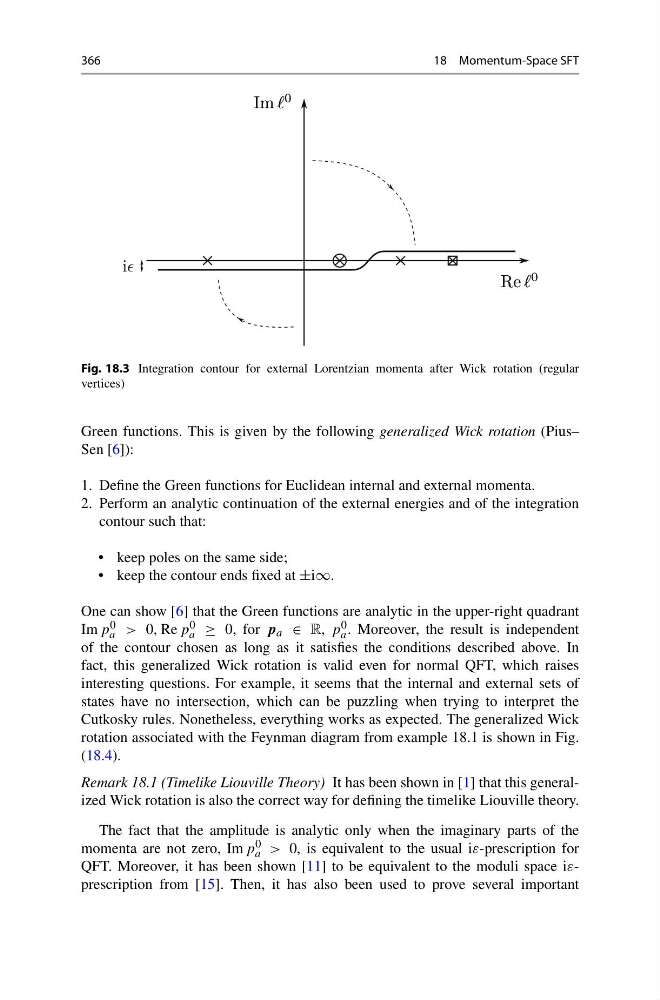
Fig. 18.3 Integration contour for external Lorentzian momenta after Wick rotation (regular
vertices)
Green functions. This is given by the following generalized Wick rotation (Pius–
Sen [6]):
1. Define the Green functions for Euclidean internal and external momenta.
2. Perform an analytic continuation of the external energies and of the integration
contour such that:
• keep poles on the same side;
• keep the contour ends fixed at ±i∞.
One can show [6] that the Green functions are analytic in the upper-right quadrant
Im p 0
a > 0, Re p 0
a ≥ 0, for p a ∈ R, p 0
a . Moreover, the result is independent
of the contour chosen as long as it satisfies the conditions described above. In
fact, this generalized Wick rotation is valid even for normal QFT, which raises
interesting questions. For example, it seems that the internal and external sets of
states have no intersection, which can be puzzling when trying to interpret the
Cutkosky rules. Nonetheless, everything works as expected. The generalized Wick
rotation associated with the Feynman diagram from example 18.1 is shown in Fig.
(18.4).
Remark 18.1 (Timelike Liouville Theory) It has been shown in [1] that this generalized Wick rotation is also the correct way for defining the timelike Liouville theory.
The fact that the amplitude is analytic only when the imaginary parts of the
momenta are not zero, Im p 0
a > 0, is equivalent to the usual iε-prescription for
QFT. Moreover, it has been shown [11] to be equivalent to the moduli space iεprescription from [15]. Then, it has also been used to prove several important
18 Momentum-Space SFT
Fig. 18.3 Integration contour for external Lorentzian momenta after Wick rotation (regular
vertices)
Green functions. This is given by the following generalized Wick rotation (Pius–
Sen [6]):
1. Define the Green functions for Euclidean internal and external momenta.
2. Perform an analytic continuation of the external energies and of the integration
contour such that:
• keep poles on the same side;
• keep the contour ends fixed at ±i∞.
One can show [6] that the Green functions are analytic in the upper-right quadrant
Im p 0
a > 0, Re p 0
a ≥ 0, for p a ∈ R, p 0
a . Moreover, the result is independent
of the contour chosen as long as it satisfies the conditions described above. In
fact, this generalized Wick rotation is valid even for normal QFT, which raises
interesting questions. For example, it seems that the internal and external sets of
states have no intersection, which can be puzzling when trying to interpret the
Cutkosky rules. Nonetheless, everything works as expected. The generalized Wick
rotation associated with the Feynman diagram from example 18.1 is shown in Fig.
(18.4).
Remark 18.1 (Timelike Liouville Theory) It has been shown in [1] that this generalized Wick rotation is also the correct way for defining the timelike Liouville theory.
The fact that the amplitude is analytic only when the imaginary parts of the
momenta are not zero, Im p 0
a > 0, is equivalent to the usual iε-prescription for
QFT. Moreover, it has been shown [11] to be equivalent to the moduli space iεprescription from [15]. Then, it has also been used to prove several important