

18.2 Generalized Wick Rotation
365
Fig. 18.1 1-loop 4-point function for a scalar field theory
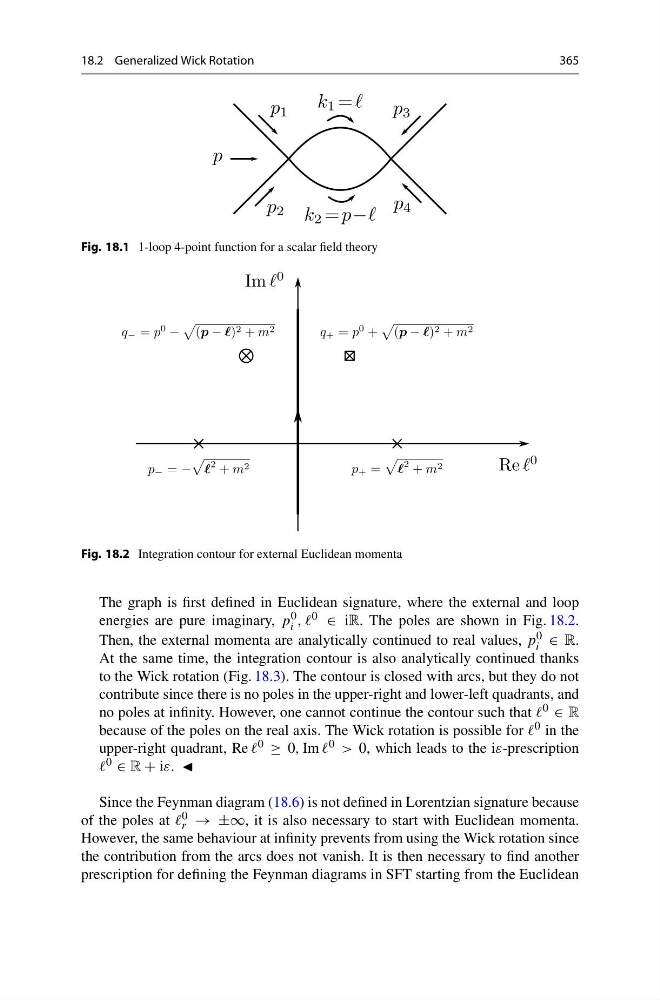
Fig. 18.2 Integration contour for external Euclidean momenta
The graph is first defined in Euclidean signature, where the external and loop
energies are pure imaginary, p 0
i , , 0 ∈ iR. The poles are shown in Fig. 18.2.
Then, the external momenta are analytically continued to real values, p 0
i ∈ R.
At the same time, the integration contour is also analytically continued thanks
to the Wick rotation (Fig. 18.3). The contour is closed with arcs, but they do not
contribute since there is no poles in the upper-right and lower-left quadrants, and
no poles at infinity. However, one cannot continue the contour such that 0 ∈ R
because of the poles on the real axis. The Wick rotation is possible for 0 in the
upper-right quadrant, Re 0 ≥ 0, Im 0 > 0, which leads to the iε-prescription
0 ∈ R + iε.
Since the Feynman diagram (18.6) is not defined in Lorentzian signature because
of the poles at 0
r → ±∞, it is also necessary to start with Euclidean momenta.
However, the same behaviour at infinity prevents from using the Wick rotation since
the contribution from the arcs does not vanish. It is then necessary to find another
prescription for defining the Feynman diagrams in SFT starting from the Euclidean
365
Fig. 18.1 1-loop 4-point function for a scalar field theory
Fig. 18.2 Integration contour for external Euclidean momenta
The graph is first defined in Euclidean signature, where the external and loop
energies are pure imaginary, p 0
i , , 0 ∈ iR. The poles are shown in Fig. 18.2.
Then, the external momenta are analytically continued to real values, p 0
i ∈ R.
At the same time, the integration contour is also analytically continued thanks
to the Wick rotation (Fig. 18.3). The contour is closed with arcs, but they do not
contribute since there is no poles in the upper-right and lower-left quadrants, and
no poles at infinity. However, one cannot continue the contour such that 0 ∈ R
because of the poles on the real axis. The Wick rotation is possible for 0 in the
upper-right quadrant, Re 0 ≥ 0, Im 0 > 0, which leads to the iε-prescription
0 ∈ R + iε.
Since the Feynman diagram (18.6) is not defined in Lorentzian signature because
of the poles at 0
r → ±∞, it is also necessary to start with Euclidean momenta.
However, the same behaviour at infinity prevents from using the Wick rotation since
the contribution from the arcs does not vanish. It is then necessary to find another
prescription for defining the Feynman diagrams in SFT starting from the Euclidean