

18.1 General Form
363
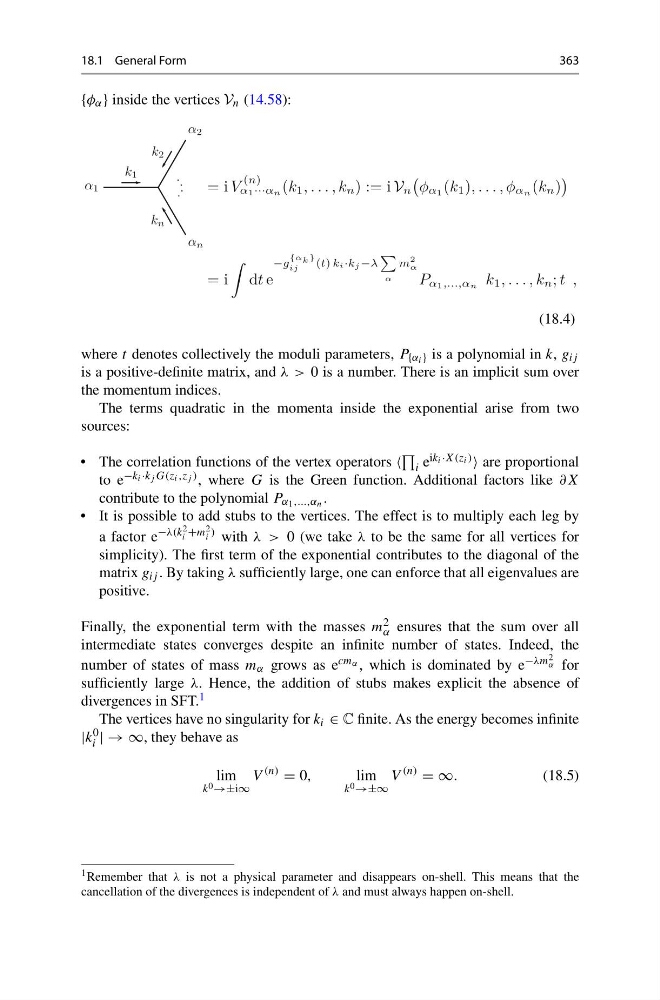
{φ α } inside the vertices V n (14.58):
= i V
(n)
α 1 ···α n (k 1 , . . . , k n ) := i V n
φ α 1 (k 1 ), . . . , φ α n (k n )
= i
dt e
−g
{α k }
ij
(t) k i ·k j −λ
α
m
2
α P α 1 ,...,α n k 1 , . . . , k n ; t ,
(18.4)
where t denotes collectively the moduli parameters, P {α i } is a polynomial in k, g ij
is a positive-definite matrix, and λ > 0 is a number. There is an implicit sum over
the momentum indices.
The terms quadratic in the momenta inside the exponential arise from two
sources:
• The correlation functions of the vertex operators
i e ik i ·X(z i ) are proportional
to e −k i ·k j G(z i ,z j ) , where G is the Green function. Additional factors like ∂X
contribute to the polynomial P α 1 ,...,α n .
• It is possible to add stubs to the vertices. The effect is to multiply each leg by
a factor e
−λ(k 2
i +m 2
i ) with λ > 0 (we take λ to be the same for all vertices for
simplicity). The first term of the exponential contributes to the diagonal of the
matrix g ij . By taking λ sufficiently large, one can enforce that all eigenvalues are
positive.
Finally, the exponential term with the masses m 2
α ensures that the sum over all
intermediate states converges despite an infinite number of states. Indeed, the
number of states of mass m α grows as e cm α , which is dominated by e −λm 2
α for
sufficiently large λ. Hence, the addition of stubs makes explicit the absence of
divergences in SFT. 1
The vertices have no singularity for k i ∈ C finite. As the energy becomes infinite
|k 0
i | → ∞, they behave as
lim
k 0 →±i∞
V
(n)
= 0,
lim
k 0 →±∞
V
(n)
= ∞.
(18.5)
1 Remember that λ is not a physical parameter and disappears on-shell. This means that the
cancellation of the divergences is independent of λ and must always happen on-shell.
363
{φ α } inside the vertices V n (14.58):
= i V
(n)
α 1 ···α n (k 1 , . . . , k n ) := i V n
φ α 1 (k 1 ), . . . , φ α n (k n )
= i
dt e
−g
{α k }
ij
(t) k i ·k j −λ
α
m
2
α P α 1 ,...,α n k 1 , . . . , k n ; t ,
(18.4)
where t denotes collectively the moduli parameters, P {α i } is a polynomial in k, g ij
is a positive-definite matrix, and λ > 0 is a number. There is an implicit sum over
the momentum indices.
The terms quadratic in the momenta inside the exponential arise from two
sources:
• The correlation functions of the vertex operators
i e ik i ·X(z i ) are proportional
to e −k i ·k j G(z i ,z j ) , where G is the Green function. Additional factors like ∂X
contribute to the polynomial P α 1 ,...,α n .
• It is possible to add stubs to the vertices. The effect is to multiply each leg by
a factor e
−λ(k 2
i +m 2
i ) with λ > 0 (we take λ to be the same for all vertices for
simplicity). The first term of the exponential contributes to the diagonal of the
matrix g ij . By taking λ sufficiently large, one can enforce that all eigenvalues are
positive.
Finally, the exponential term with the masses m 2
α ensures that the sum over all
intermediate states converges despite an infinite number of states. Indeed, the
number of states of mass m α grows as e cm α , which is dominated by e −λm 2
α for
sufficiently large λ. Hence, the addition of stubs makes explicit the absence of
divergences in SFT. 1
The vertices have no singularity for k i ∈ C finite. As the energy becomes infinite
|k 0
i | → ∞, they behave as
lim
k 0 →±i∞
V
(n)
= 0,
lim
k 0 →±∞
V
(n)
= ∞.
(18.5)
1 Remember that λ is not a physical parameter and disappears on-shell. This means that the
cancellation of the divergences is independent of λ and must always happen on-shell.