

362
18 Momentum-Space SFT
The non-locality of the interactions is the most salient property of SFT, beyond
the infinite number of fields. This has a number of consequences:
• the Wick rotation is ill-defined;
• the position representation cannot be used, nor any property relying on it (microcausality, largest time equation. . . );
• standard assumptions from local QFT (in particular, from the constructive Smatrix program, such as micro-causality) break down.
Together, these points imply that the usual arguments from QFTs must be improved.
This has been an active topic in the recent years, and the results will be summarized
in Sect. 18.2.
We expand the string field in Fourier space using a basis {φ α (k)} as (Chap. 9)
| =
j
d D k
(2π) D ψ α (k) |φ α (k) ,
(18.1)
where k is the D-dimensional momentum and α the discrete indices (Lorentz
indices, group representation, KK modes. . . ) of the spacetime fields ψ α (k). The
action in momentum space takes the form (in Lorentzian signature):
S = −
d
D k ψ α (k)K αβ (k)ψ β (−k)
−
n≥0
d
D k 1 · · · d
D k n V
(n)
α 1 ···α n
(k 1 , . . . , k n ) ψ α 1 (k 1 ) · · · ψ α n (k n ).
(18.2)
The kinetic matrix K αβ is usually quadratic in the momentum. In the direct Fourier
expansion of the SFT action (15.24), it describes only the classical kinetic term: the
quantum corrections are found in the vertex V (2) .
From the action, we can write the Feynman rules (for the path integral weight e iS
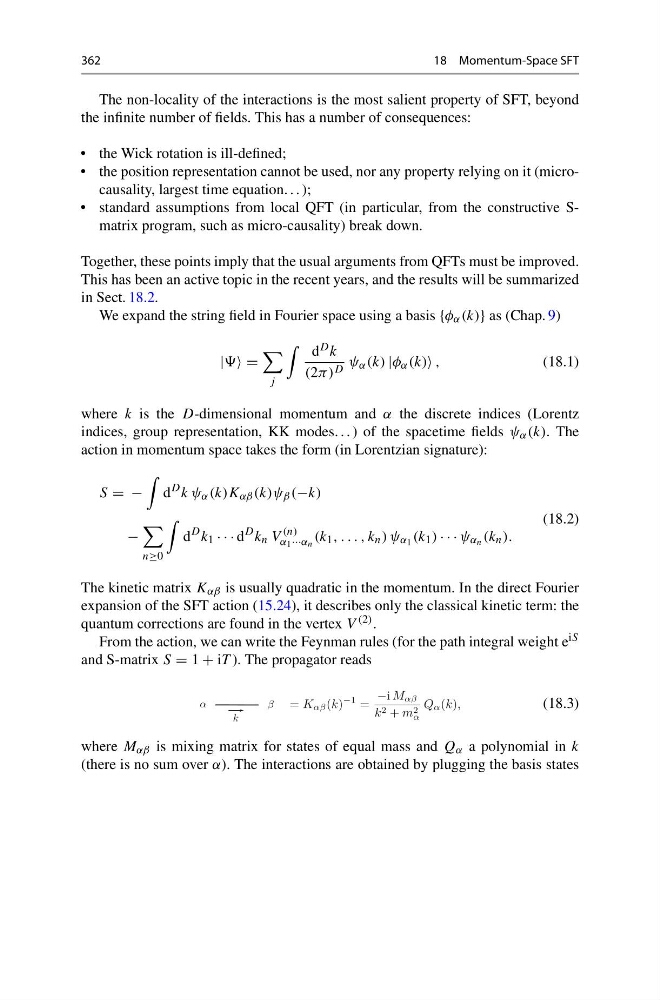
and S-matrix S = 1 + iT ). The propagator reads
(18.3)
where M αβ is mixing matrix for states of equal mass and Q α a polynomial in k
(there is no sum over α). The interactions are obtained by plugging the basis states
18 Momentum-Space SFT
The non-locality of the interactions is the most salient property of SFT, beyond
the infinite number of fields. This has a number of consequences:
• the Wick rotation is ill-defined;
• the position representation cannot be used, nor any property relying on it (microcausality, largest time equation. . . );
• standard assumptions from local QFT (in particular, from the constructive Smatrix program, such as micro-causality) break down.
Together, these points imply that the usual arguments from QFTs must be improved.
This has been an active topic in the recent years, and the results will be summarized
in Sect. 18.2.
We expand the string field in Fourier space using a basis {φ α (k)} as (Chap. 9)
| =
j
d D k
(2π) D ψ α (k) |φ α (k) ,
(18.1)
where k is the D-dimensional momentum and α the discrete indices (Lorentz
indices, group representation, KK modes. . . ) of the spacetime fields ψ α (k). The
action in momentum space takes the form (in Lorentzian signature):
S = −
d
D k ψ α (k)K αβ (k)ψ β (−k)
−
n≥0
d
D k 1 · · · d
D k n V
(n)
α 1 ···α n
(k 1 , . . . , k n ) ψ α 1 (k 1 ) · · · ψ α n (k n ).
(18.2)
The kinetic matrix K αβ is usually quadratic in the momentum. In the direct Fourier
expansion of the SFT action (15.24), it describes only the classical kinetic term: the
quantum corrections are found in the vertex V (2) .
From the action, we can write the Feynman rules (for the path integral weight e iS
and S-matrix S = 1 + iT ). The propagator reads
(18.3)
where M αβ is mixing matrix for states of equal mass and Q α a polynomial in k
(there is no sum over α). The interactions are obtained by plugging the basis states