

350
17 Superstring
• one PCO and one matter vertex collide;
• other singularities of the correlation functions.
The last source is the less intuitive one and we focus on it.
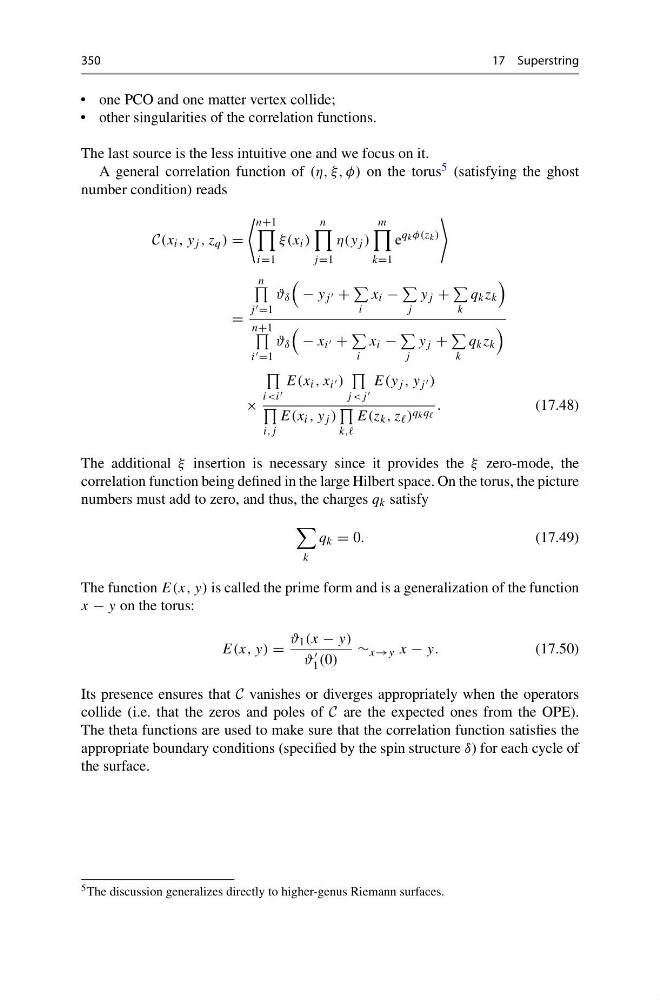
A general correlation function of (η, ξ, φ) on the torus 5 (satisfying the ghost
number condition) reads
C(x i , y j , z q ) =
n+1
i=1
ξ(x i )
n
j =1
η(y j )
m
k=1
e
q k φ(z k )
=
n
j =1
ϑ δ
− y j +
i
x i −
j
y j +
k
q k z k
n+1
i =1
ϑ δ
− x i +
i
x i −
j
y j +
k
q k z k
×
i
j
i,j
E(x i , y j )
k,,
E(z k , z ) q k q
.
(17.48)
The additional ξ insertion is necessary since it provides the ξ zero-mode, the
correlation function being defined in the large Hilbert space. On the torus, the picture
numbers must add to zero, and thus, the charges q k satisfy
k
q k = 0.
(17.49)
The function E(x, y) is called the prime form and is a generalization of the function
x − y on the torus:
E(x, y) =
ϑ 1 (x − y)
ϑ
1 (0)
∼ x→y x − y.
(17.50)
Its presence ensures that C vanishes or diverges appropriately when the operators
collide (i.e. that the zeros and poles of C are the expected ones from the OPE).
The theta functions are used to make sure that the correlation function satisfies the
appropriate boundary conditions (specified by the spin structure δ) for each cycle of
the surface.
5 The discussion generalizes directly to higher-genus Riemann surfaces.
17 Superstring
• one PCO and one matter vertex collide;
• other singularities of the correlation functions.
The last source is the less intuitive one and we focus on it.
A general correlation function of (η, ξ, φ) on the torus 5 (satisfying the ghost
number condition) reads
C(x i , y j , z q ) =
n+1
i=1
ξ(x i )
n
j =1
η(y j )
m
k=1
e
q k φ(z k )
=
n
j =1
ϑ δ
− y j +
i
x i −
j
y j +
k
q k z k
n+1
i =1
ϑ δ
− x i +
i
x i −
j
y j +
k
q k z k
×
i
j
i,j
E(x i , y j )
k,,
E(z k , z ) q k q
.
(17.48)
The additional ξ insertion is necessary since it provides the ξ zero-mode, the
correlation function being defined in the large Hilbert space. On the torus, the picture
numbers must add to zero, and thus, the charges q k satisfy
k
q k = 0.
(17.49)
The function E(x, y) is called the prime form and is a generalization of the function
x − y on the torus:
E(x, y) =
ϑ 1 (x − y)
ϑ
1 (0)
∼ x→y x − y.
(17.50)
Its presence ensures that C vanishes or diverges appropriately when the operators
collide (i.e. that the zeros and poles of C are the expected ones from the OPE).
The theta functions are used to make sure that the correlation function satisfies the
appropriate boundary conditions (specified by the spin structure δ) for each cycle of
the surface.
5 The discussion generalizes directly to higher-genus Riemann surfaces.