

18
1 Introduction
Some of these problems can be addressed with various prescriptions, but it is
desirable to dispose of a unified and systematic procedure, which is to be found
in the field theory description.
1.3.2 String Field Action
A string field theory (SFT) for open and closed strings is based on two fields
[X(σ )] (open string field) and [X(σ )] (closed string field) governed by some
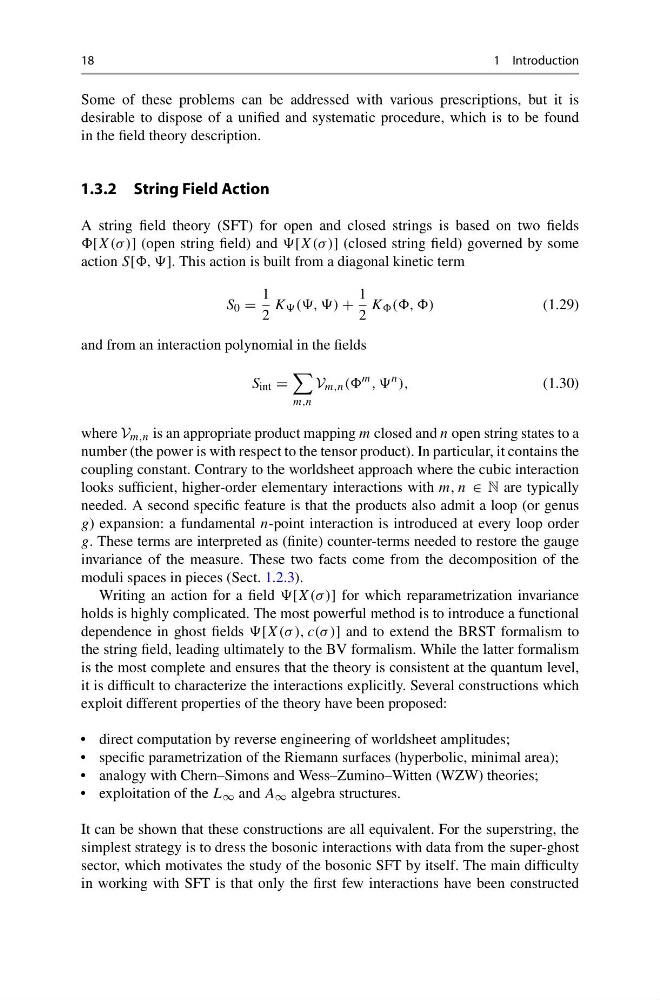
action S[ ,]. This action is built from a diagonal kinetic term
S 0 =
1
2
K ((, ,) +
1
2
K ((, ,)
(1.29)
and from an interaction polynomial in the fields
S int =
m,n
V m,n ((
m , ,
n ),
(1.30)
where V m,n is an appropriate product mapping m closed and n open string states to a
number (the power is with respect to the tensor product). In particular, it contains the
coupling constant. Contrary to the worldsheet approach where the cubic interaction
looks sufficient, higher-order elementary interactions with m, n ∈ N are typically
needed. A second specific feature is that the products also admit a loop (or genus
g) expansion: a fundamental n-point interaction is introduced at every loop order
g. These terms are interpreted as (finite) counter-terms needed to restore the gauge
invariance of the measure. These two facts come from the decomposition of the
moduli spaces in pieces (Sect. 1.2.3).
Writing an action for a field [X(σ )] for which reparametrization invariance
holds is highly complicated. The most powerful method is to introduce a functional
dependence in ghost fields [X(σ ), c(σ )] and to extend the BRST formalism to
the string field, leading ultimately to the BV formalism. While the latter formalism
is the most complete and ensures that the theory is consistent at the quantum level,
it is difficult to characterize the interactions explicitly. Several constructions which
exploit different properties of the theory have been proposed:
• direct computation by reverse engineering of worldsheet amplitudes;
• specific parametrization of the Riemann surfaces (hyperbolic, minimal area);
• analogy with Chern–Simons and Wess–Zumino–Witten (WZW) theories;
• exploitation of the L ∞ and A ∞ algebra structures.
It can be shown that these constructions are all equivalent. For the superstring, the
simplest strategy is to dress the bosonic interactions with data from the super-ghost
sector, which motivates the study of the bosonic SFT by itself. The main difficulty
in working with SFT is that only the first few interactions have been constructed
1 Introduction
Some of these problems can be addressed with various prescriptions, but it is
desirable to dispose of a unified and systematic procedure, which is to be found
in the field theory description.
1.3.2 String Field Action
A string field theory (SFT) for open and closed strings is based on two fields
[X(σ )] (open string field) and [X(σ )] (closed string field) governed by some
action S[ ,]. This action is built from a diagonal kinetic term
S 0 =
1
2
K ((, ,) +
1
2
K ((, ,)
(1.29)
and from an interaction polynomial in the fields
S int =
m,n
V m,n ((
m , ,
n ),
(1.30)
where V m,n is an appropriate product mapping m closed and n open string states to a
number (the power is with respect to the tensor product). In particular, it contains the
coupling constant. Contrary to the worldsheet approach where the cubic interaction
looks sufficient, higher-order elementary interactions with m, n ∈ N are typically
needed. A second specific feature is that the products also admit a loop (or genus
g) expansion: a fundamental n-point interaction is introduced at every loop order
g. These terms are interpreted as (finite) counter-terms needed to restore the gauge
invariance of the measure. These two facts come from the decomposition of the
moduli spaces in pieces (Sect. 1.2.3).
Writing an action for a field [X(σ )] for which reparametrization invariance
holds is highly complicated. The most powerful method is to introduce a functional
dependence in ghost fields [X(σ ), c(σ )] and to extend the BRST formalism to
the string field, leading ultimately to the BV formalism. While the latter formalism
is the most complete and ensures that the theory is consistent at the quantum level,
it is difficult to characterize the interactions explicitly. Several constructions which
exploit different properties of the theory have been proposed:
• direct computation by reverse engineering of worldsheet amplitudes;
• specific parametrization of the Riemann surfaces (hyperbolic, minimal area);
• analogy with Chern–Simons and Wess–Zumino–Witten (WZW) theories;
• exploitation of the L ∞ and A ∞ algebra structures.
It can be shown that these constructions are all equivalent. For the superstring, the
simplest strategy is to dress the bosonic interactions with data from the super-ghost
sector, which motivates the study of the bosonic SFT by itself. The main difficulty
in working with SFT is that only the first few interactions have been constructed