

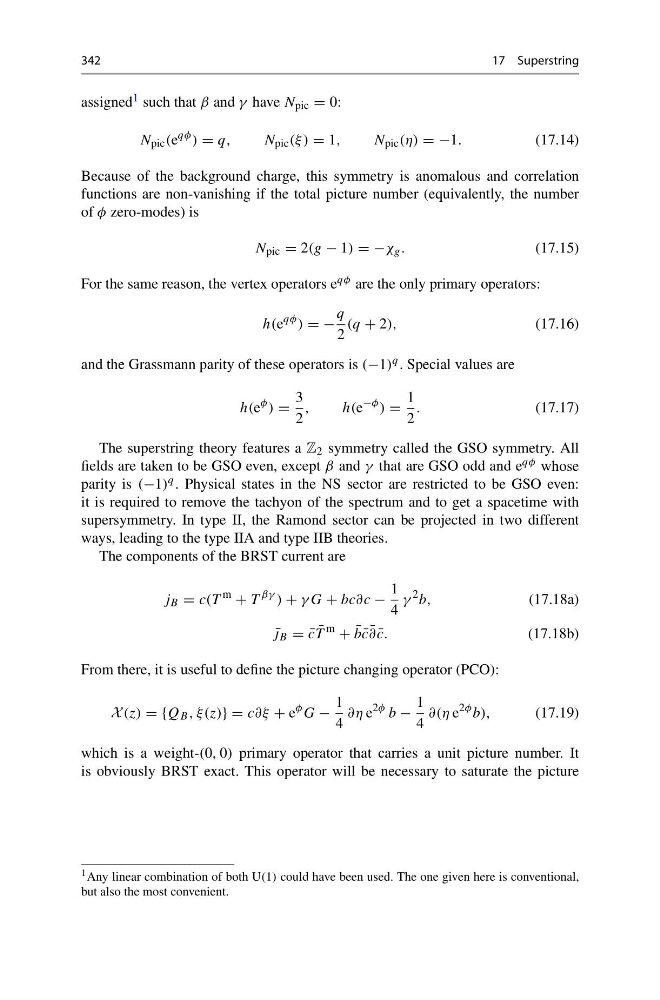
342
17 Superstring
assigned 1 such that β and γ have N pic = 0:
N pic (e
qφ ) = q,
N pic (ξ ) = 1,
N pic (η) = −1.
(17.14)
Because of the background charge, this symmetry is anomalous and correlation
functions are non-vanishing if the total picture number (equivalently, the number
of φ zero-modes) is
N pic = 2(g − 1) = −χ g .
(17.15)
For the same reason, the vertex operators e qφ are the only primary operators:
h(e
qφ ) = −
q
2
(q + 2),
(17.16)
and the Grassmann parity of these operators is (−1) q . Special values are
h(e
φ ) =
3
2
,
h(e
−φ ) =
1
2
.
(17.17)
The superstring theory features a Z 2 symmetry called the GSO symmetry. All
fields are taken to be GSO even, except β and γ that are GSO odd and e qφ whose
parity is (−1) q . Physical states in the NS sector are restricted to be GSO even:
it is required to remove the tachyon of the spectrum and to get a spacetime with
supersymmetry. In type II, the Ramond sector can be projected in two different
ways, leading to the type IIA and type IIB theories.
The components of the BRST current are
j B = c(T
m
+ T
βγ ) + γ G + bc∂c −
1
4
γ
2 b,
(17.18a)
¯
j B = ¯
c ¯
T
m
+ ¯
b ¯
c ¯
∂ ¯
c.
(17.18b)
From there, it is useful to define the picture changing operator (PCO):
X (z) = {Q B , ξ(z)} = c∂ξ + e
φ G −
1
4
∂η e
2φ b −
1
4
∂(η e
2φ b),
(17.19)
which is a weight-(0, 0) primary operator that carries a unit picture number. It
is obviously BRST exact. This operator will be necessary to saturate the picture
1 Any linear combination of both U(1) could have been used. The one given here is conventional,
but also the most convenient.
17 Superstring
assigned 1 such that β and γ have N pic = 0:
N pic (e
qφ ) = q,
N pic (ξ ) = 1,
N pic (η) = −1.
(17.14)
Because of the background charge, this symmetry is anomalous and correlation
functions are non-vanishing if the total picture number (equivalently, the number
of φ zero-modes) is
N pic = 2(g − 1) = −χ g .
(17.15)
For the same reason, the vertex operators e qφ are the only primary operators:
h(e
qφ ) = −
q
2
(q + 2),
(17.16)
and the Grassmann parity of these operators is (−1) q . Special values are
h(e
φ ) =
3
2
,
h(e
−φ ) =
1
2
.
(17.17)
The superstring theory features a Z 2 symmetry called the GSO symmetry. All
fields are taken to be GSO even, except β and γ that are GSO odd and e qφ whose
parity is (−1) q . Physical states in the NS sector are restricted to be GSO even:
it is required to remove the tachyon of the spectrum and to get a spacetime with
supersymmetry. In type II, the Ramond sector can be projected in two different
ways, leading to the type IIA and type IIB theories.
The components of the BRST current are
j B = c(T
m
+ T
βγ ) + γ G + bc∂c −
1
4
γ
2 b,
(17.18a)
¯
j B = ¯
c ¯
T
m
+ ¯
b ¯
c ¯
∂ ¯
c.
(17.18b)
From there, it is useful to define the picture changing operator (PCO):
X (z) = {Q B , ξ(z)} = c∂ξ + e
φ G −
1
4
∂η e
2φ b −
1
4
∂(η e
2φ b),
(17.19)
which is a weight-(0, 0) primary operator that carries a unit picture number. It
is obviously BRST exact. This operator will be necessary to saturate the picture
1 Any linear combination of both U(1) could have been used. The one given here is conventional,
but also the most convenient.