

17.1 Worldsheet Superstring Theory
341
βγ System
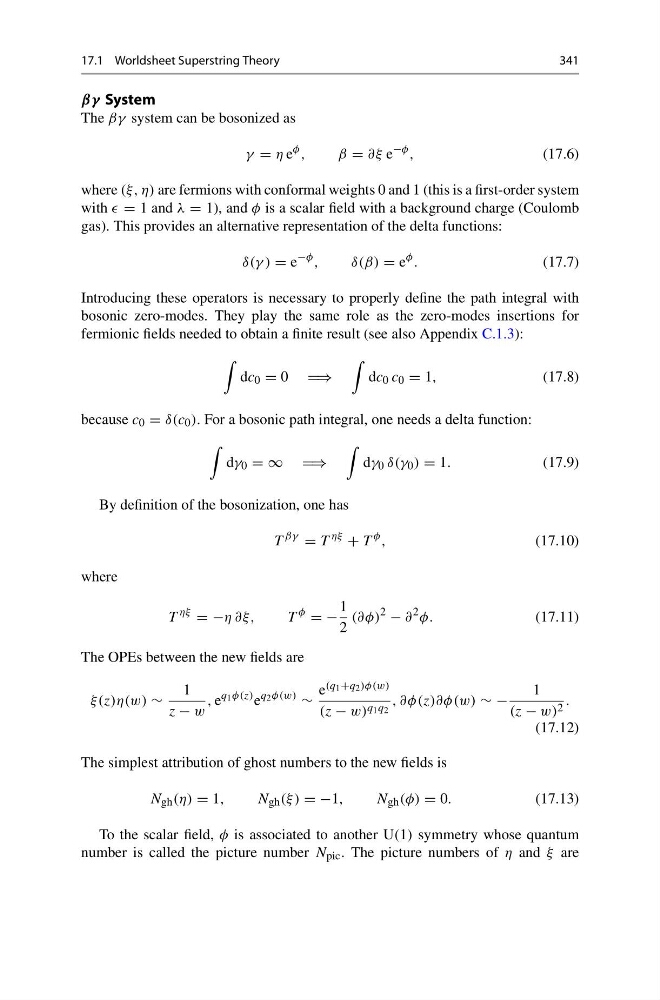
The βγ system can be bosonized as
γ = η e
φ ,
β = ∂ξ e
−φ ,
(17.6)
where (ξ, η) are fermions with conformal weights 0 and 1 (this is a first-order system
with = 1 and λ = 1), and φ is a scalar field with a background charge (Coulomb
gas). This provides an alternative representation of the delta functions:
δ(γ ) = e
−φ ,
δ(β)= e
φ .
(17.7)
Introducing these operators is necessary to properly define the path integral with
bosonic zero-modes. They play the same role as the zero-modes insertions for
fermionic fields needed to obtain a finite result (see also Appendix C.1.3):
dc 0 = 0 ⇒
dc 0 c 0 = 1,
(17.8)
because c 0 = δ(c 0 ). For a bosonic path integral, one needs a delta function:
dγ 0 = ∞ ∞⇒
dγ 0 δ(γ 0 ) = 1.
(17.9)
By definition of the bosonization, one has
T
βγ
= T
ηξ
+ T
φ ,
(17.10)
where
T
ηξ
= −η ∂ξ,
T
φ
= −
1
2
(∂φ)
2
− ∂
2 φ.
(17.11)
The OPEs between the new fields are
ξ(z)η(w) ∼
1
z − w
, e
q 1 φ(z) e
q 2 φ(w)
∼
e (q 1 +q 2 )φ(w)
(z − w) q 1 q 2
, ∂φ(z)∂φ(w) ∼ −
1
(z − w) 2 .
(17.12)
The simplest attribution of ghost numbers to the new fields is
N gh (η) = 1,
N gh (ξ ) = −1,
N gh (φ) = 0.
(17.13)
To the scalar field, φ is associated to another U(1) symmetry whose quantum
number is called the picture number N pic . The picture numbers of η and ξ are
341
βγ System
The βγ system can be bosonized as
γ = η e
φ ,
β = ∂ξ e
−φ ,
(17.6)
where (ξ, η) are fermions with conformal weights 0 and 1 (this is a first-order system
with = 1 and λ = 1), and φ is a scalar field with a background charge (Coulomb
gas). This provides an alternative representation of the delta functions:
δ(γ ) = e
−φ ,
δ(β)= e
φ .
(17.7)
Introducing these operators is necessary to properly define the path integral with
bosonic zero-modes. They play the same role as the zero-modes insertions for
fermionic fields needed to obtain a finite result (see also Appendix C.1.3):
dc 0 = 0 ⇒
dc 0 c 0 = 1,
(17.8)
because c 0 = δ(c 0 ). For a bosonic path integral, one needs a delta function:
dγ 0 = ∞ ∞⇒
dγ 0 δ(γ 0 ) = 1.
(17.9)
By definition of the bosonization, one has
T
βγ
= T
ηξ
+ T
φ ,
(17.10)
where
T
ηξ
= −η ∂ξ,
T
φ
= −
1
2
(∂φ)
2
− ∂
2 φ.
(17.11)
The OPEs between the new fields are
ξ(z)η(w) ∼
1
z − w
, e
q 1 φ(z) e
q 2 φ(w)
∼
e (q 1 +q 2 )φ(w)
(z − w) q 1 q 2
, ∂φ(z)∂φ(w) ∼ −
1
(z − w) 2 .
(17.12)
The simplest attribution of ghost numbers to the new fields is
N gh (η) = 1,
N gh (ξ ) = −1,
N gh (φ) = 0.
(17.13)
To the scalar field, φ is associated to another U(1) symmetry whose quantum
number is called the picture number N pic . The picture numbers of η and ξ are