

16.3 Deformation of the CFT
331
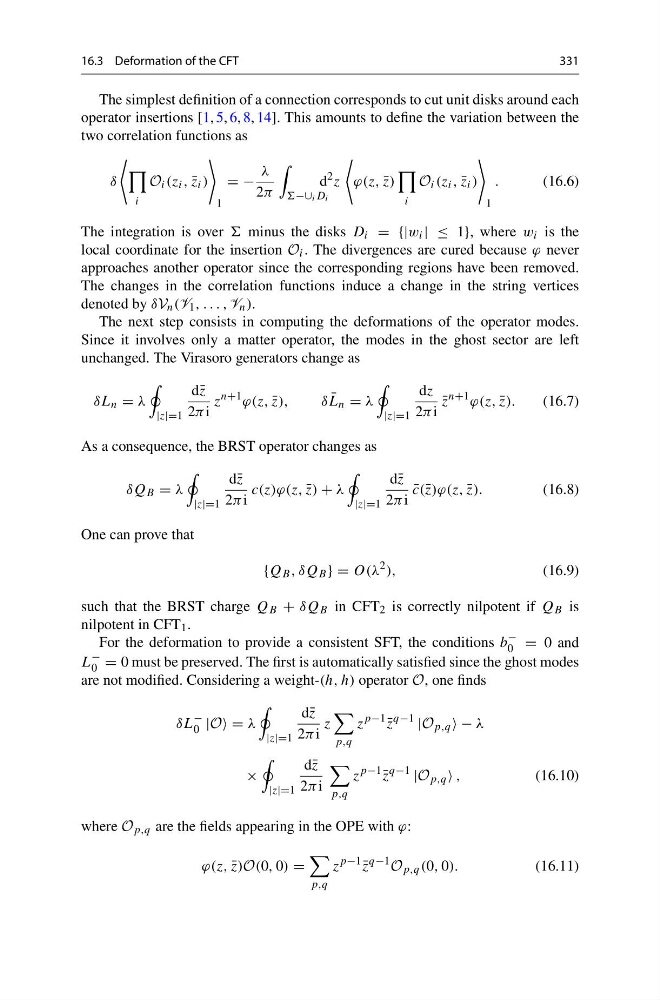
The simplest definition of a connection corresponds to cut unit disks around each
operator insertions [1, 5, 6, 8, 14]. This amounts to define the variation between the
two correlation functions as
δ
i
O i (z i , ¯
z i )
1
= −
λ
2π
−∪ i D i
d
2 z
ϕ(z, ¯
z)
i
O i (z i , ¯
z i )
1
.
(16.6)
The integration is over minus the disks D i = {|w i | ≤ 1}, where w i is the
local coordinate for the insertion O i . The divergences are cured because ϕ never
approaches another operator since the corresponding regions have been removed.
The changes in the correlation functions induce a change in the string vertices
denoted by δV n (V 1 , . . . , V n ).
The next step consists in computing the deformations of the operator modes.
Since it involves only a matter operator, the modes in the ghost sector are left
unchanged. The Virasoro generators change as
δL n = λ
|z|=1
d¯ z
2π i
z
n+1 ϕ(z, ¯
z),
δ ¯
L n = λ
|z|=1
dz
2π i
¯
z
n+1 ϕ(z, ¯
z).
(16.7)
As a consequence, the BRST operator changes as
δQ B = λ
|z|=1
d¯ z
2π i
c(z)ϕ(z, ¯
z) + λ
|z|=1
d¯ z
2π i
¯
c(¯ z)ϕ(z, ¯
z).
(16.8)
One can prove that
{Q B , δQ B } = O(λ
2 ),
(16.9)
such that the BRST charge Q B + δQ B in CFT 2 is correctly nilpotent if Q B is
nilpotent in CFT 1 .
For the deformation to provide a consistent SFT, the conditions b
−
0 = 0 and
L
−
0 = 0 must be preserved. The first is automatically satisfied since the ghost modes
are not modified. Considering a weight-(h, h) operator O, one finds
δL
−
0 |O = λ
|z|=1
d¯ z
2π i
z
p,q
z
p−1
¯
z
q−1
|O p,q − λ
×
|z|=1
d¯ z
2π i
p,q
z
p−1
¯
z
q−1
|O p,q ,
(16.10)
where O p,q are the fields appearing in the OPE with ϕ:
ϕ(z, ¯
z)O(0, 0) =
p,q
z
p−1
¯
z
q−1
O p,q (0, 0).
(16.11)
331
The simplest definition of a connection corresponds to cut unit disks around each
operator insertions [1, 5, 6, 8, 14]. This amounts to define the variation between the
two correlation functions as
δ
i
O i (z i , ¯
z i )
1
= −
λ
2π
−∪ i D i
d
2 z
ϕ(z, ¯
z)
i
O i (z i , ¯
z i )
1
.
(16.6)
The integration is over minus the disks D i = {|w i | ≤ 1}, where w i is the
local coordinate for the insertion O i . The divergences are cured because ϕ never
approaches another operator since the corresponding regions have been removed.
The changes in the correlation functions induce a change in the string vertices
denoted by δV n (V 1 , . . . , V n ).
The next step consists in computing the deformations of the operator modes.
Since it involves only a matter operator, the modes in the ghost sector are left
unchanged. The Virasoro generators change as
δL n = λ
|z|=1
d¯ z
2π i
z
n+1 ϕ(z, ¯
z),
δ ¯
L n = λ
|z|=1
dz
2π i
¯
z
n+1 ϕ(z, ¯
z).
(16.7)
As a consequence, the BRST operator changes as
δQ B = λ
|z|=1
d¯ z
2π i
c(z)ϕ(z, ¯
z) + λ
|z|=1
d¯ z
2π i
¯
c(¯ z)ϕ(z, ¯
z).
(16.8)
One can prove that
{Q B , δQ B } = O(λ
2 ),
(16.9)
such that the BRST charge Q B + δQ B in CFT 2 is correctly nilpotent if Q B is
nilpotent in CFT 1 .
For the deformation to provide a consistent SFT, the conditions b
−
0 = 0 and
L
−
0 = 0 must be preserved. The first is automatically satisfied since the ghost modes
are not modified. Considering a weight-(h, h) operator O, one finds
δL
−
0 |O = λ
|z|=1
d¯ z
2π i
z
p,q
z
p−1
¯
z
q−1
|O p,q − λ
×
|z|=1
d¯ z
2π i
p,q
z
p−1
¯
z
q−1
|O p,q ,
(16.10)
where O p,q are the fields appearing in the OPE with ϕ:
ϕ(z, ¯
z)O(0, 0) =
p,q
z
p−1
¯
z
q−1
O p,q (0, 0).
(16.11)