

330
16 Background Independence
Remember the form of the 1PI action (15.59):
S 1 [ 1 ] =
1
g 2
s
⎛
⎝ 1
2
1 | c
−
0 Q B | 1 +
n≥0
1
n!
V
1PI
n ((
n
1 )
⎞
⎠ ,
(16.2)
where the prime indicates that vertices with n < 3 do not include contributions from
the sphere. In all this chapter, we remove the index 1PI to lighten the notations. The
equation of motion is
F 1 (( 1 ) = Q B | 1 +
n
1
n!
n ((
n
1 ) = 0.
(16.3)
16.3 Deformation of the CFT
Consider the case where the theory CFT 1 is described by an action S cft,1 [ψ 1 ] given
in terms of fields ψ 1 . Then, the deformation of this action by (16.1) gives an action
for CFT 2 :
S cft,2 [ψ 1 ] = S cft,1 [ψ 1 ] +
λ
2π
d
2 z ϕ(z, ¯
z).
(16.4)
Correlation functions on a Riemann surface in both theories can be related by
expanding the action to first order in λ in the path integral:
i
O i (z i , ¯
z i )
2
=
exp
−
λ
2π
d
2 z ϕ(z, ¯
z)
i
O i (z i , ¯
z i )
1
(16.5a)
≈
i
O i (z i , ¯
z i )
1
−
λ
2π
d
2 z
ϕ(z, ¯
z)
i
O i (z i , ¯
z i )
1
,
(16.5b)
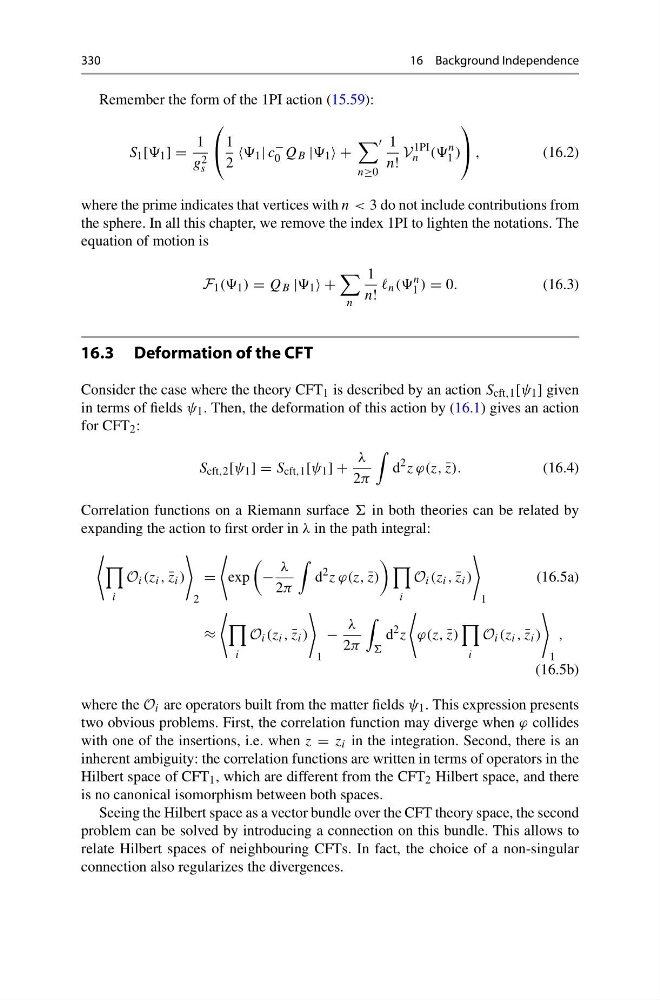
where the O i are operators built from the matter fields ψ 1 . This expression presents
two obvious problems. First, the correlation function may diverge when ϕ collides
with one of the insertions, i.e. when z = z i in the integration. Second, there is an
inherent ambiguity: the correlation functions are written in terms of operators in the
Hilbert space of CFT 1 , which are different from the CFT 2 Hilbert space, and there
is no canonical isomorphism between both spaces.
Seeing the Hilbert space as a vector bundle over the CFT theory space, the second
problem can be solved by introducing a connection on this bundle. This allows to
relate Hilbert spaces of neighbouring CFTs. In fact, the choice of a non-singular
connection also regularizes the divergences.
16 Background Independence
Remember the form of the 1PI action (15.59):
S 1 [ 1 ] =
1
g 2
s
⎛
⎝ 1
2
1 | c
−
0 Q B | 1 +
n≥0
1
n!
V
1PI
n ((
n
1 )
⎞
⎠ ,
(16.2)
where the prime indicates that vertices with n < 3 do not include contributions from
the sphere. In all this chapter, we remove the index 1PI to lighten the notations. The
equation of motion is
F 1 (( 1 ) = Q B | 1 +
n
1
n!
n ((
n
1 ) = 0.
(16.3)
16.3 Deformation of the CFT
Consider the case where the theory CFT 1 is described by an action S cft,1 [ψ 1 ] given
in terms of fields ψ 1 . Then, the deformation of this action by (16.1) gives an action
for CFT 2 :
S cft,2 [ψ 1 ] = S cft,1 [ψ 1 ] +
λ
2π
d
2 z ϕ(z, ¯
z).
(16.4)
Correlation functions on a Riemann surface in both theories can be related by
expanding the action to first order in λ in the path integral:
i
O i (z i , ¯
z i )
2
=
exp
−
λ
2π
d
2 z ϕ(z, ¯
z)
i
O i (z i , ¯
z i )
1
(16.5a)
≈
i
O i (z i , ¯
z i )
1
−
λ
2π
d
2 z
ϕ(z, ¯
z)
i
O i (z i , ¯
z i )
1
,
(16.5b)
where the O i are operators built from the matter fields ψ 1 . This expression presents
two obvious problems. First, the correlation function may diverge when ϕ collides
with one of the insertions, i.e. when z = z i in the integration. Second, there is an
inherent ambiguity: the correlation functions are written in terms of operators in the
Hilbert space of CFT 1 , which are different from the CFT 2 Hilbert space, and there
is no canonical isomorphism between both spaces.
Seeing the Hilbert space as a vector bundle over the CFT theory space, the second
problem can be solved by introducing a connection on this bundle. This allows to
relate Hilbert spaces of neighbouring CFTs. In fact, the choice of a non-singular
connection also regularizes the divergences.