

15.5 1PI Theory
323
not identically zero means that the measure is not invariant under the classical gauge
symmetry (anomalous symmetry): corrections need to be introduced to cancel the
anomaly. It is a remarkable fact that one can construct directly the quantum master
action in SFT and that it takes the same form as the classical action.
15.5 1PI Theory
The BV action is complicated: instead, it is often simpler and sufficient to work
with the 1PI effective action. The latter incorporates all the quantum corrections
in 1PI vertices such that scattering amplitudes are expressed only in terms of tree
Feynman graphs (there are no loops in diagrams since they correspond to quantum
effects, already included in the definitions of the vertices).
A 1PI graph is a Feynman graph that stays connected if one cuts any single
internal line. On the other hand, a 1PR graph splits into two disconnected by
cutting one of the lines. The scattering amplitudes A g,n are built by summing all the
different ways to connect two 1PI vertices with a propagator: diagrams connecting
two legs of the same 1PI vertex are forbidden by definition.
The g-loop n-point 1PR and 1PI Feynman diagrams are associated to some
regions of the moduli space M g,n . Comparing the previous definitions with the
gluing of Riemann surfaces (Sect. 12.3), 1PR diagrams are obtained by gluing
surfaces with the separating plumbing fixture (Sect. 14.1.1). Thus, the 1PR and
1PI regions F 1PR
g,n and V 1PI
g,n can be identified with the regions defined in (12.43a)
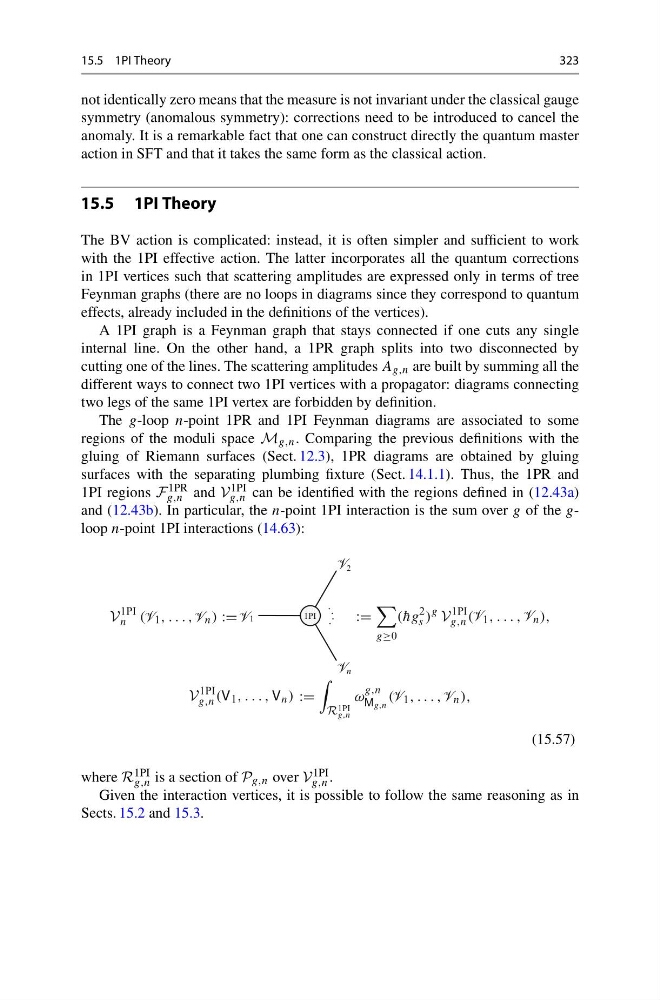
and (12.43b). In particular, the n-point 1PI interaction is the sum over g of the gloop n-point 1PI interactions (14.63):
V
1PI
n ( 1 , . . . , n ) :=
:=
g≥0
( ¯
hg
2
s )
g
V
1PI
1PI
g,n ( 1 , . . . , n ),
V
1PI
g,n (V 1 , . . . , V n ) :=
R 1PI
g,n
ω
g,n
M g,n
( 1
1
, . . . , n ),
2
n
(15.57)
where R 1PI
g,n is a section of P g,n over V 1PI
g,n .
Given the interaction vertices, it is possible to follow the same reasoning as in
Sects. 15.2 and 15.3.
323
not identically zero means that the measure is not invariant under the classical gauge
symmetry (anomalous symmetry): corrections need to be introduced to cancel the
anomaly. It is a remarkable fact that one can construct directly the quantum master
action in SFT and that it takes the same form as the classical action.
15.5 1PI Theory
The BV action is complicated: instead, it is often simpler and sufficient to work
with the 1PI effective action. The latter incorporates all the quantum corrections
in 1PI vertices such that scattering amplitudes are expressed only in terms of tree
Feynman graphs (there are no loops in diagrams since they correspond to quantum
effects, already included in the definitions of the vertices).
A 1PI graph is a Feynman graph that stays connected if one cuts any single
internal line. On the other hand, a 1PR graph splits into two disconnected by
cutting one of the lines. The scattering amplitudes A g,n are built by summing all the
different ways to connect two 1PI vertices with a propagator: diagrams connecting
two legs of the same 1PI vertex are forbidden by definition.
The g-loop n-point 1PR and 1PI Feynman diagrams are associated to some
regions of the moduli space M g,n . Comparing the previous definitions with the
gluing of Riemann surfaces (Sect. 12.3), 1PR diagrams are obtained by gluing
surfaces with the separating plumbing fixture (Sect. 14.1.1). Thus, the 1PR and
1PI regions F 1PR
g,n and V 1PI
g,n can be identified with the regions defined in (12.43a)
and (12.43b). In particular, the n-point 1PI interaction is the sum over g of the gloop n-point 1PI interactions (14.63):
V
1PI
n ( 1 , . . . , n ) :=
:=
g≥0
( ¯
hg
2
s )
g
V
1PI
1PI
g,n ( 1 , . . . , n ),
V
1PI
g,n (V 1 , . . . , V n ) :=
R 1PI
g,n
ω
g,n
M g,n
( 1
1
, . . . , n ),
2
n
(15.57)
where R 1PI
g,n is a section of P g,n over V 1PI
g,n .
Given the interaction vertices, it is possible to follow the same reasoning as in
Sects. 15.2 and 15.3.