

322
15 Closed String Field Theory
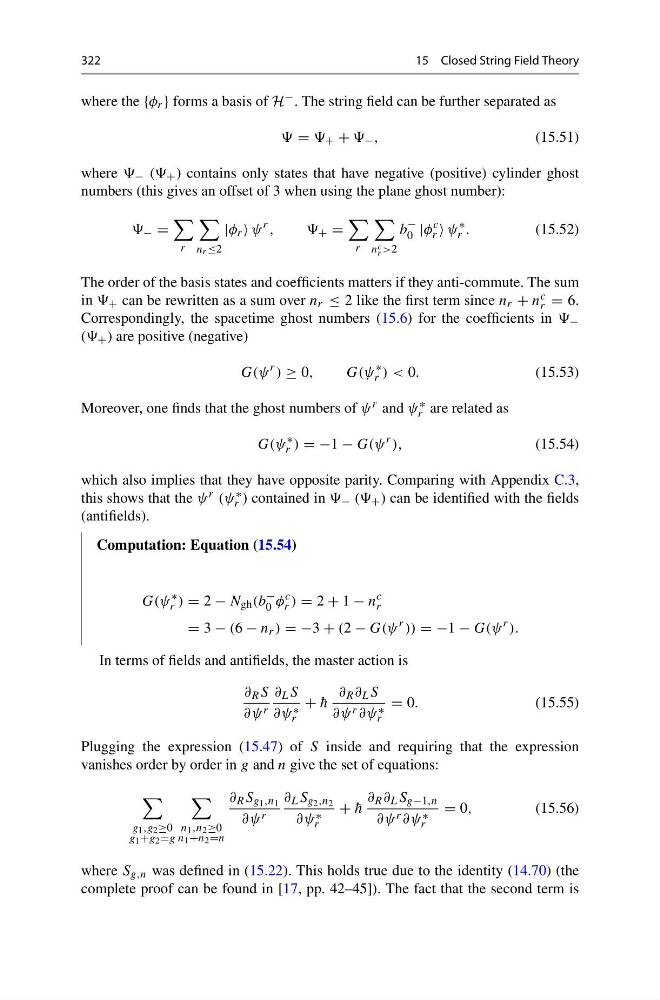
where the {φ r } forms a basis of H − . The string field can be further separated as
= + + − ,
(15.51)
where − ( + ) contains only states that have negative (positive) cylinder ghost
numbers (this gives an offset of 3 when using the plane ghost number):
− =
r
n r ≤2
|φ r ψ
r ,
, + =
r
n c
r >2
b
−
0 |φ
c
r ψ
∗
r .
(15.52)
The order of the basis states and coefficients matters if they anti-commute. The sum
in + can be rewritten as a sum over n r ≤ 2 like the first term since n r + n c
r = 6.
Correspondingly, the spacetime ghost numbers (15.6) for the coefficients in −
( + ) are positive (negative)
G(ψ
r ) ≥ 0,
G(ψ
∗
r ) < 0.
(15.53)
Moreover, one finds that the ghost numbers of ψ r and ψ ∗
r are related as
G(ψ
∗
r ) = −1 − G(ψ
r ),
(15.54)
which also implies that they have opposite parity. Comparing with Appendix C.3,
this shows that the ψ r (ψ ∗
r ) contained in − ( + ) can be identified with the fields
(antifields).
Computation: Equation (15.54)
G(ψ
∗
r ) = 2 − N gh (b
−
0 φ
c
r ) = 2 + 1 − n
c
r
= 3 − (6 − n r ) = −3 + (2 − G(ψ
r )) = −1 − G(ψ
r ).
In terms of fields and antifields, the master action is
∂ R S
∂ψ r
∂ L S
∂ψ ∗
r
+ ¯
h
∂ R ∂ L S
∂ψ r ∂ψ ∗
r
= 0.
(15.55)
Plugging the expression (15.47) of S inside and requiring that the expression
vanishes order by order in g and n give the set of equations:
g 1 ,g 2 ≥0
g 1 +g 2 =g
n 1 ,n 2 ≥0
n 1 +n 2 =n
∂ R S g 1 ,n 1
∂ψ r
∂ L S g 2 ,n 2
∂ψ ∗
r
+ ¯
h
∂ R ∂ L S g−1,n
∂ψ r ∂ψ ∗
r
= 0,
(15.56)
where S g,n was defined in (15.22). This holds true due to the identity (14.70) (the
complete proof can be found in [17, pp. 42–45]). The fact that the second term is
15 Closed String Field Theory
where the {φ r } forms a basis of H − . The string field can be further separated as
= + + − ,
(15.51)
where − ( + ) contains only states that have negative (positive) cylinder ghost
numbers (this gives an offset of 3 when using the plane ghost number):
− =
r
n r ≤2
|φ r ψ
r ,
, + =
r
n c
r >2
b
−
0 |φ
c
r ψ
∗
r .
(15.52)
The order of the basis states and coefficients matters if they anti-commute. The sum
in + can be rewritten as a sum over n r ≤ 2 like the first term since n r + n c
r = 6.
Correspondingly, the spacetime ghost numbers (15.6) for the coefficients in −
( + ) are positive (negative)
G(ψ
r ) ≥ 0,
G(ψ
∗
r ) < 0.
(15.53)
Moreover, one finds that the ghost numbers of ψ r and ψ ∗
r are related as
G(ψ
∗
r ) = −1 − G(ψ
r ),
(15.54)
which also implies that they have opposite parity. Comparing with Appendix C.3,
this shows that the ψ r (ψ ∗
r ) contained in − ( + ) can be identified with the fields
(antifields).
Computation: Equation (15.54)
G(ψ
∗
r ) = 2 − N gh (b
−
0 φ
c
r ) = 2 + 1 − n
c
r
= 3 − (6 − n r ) = −3 + (2 − G(ψ
r )) = −1 − G(ψ
r ).
In terms of fields and antifields, the master action is
∂ R S
∂ψ r
∂ L S
∂ψ ∗
r
+ ¯
h
∂ R ∂ L S
∂ψ r ∂ψ ∗
r
= 0.
(15.55)
Plugging the expression (15.47) of S inside and requiring that the expression
vanishes order by order in g and n give the set of equations:
g 1 ,g 2 ≥0
g 1 +g 2 =g
n 1 ,n 2 ≥0
n 1 +n 2 =n
∂ R S g 1 ,n 1
∂ψ r
∂ L S g 2 ,n 2
∂ψ ∗
r
+ ¯
h
∂ R ∂ L S g−1,n
∂ψ r ∂ψ ∗
r
= 0,
(15.56)
where S g,n was defined in (15.22). This holds true due to the identity (14.70) (the
complete proof can be found in [17, pp. 42–45]). The fact that the second term is