

14.3 Properties of Fundamental Vertices
305
where R 1PI
g,n is a section of P g,n whose projection on the base is V 1PI
g,n .
14.3 Properties of Fundamental Vertices
14.3.1 String Product
Following the definition of surfaces states (Sect. 13.1.2), the vertex state is defined
as
V
g,n
| ⊗ i V i := V g,n (⊗ i V i ).
(14.64)
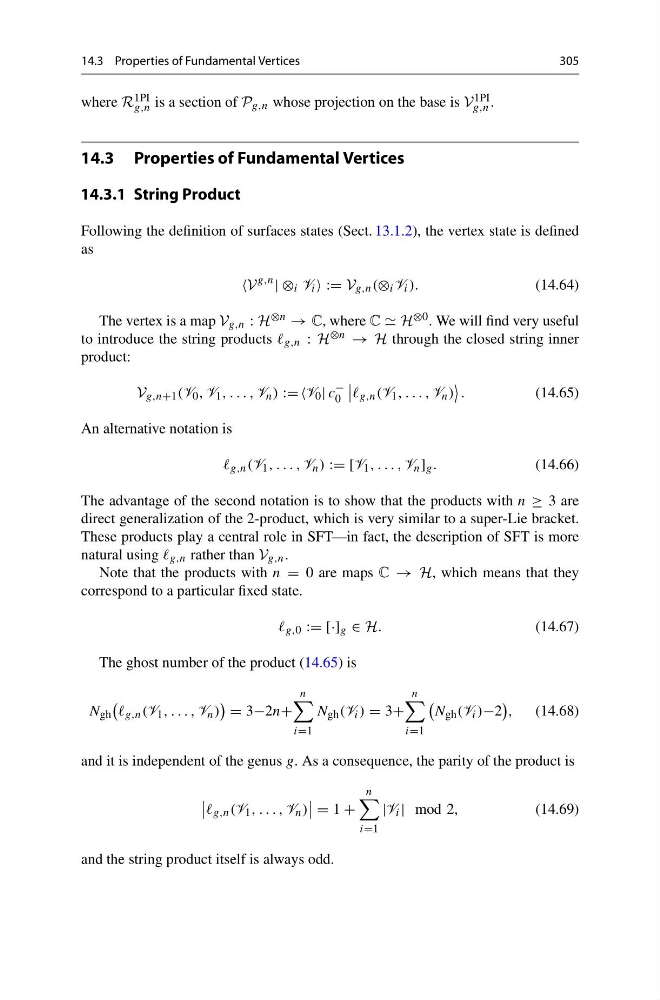
The vertex is a map V g,n : H ⊗n → C, where C H ⊗0 . We will find very useful
to introduce the string products g,n : H ⊗n → H through the closed string inner
product:
V g,n+1 (V 0 , V 1 , . . . , V n ) := =V 0 | c
−
0
g,n (V 1 , . . . , V n )
.
(14.65)
An alternative notation is
g,n (V 1 , . . . , V n ) := [V 1 , . . . , V n ] g .
(14.66)
The advantage of the second notation is to show that the products with n ≥ 3 are
direct generalization of the 2-product, which is very similar to a super-Lie bracket.
These products play a central role in SFT—in fact, the description of SFT is more
natural using g,n rather than V g,n .
Note that the products with n = 0 are maps C → H, which means that they
correspond to a particular fixed state.
g,0 := [·] g ∈ H.
(14.67)
The ghost number of the product (14.65) is
N gh
g,n (V 1 , . . . , V n )
= 3−2n+
n
i=1
N gh (V i ) = 3+
n
i=1
N gh (V i )−2
,
(14.68)
and it is independent of the genus g. As a consequence, the parity of the product is
g,n (V 1 , . . . , V n )
= 1 +
n
i=1
|V i | mod 2,
(14.69)
and the string product itself is always odd.
305
where R 1PI
g,n is a section of P g,n whose projection on the base is V 1PI
g,n .
14.3 Properties of Fundamental Vertices
14.3.1 String Product
Following the definition of surfaces states (Sect. 13.1.2), the vertex state is defined
as
V
g,n
| ⊗ i V i := V g,n (⊗ i V i ).
(14.64)
The vertex is a map V g,n : H ⊗n → C, where C H ⊗0 . We will find very useful
to introduce the string products g,n : H ⊗n → H through the closed string inner
product:
V g,n+1 (V 0 , V 1 , . . . , V n ) := =V 0 | c
−
0
g,n (V 1 , . . . , V n )
.
(14.65)
An alternative notation is
g,n (V 1 , . . . , V n ) := [V 1 , . . . , V n ] g .
(14.66)
The advantage of the second notation is to show that the products with n ≥ 3 are
direct generalization of the 2-product, which is very similar to a super-Lie bracket.
These products play a central role in SFT—in fact, the description of SFT is more
natural using g,n rather than V g,n .
Note that the products with n = 0 are maps C → H, which means that they
correspond to a particular fixed state.
g,0 := [·] g ∈ H.
(14.67)
The ghost number of the product (14.65) is
N gh
g,n (V 1 , . . . , V n )
= 3−2n+
n
i=1
N gh (V i ) = 3+
n
i=1
N gh (V i )−2
,
(14.68)
and it is independent of the genus g. As a consequence, the parity of the product is
g,n (V 1 , . . . , V n )
= 1 +
n
i=1
|V i | mod 2,
(14.69)
and the string product itself is always odd.