

14.2 Feynman Diagrams and Feynman Rules
297
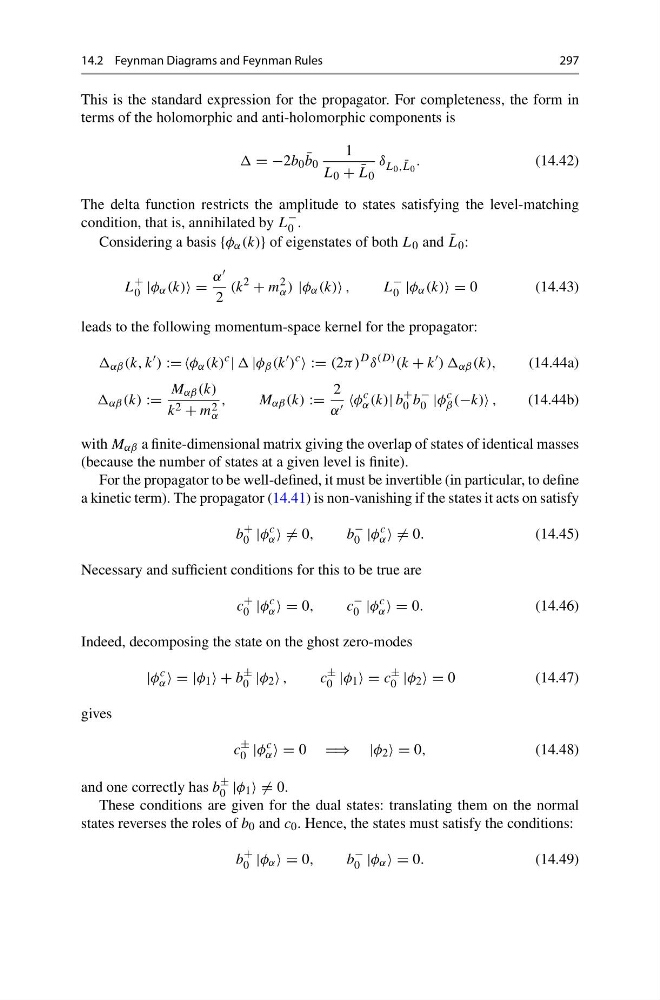
This is the standard expression for the propagator. For completeness, the form in
terms of the holomorphic and anti-holomorphic components is
= −2b 0 ¯
b 0
1
L 0 + ¯
L 0
δ L 0 , ¯
L 0
.
(14.42)
The delta function restricts the amplitude to states satisfying the level-matching
condition, that is, annihilated by L
−
0 .
Considering a basis {φ α (k)} of eigenstates of both L 0 and ¯
L 0 :
L
+
0 |φ α (k) =
α
2
(k
2
+ m
2
α ) |φ α (k) ,
L
−
0 |φ α (k) = 0
(14.43)
leads to the following momentum-space kernel for the propagator:
αβ (k, k
) := =φ α (k)
c
| |φ β (k
)
c
:= (2π)
D δ
(D) (k + k
) ) αβ (k),
(14.44a)
αβ (k) :=
M αβ (k)
k 2 + m 2
α
,
M αβ (k) :=
2
α φ
c
α (k)| b
+
0 b
−
0 |φ
c
β (−k) ,
(14.44b)
with M αβ a finite-dimensional matrix giving the overlap of states of identical masses
(because the number of states at a given level is finite).
For the propagator to be well-defined, it must be invertible (in particular, to define
a kinetic term). The propagator (14.41) is non-vanishing if the states it acts on satisfy
b
+
0 |φ
c
α = 0,
b
−
0 |φ
c
α = 0.
(14.45)
Necessary and sufficient conditions for this to be true are
c
+
0 |φ
c
α = 0,
c
−
0 |φ
c
α = 0.
(14.46)
Indeed, decomposing the state on the ghost zero-modes
|φ
c
α = |φ 1 + b
±
0 |φ 2 ,
c
±
0 |φ 1 = c
±
0 |φ 2 = 0
(14.47)
gives
c
±
0 |φ
c
α = 0 ⇒ |φ 2 = 0,
(14.48)
and one correctly has b
±
0 |φ 1 = 0.
These conditions are given for the dual states: translating them on the normal
states reverses the roles of b 0 and c 0 . Hence, the states must satisfy the conditions:
b
+
0 |φ α = 0,
b
−
0 |φ α = 0.
(14.49)
297
This is the standard expression for the propagator. For completeness, the form in
terms of the holomorphic and anti-holomorphic components is
= −2b 0 ¯
b 0
1
L 0 + ¯
L 0
δ L 0 , ¯
L 0
.
(14.42)
The delta function restricts the amplitude to states satisfying the level-matching
condition, that is, annihilated by L
−
0 .
Considering a basis {φ α (k)} of eigenstates of both L 0 and ¯
L 0 :
L
+
0 |φ α (k) =
α
2
(k
2
+ m
2
α ) |φ α (k) ,
L
−
0 |φ α (k) = 0
(14.43)
leads to the following momentum-space kernel for the propagator:
αβ (k, k
) := =φ α (k)
c
| |φ β (k
)
c
:= (2π)
D δ
(D) (k + k
) ) αβ (k),
(14.44a)
αβ (k) :=
M αβ (k)
k 2 + m 2
α
,
M αβ (k) :=
2
α φ
c
α (k)| b
+
0 b
−
0 |φ
c
β (−k) ,
(14.44b)
with M αβ a finite-dimensional matrix giving the overlap of states of identical masses
(because the number of states at a given level is finite).
For the propagator to be well-defined, it must be invertible (in particular, to define
a kinetic term). The propagator (14.41) is non-vanishing if the states it acts on satisfy
b
+
0 |φ
c
α = 0,
b
−
0 |φ
c
α = 0.
(14.45)
Necessary and sufficient conditions for this to be true are
c
+
0 |φ
c
α = 0,
c
−
0 |φ
c
α = 0.
(14.46)
Indeed, decomposing the state on the ghost zero-modes
|φ
c
α = |φ 1 + b
±
0 |φ 2 ,
c
±
0 |φ 1 = c
±
0 |φ 2 = 0
(14.47)
gives
c
±
0 |φ
c
α = 0 ⇒ |φ 2 = 0,
(14.48)
and one correctly has b
±
0 |φ 1 = 0.
These conditions are given for the dual states: translating them on the normal
states reverses the roles of b 0 and c 0 . Hence, the states must satisfy the conditions:
b
+
0 |φ α = 0,
b
−
0 |φ α = 0.
(14.49)