

276
13 Off-Shell Amplitudes
13.2.1 Vanishing of Forms with Trivial Vectors
Reparametrization of z a Consider the sphere S a with coordinate z a , and denote
by C 1 , C 2 and C 3 the three boundaries. Then, a reparametrization
z a −→ z a + φ(z a )
(13.31)
is generated by a vector field φ(z) that is regular on S a . This transformation modifies
the transition functions on the three circles and is thus associated to a tangent vector
V described by a vector field v with support on the three circles
C i : v
(i)
= φ| C i .
(13.32)
The Beltrami form then reads
B(V ) =
3
i=1
C i
dz a b(z a )φ(z a ) + c.c.,
(13.33)
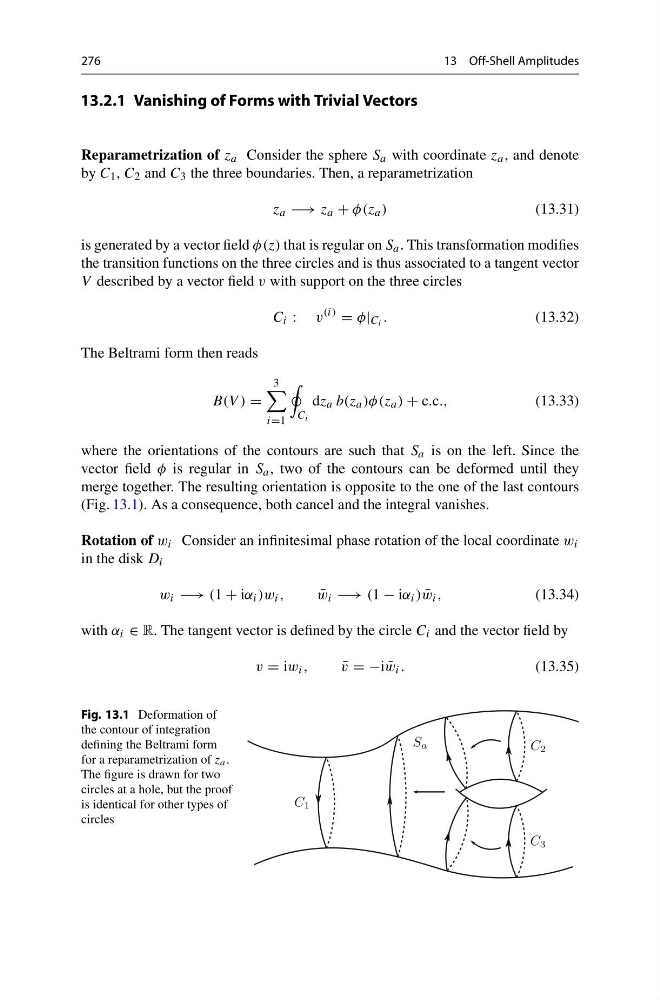
where the orientations of the contours are such that S a is on the left. Since the
vector field φ is regular in S a , two of the contours can be deformed until they
merge together. The resulting orientation is opposite to the one of the last contours
(Fig. 13.1). As a consequence, both cancel and the integral vanishes.
Rotation of w i Consider an infinitesimal phase rotation of the local coordinate w i
in the disk D i
w i −→ (1 + iα i )w i ,
¯
w i −→ (1 − iα i ) ¯
w i ,
(13.34)
with α i ∈ R. The tangent vector is defined by the circle C i and the vector field by
v = iw i ,
¯
v = −i ¯
w i .
(13.35)
Fig. 13.1 Deformation of
the contour of integration
defining the Beltrami form
for a reparametrization of z a .
The figure is drawn for two
circles at a hole, but the proof
is identical for other types of
circles
13 Off-Shell Amplitudes
13.2.1 Vanishing of Forms with Trivial Vectors
Reparametrization of z a Consider the sphere S a with coordinate z a , and denote
by C 1 , C 2 and C 3 the three boundaries. Then, a reparametrization
z a −→ z a + φ(z a )
(13.31)
is generated by a vector field φ(z) that is regular on S a . This transformation modifies
the transition functions on the three circles and is thus associated to a tangent vector
V described by a vector field v with support on the three circles
C i : v
(i)
= φ| C i .
(13.32)
The Beltrami form then reads
B(V ) =
3
i=1
C i
dz a b(z a )φ(z a ) + c.c.,
(13.33)
where the orientations of the contours are such that S a is on the left. Since the
vector field φ is regular in S a , two of the contours can be deformed until they
merge together. The resulting orientation is opposite to the one of the last contours
(Fig. 13.1). As a consequence, both cancel and the integral vanishes.
Rotation of w i Consider an infinitesimal phase rotation of the local coordinate w i
in the disk D i
w i −→ (1 + iα i )w i ,
¯
w i −→ (1 − iα i ) ¯
w i ,
(13.34)
with α i ∈ R. The tangent vector is defined by the circle C i and the vector field by
v = iw i ,
¯
v = −i ¯
w i .
(13.35)
Fig. 13.1 Deformation of
the contour of integration
defining the Beltrami form
for a reparametrization of z a .
The figure is drawn for two
circles at a hole, but the proof
is identical for other types of
circles