

13.2 Properties of Forms
275
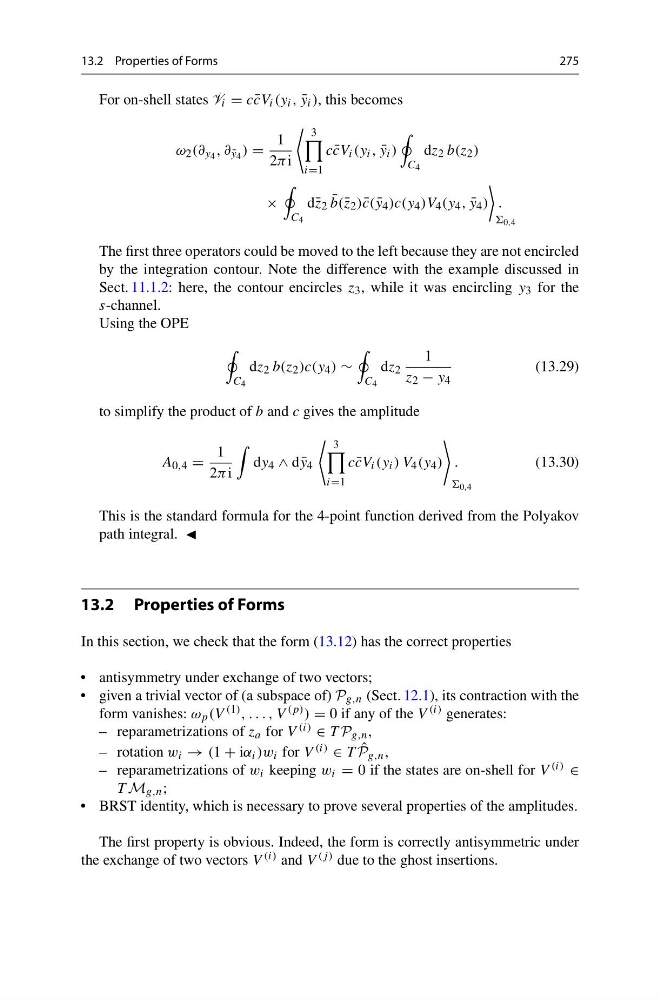
For on-shell states V i = c ¯
cV i (y i , ¯
y i ), this becomes
ω 2 (∂ y 4 , ∂ ¯
y 4 ) =
1
2π i
3
i=1
c ¯
cV i (y i , ¯
y i )
C 4
dz 2 b(z 2 )
×
C 4
d¯ z 2 ¯
b(¯ z 2 ) ¯
c( ¯
y 4 )c(y 4 )V 4 (y 4 , ¯
y 4 )
0,4
.
The first three operators could be moved to the left because they are not encircled
by the integration contour. Note the difference with the example discussed in
Sect. 11.1.2: here, the contour encircles z 3 , while it was encircling y 3 for the
s-channel.
Using the OPE
C 4
dz 2 b(z 2 )c(y 4 ) ∼
C 4
dz 2
1
z 2 − y 4
(13.29)
to simplify the product of b and c gives the amplitude
A 0,4 =
1
2π i
dy 4 ∧ d ¯
y 4
3
i=1
c ¯
cV i (y i ) V 4 (y 4 )
0,4
.
(13.30)
This is the standard formula for the 4-point function derived from the Polyakov
path integral.
13.2 Properties of Forms
In this section, we check that the form (13.12) has the correct properties
• antisymmetry under exchange of two vectors;
• given a trivial vector of (a subspace of) P g,n (Sect. 12.1), its contraction with the
form vanishes: ω p (V (1) , . . . , V (p) ) = 0 if any of the V (i) generates:
– reparametrizations of z a for V (i) ∈ T P g,n ,
– rotation w i → (1 + iα i )w i for V (i) ∈ T ˆ
P g,n ,
– reparametrizations of w i keeping w i = 0 if the states are on-shell for V (i) ∈
T M g,n ;
• BRST identity, which is necessary to prove several properties of the amplitudes.
The first property is obvious. Indeed, the form is correctly antisymmetric under
the exchange of two vectors V (i) and V (j ) due to the ghost insertions.
275
For on-shell states V i = c ¯
cV i (y i , ¯
y i ), this becomes
ω 2 (∂ y 4 , ∂ ¯
y 4 ) =
1
2π i
3
i=1
c ¯
cV i (y i , ¯
y i )
C 4
dz 2 b(z 2 )
×
C 4
d¯ z 2 ¯
b(¯ z 2 ) ¯
c( ¯
y 4 )c(y 4 )V 4 (y 4 , ¯
y 4 )
0,4
.
The first three operators could be moved to the left because they are not encircled
by the integration contour. Note the difference with the example discussed in
Sect. 11.1.2: here, the contour encircles z 3 , while it was encircling y 3 for the
s-channel.
Using the OPE
C 4
dz 2 b(z 2 )c(y 4 ) ∼
C 4
dz 2
1
z 2 − y 4
(13.29)
to simplify the product of b and c gives the amplitude
A 0,4 =
1
2π i
dy 4 ∧ d ¯
y 4
3
i=1
c ¯
cV i (y i ) V 4 (y 4 )
0,4
.
(13.30)
This is the standard formula for the 4-point function derived from the Polyakov
path integral.
13.2 Properties of Forms
In this section, we check that the form (13.12) has the correct properties
• antisymmetry under exchange of two vectors;
• given a trivial vector of (a subspace of) P g,n (Sect. 12.1), its contraction with the
form vanishes: ω p (V (1) , . . . , V (p) ) = 0 if any of the V (i) generates:
– reparametrizations of z a for V (i) ∈ T P g,n ,
– rotation w i → (1 + iα i )w i for V (i) ∈ T ˆ
P g,n ,
– reparametrizations of w i keeping w i = 0 if the states are on-shell for V (i) ∈
T M g,n ;
• BRST identity, which is necessary to prove several properties of the amplitudes.
The first property is obvious. Indeed, the form is correctly antisymmetric under
the exchange of two vectors V (i) and V (j ) due to the ghost insertions.