

272
13 Off-Shell Amplitudes
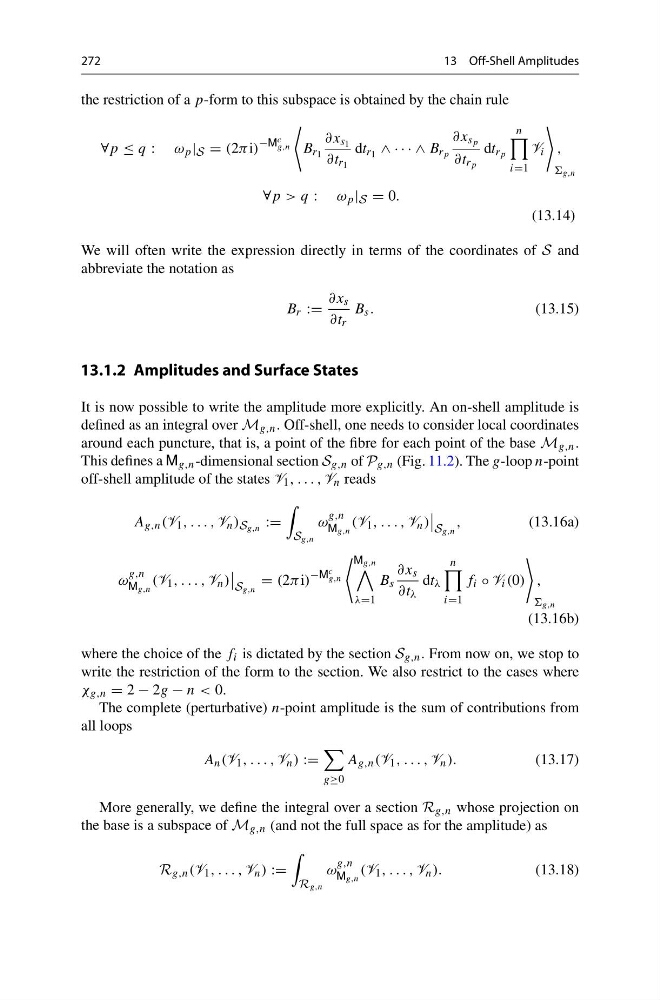
the restriction of a p-form to this subspace is obtained by the chain rule
∀p ≤ q : ω p | S = (2π i)
−M c
g,n
B r 1
∂x s 1
∂t r 1
dt r 1 ∧ · · · ∧ B r p
∂x s p
∂t r p
dt r p
n
i=1
V i
g,n
,
∀p > q : ω p | S = 0.
(13.14)
We will often write the expression directly in terms of the coordinates of S and
abbreviate the notation as
B r :=
∂x s
∂t r
B s .
(13.15)
13.1.2 Amplitudes and Surface States
It is now possible to write the amplitude more explicitly. An on-shell amplitude is
defined as an integral over M g,n . Off-shell, one needs to consider local coordinates
around each puncture, that is, a point of the fibre for each point of the base M g,n .
This defines a M g,n -dimensional section S g,n of P g,n (Fig. 11.2). The g-loop n-point
off-shell amplitude of the states V 1 , . . . , V n reads
A g,n (V 1 , . . . , V n ) S g,n :=
S g,n
ω
g,n
M g,n
(V 1 , . . . , V n )
S g,n
,
(13.16a)
ω
g,n
M g,n
(V 1 , . . . , V n )
S g,n
= (2π i)
−M c
g,n
M g,n
λ=1
B s
∂x s
∂t λ
dt λ
n
i=1
f i ◦ V i (0)
g,n
,
(13.16b)
where the choice of the f i is dictated by the section S g,n . From now on, we stop to
write the restriction of the form to the section. We also restrict to the cases where
χ g,n = 2 − 2g − n < 0.
The complete (perturbative) n-point amplitude is the sum of contributions from
all loops
A n (V 1 , . . . , V n ) :=
g≥0
A g,n (V 1 , . . . , V n ).
(13.17)
More generally, we define the integral over a section R g,n whose projection on
the base is a subspace of M g,n (and not the full space as for the amplitude) as
R g,n (V 1 , . . . , V n ) :=
R g,n
ω
g,n
M g,n
(V 1 , . . . , V n ).
(13.18)
13 Off-Shell Amplitudes
the restriction of a p-form to this subspace is obtained by the chain rule
∀p ≤ q : ω p | S = (2π i)
−M c
g,n
B r 1
∂x s 1
∂t r 1
dt r 1 ∧ · · · ∧ B r p
∂x s p
∂t r p
dt r p
n
i=1
V i
g,n
,
∀p > q : ω p | S = 0.
(13.14)
We will often write the expression directly in terms of the coordinates of S and
abbreviate the notation as
B r :=
∂x s
∂t r
B s .
(13.15)
13.1.2 Amplitudes and Surface States
It is now possible to write the amplitude more explicitly. An on-shell amplitude is
defined as an integral over M g,n . Off-shell, one needs to consider local coordinates
around each puncture, that is, a point of the fibre for each point of the base M g,n .
This defines a M g,n -dimensional section S g,n of P g,n (Fig. 11.2). The g-loop n-point
off-shell amplitude of the states V 1 , . . . , V n reads
A g,n (V 1 , . . . , V n ) S g,n :=
S g,n
ω
g,n
M g,n
(V 1 , . . . , V n )
S g,n
,
(13.16a)
ω
g,n
M g,n
(V 1 , . . . , V n )
S g,n
= (2π i)
−M c
g,n
M g,n
λ=1
B s
∂x s
∂t λ
dt λ
n
i=1
f i ◦ V i (0)
g,n
,
(13.16b)
where the choice of the f i is dictated by the section S g,n . From now on, we stop to
write the restriction of the form to the section. We also restrict to the cases where
χ g,n = 2 − 2g − n < 0.
The complete (perturbative) n-point amplitude is the sum of contributions from
all loops
A n (V 1 , . . . , V n ) :=
g≥0
A g,n (V 1 , . . . , V n ).
(13.17)
More generally, we define the integral over a section R g,n whose projection on
the base is a subspace of M g,n (and not the full space as for the amplitude) as
R g,n (V 1 , . . . , V n ) :=
R g,n
ω
g,n
M g,n
(V 1 , . . . , V n ).
(13.18)