

13.1 Cotangent Spaces and Amplitudes
271
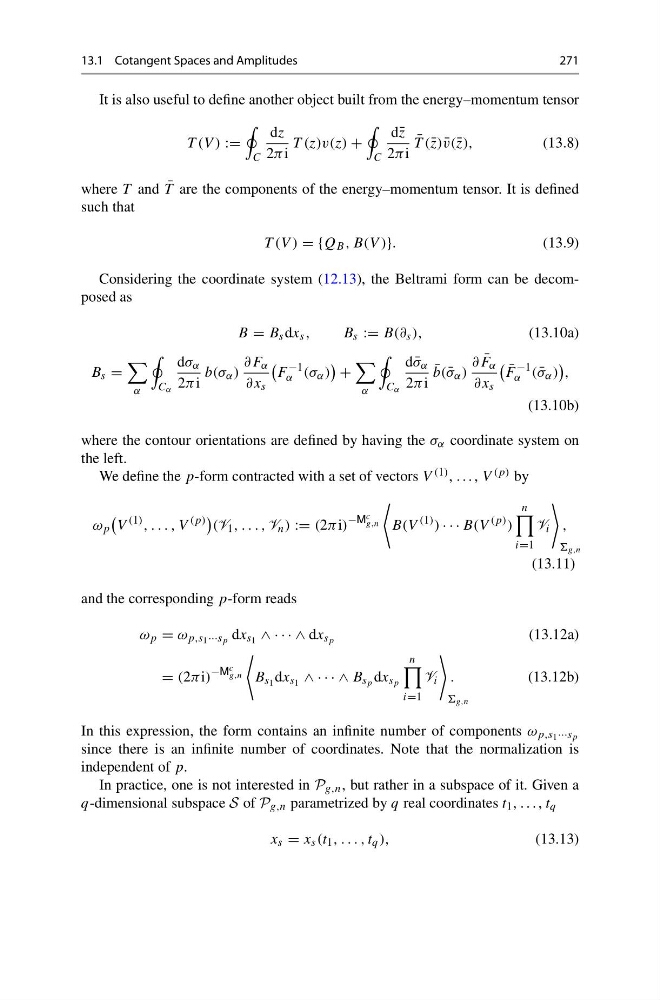
It is also useful to define another object built from the energy–momentum tensor
T (V ) :=
C
dz
2π i
T (z)v(z) +
C
d¯ z
2π i
¯
T (¯ z) ¯
v(¯ z),
(13.8)
where T and ¯
T are the components of the energy–momentum tensor. It is defined
such that
T (V ) = {Q B , B(V )}.
(13.9)
Considering the coordinate system (12.13), the Beltrami form can be decomposed as
B = B s dx s ,
B s := B(∂ s ),
(13.10a)
B s =
α
C α
dσ α
2π i
b(σ α )
∂F α
∂x s
F
−1
α (σ α )
+
α
C α
d ¯
σ α
2π i
¯
b( ¯
σ α )
∂ ¯
F α
∂x s
¯
F
−1
α ( ¯
σ α )
,
(13.10b)
where the contour orientations are defined by having the σ α coordinate system on
the left.
We define the p-form contracted with a set of vectors V (1) , . . . , V (p) by
ω p
V
(1) , . . . , V
(p)
(V 1 , . . . , V n ) := (2π i)
−M c
g,n
B(V
(1) ) · · · B(V
(p) )
n
i=1
V i
g,n
,
(13.11)
and the corresponding p-form reads
ω p = ω p,s 1 ···s p dx s 1 ∧ · · · ∧ dx s p
(13.12a)
= (2π i)
−M c
g,n
B s 1 dx s 1 ∧ · · · ∧ B s p dx s p
n
i=1
V i
g,n
.
(13.12b)
In this expression, the form contains an infinite number of components ω p,s 1 ···s p
since there is an infinite number of coordinates. Note that the normalization is
independent of p.
In practice, one is not interested in P g,n , but rather in a subspace of it. Given a
q-dimensional subspace S of P g,n parametrized by q real coordinates t 1 , . . . , t q
x s = x s (t 1 , . . . , t q ),
(13.13)
271
It is also useful to define another object built from the energy–momentum tensor
T (V ) :=
C
dz
2π i
T (z)v(z) +
C
d¯ z
2π i
¯
T (¯ z) ¯
v(¯ z),
(13.8)
where T and ¯
T are the components of the energy–momentum tensor. It is defined
such that
T (V ) = {Q B , B(V )}.
(13.9)
Considering the coordinate system (12.13), the Beltrami form can be decomposed as
B = B s dx s ,
B s := B(∂ s ),
(13.10a)
B s =
α
C α
dσ α
2π i
b(σ α )
∂F α
∂x s
F
−1
α (σ α )
+
α
C α
d ¯
σ α
2π i
¯
b( ¯
σ α )
∂ ¯
F α
∂x s
¯
F
−1
α ( ¯
σ α )
,
(13.10b)
where the contour orientations are defined by having the σ α coordinate system on
the left.
We define the p-form contracted with a set of vectors V (1) , . . . , V (p) by
ω p
V
(1) , . . . , V
(p)
(V 1 , . . . , V n ) := (2π i)
−M c
g,n
B(V
(1) ) · · · B(V
(p) )
n
i=1
V i
g,n
,
(13.11)
and the corresponding p-form reads
ω p = ω p,s 1 ···s p dx s 1 ∧ · · · ∧ dx s p
(13.12a)
= (2π i)
−M c
g,n
B s 1 dx s 1 ∧ · · · ∧ B s p dx s p
n
i=1
V i
g,n
.
(13.12b)
In this expression, the form contains an infinite number of components ω p,s 1 ···s p
since there is an infinite number of coordinates. Note that the normalization is
independent of p.
In practice, one is not interested in P g,n , but rather in a subspace of it. Given a
q-dimensional subspace S of P g,n parametrized by q real coordinates t 1 , . . . , t q
x s = x s (t 1 , . . . , t q ),
(13.13)