

References
233
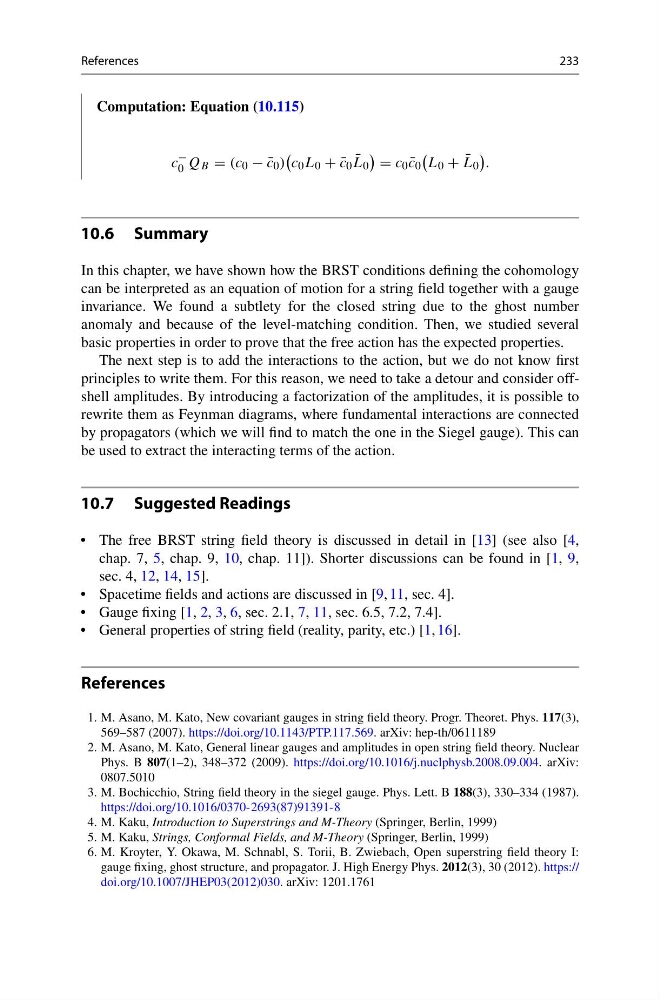
Computation: Equation (10.115)
c
−
0 Q B = (c 0 − ¯
c 0 )
c 0 L 0 + ¯
c 0 ¯
L 0
= c 0 ¯
c 0
L 0 + ¯
L 0
.
10.6 Summary
In this chapter, we have shown how the BRST conditions defining the cohomology
can be interpreted as an equation of motion for a string field together with a gauge
invariance. We found a subtlety for the closed string due to the ghost number
anomaly and because of the level-matching condition. Then, we studied several
basic properties in order to prove that the free action has the expected properties.
The next step is to add the interactions to the action, but we do not know first
principles to write them. For this reason, we need to take a detour and consider offshell amplitudes. By introducing a factorization of the amplitudes, it is possible to
rewrite them as Feynman diagrams, where fundamental interactions are connected
by propagators (which we will find to match the one in the Siegel gauge). This can
be used to extract the interacting terms of the action.
10.7 Suggested Readings
• The free BRST string field theory is discussed in detail in [13] (see also [4,
chap. 7, 5, chap. 9, 10, chap. 11]). Shorter discussions can be found in [1, 9,
sec. 4, 12, 14, 15].
• Spacetime fields and actions are discussed in [9, 11, sec. 4].
• Gauge fixing [1, 2, 3, 6, sec. 2.1, 7, 11, sec. 6.5, 7.2, 7.4].
• General properties of string field (reality, parity, etc.) [1, 16].
References
1. M. Asano, M. Kato, New covariant gauges in string field theory. Progr. Theoret. Phys. 117(3),
569–587 (2007). https://doi.org/10.1143/PTP.117.569. arXiv: hep-th/0611189
2. M. Asano, M. Kato, General linear gauges and amplitudes in open string field theory. Nuclear
Phys. B 807(1–2), 348–372 (2009). https://doi.org/10.1016/j.nuclphysb.2008.09.004. arXiv:
0807.5010
3. M. Bochicchio, String field theory in the siegel gauge. Phys. Lett. B 188(3), 330–334 (1987).
https://doi.org/10.1016/0370-2693(87)91391-8
4. M. Kaku, Introduction to Superstrings and M-Theory (Springer, Berlin, 1999)
5. M. Kaku, Strings, Conformal Fields, and M-Theory (Springer, Berlin, 1999)
6. M. Kroyter, Y. Okawa, M. Schnabl, S. Torii, B. Zwiebach, Open superstring field theory I:
gauge fixing, ghost structure, and propagator. J. High Energy Phys. 2012(3), 30 (2012). https://
doi.org/10.1007/JHEP03(2012)030. arXiv: 1201.1761
233
Computation: Equation (10.115)
c
−
0 Q B = (c 0 − ¯
c 0 )
c 0 L 0 + ¯
c 0 ¯
L 0
= c 0 ¯
c 0
L 0 + ¯
L 0
.
10.6 Summary
In this chapter, we have shown how the BRST conditions defining the cohomology
can be interpreted as an equation of motion for a string field together with a gauge
invariance. We found a subtlety for the closed string due to the ghost number
anomaly and because of the level-matching condition. Then, we studied several
basic properties in order to prove that the free action has the expected properties.
The next step is to add the interactions to the action, but we do not know first
principles to write them. For this reason, we need to take a detour and consider offshell amplitudes. By introducing a factorization of the amplitudes, it is possible to
rewrite them as Feynman diagrams, where fundamental interactions are connected
by propagators (which we will find to match the one in the Siegel gauge). This can
be used to extract the interacting terms of the action.
10.7 Suggested Readings
• The free BRST string field theory is discussed in detail in [13] (see also [4,
chap. 7, 5, chap. 9, 10, chap. 11]). Shorter discussions can be found in [1, 9,
sec. 4, 12, 14, 15].
• Spacetime fields and actions are discussed in [9, 11, sec. 4].
• Gauge fixing [1, 2, 3, 6, sec. 2.1, 7, 11, sec. 6.5, 7.2, 7.4].
• General properties of string field (reality, parity, etc.) [1, 16].
References
1. M. Asano, M. Kato, New covariant gauges in string field theory. Progr. Theoret. Phys. 117(3),
569–587 (2007). https://doi.org/10.1143/PTP.117.569. arXiv: hep-th/0611189
2. M. Asano, M. Kato, General linear gauges and amplitudes in open string field theory. Nuclear
Phys. B 807(1–2), 348–372 (2009). https://doi.org/10.1016/j.nuclphysb.2008.09.004. arXiv:
0807.5010
3. M. Bochicchio, String field theory in the siegel gauge. Phys. Lett. B 188(3), 330–334 (1987).
https://doi.org/10.1016/0370-2693(87)91391-8
4. M. Kaku, Introduction to Superstrings and M-Theory (Springer, Berlin, 1999)
5. M. Kaku, Strings, Conformal Fields, and M-Theory (Springer, Berlin, 1999)
6. M. Kroyter, Y. Okawa, M. Schnabl, S. Torii, B. Zwiebach, Open superstring field theory I:
gauge fixing, ghost structure, and propagator. J. High Energy Phys. 2012(3), 30 (2012). https://
doi.org/10.1007/JHEP03(2012)030. arXiv: 1201.1761