

232
10 Free BRST String Field Theory
The necessity of this condition can be understood differently. We had found
that it is necessary to ensure that the closed string parametrization is invariant
under translations along the string (Sect. 3.2.2). Since there is no BRST symmetry
associated to this symmetry, one needs to keep the constraint. 2 This suggests that
one may enlarge further the gauge symmetry and interpret (10.109) as a gauge fixing
condition. This would be quite desirable: one could argue that a fundamental field
should be completely described by the Lagrangian (if such a description exists) and
that it should not be necessary to supplement it with constraints imposed by hand.
While this can be achieved at the free level, this idea runs into problems in the
presence of interactions (Sect. 13.3.1) and the interpretation is not clear. 3
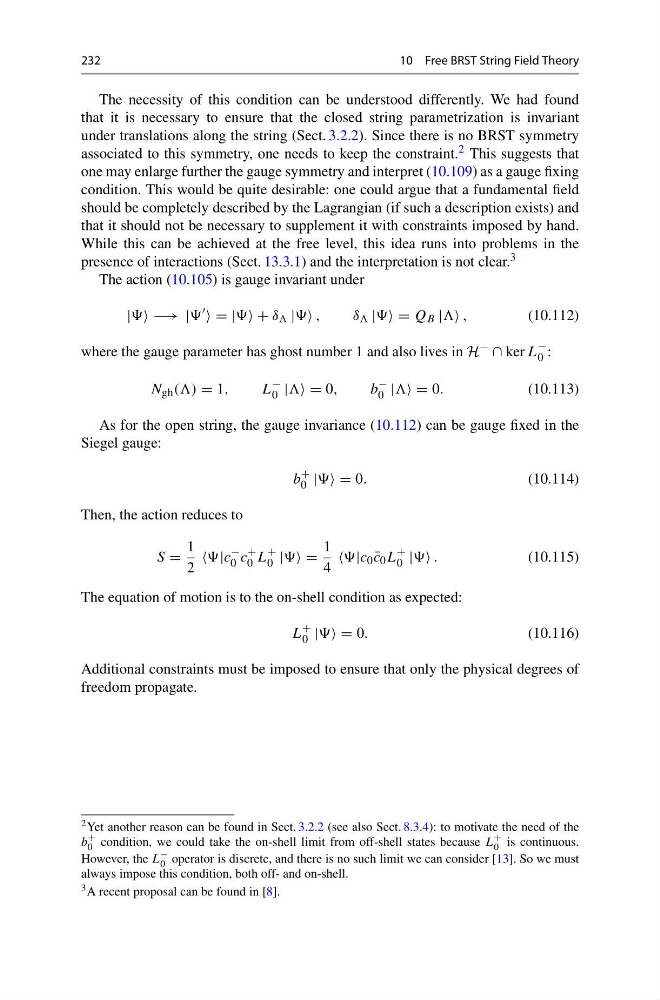
The action (10.105) is gauge invariant under
| −→ |
= | + δ | ,
δ | = Q B | ,
(10.112)
where the gauge parameter has ghost number 1 and also lives in H − ∩ ker L
−
0 :
N gh (() = 1,
L
−
0 | = 0,
b
−
0 | = 0.
(10.113)
As for the open string, the gauge invariance (10.112) can be gauge fixed in the
Siegel gauge:
b
+
0 | = 0.
(10.114)
Then, the action reduces to
S =
1
2
|c
−
0 c
+
0 L
+
0 | =
1
4
|c 0 ¯
c 0 L
+
0 | .
(10.115)
The equation of motion is to the on-shell condition as expected:
L
+
0 | = 0.
(10.116)
Additional constraints must be imposed to ensure that only the physical degrees of
freedom propagate.
2 Yet another reason can be found in Sect. 3.2.2 (see also Sect. 8.3.4): to motivate the need of the
b
+
0 condition, we could take the on-shell limit from off-shell states because L
+
0 is continuous.
However, the L
−
0 operator is discrete, and there is no such limit we can consider [13]. So we must
always impose this condition, both off- and on-shell.
3 A recent proposal can be found in [8].
10 Free BRST String Field Theory
The necessity of this condition can be understood differently. We had found
that it is necessary to ensure that the closed string parametrization is invariant
under translations along the string (Sect. 3.2.2). Since there is no BRST symmetry
associated to this symmetry, one needs to keep the constraint. 2 This suggests that
one may enlarge further the gauge symmetry and interpret (10.109) as a gauge fixing
condition. This would be quite desirable: one could argue that a fundamental field
should be completely described by the Lagrangian (if such a description exists) and
that it should not be necessary to supplement it with constraints imposed by hand.
While this can be achieved at the free level, this idea runs into problems in the
presence of interactions (Sect. 13.3.1) and the interpretation is not clear. 3
The action (10.105) is gauge invariant under
| −→ |
= | + δ | ,
δ | = Q B | ,
(10.112)
where the gauge parameter has ghost number 1 and also lives in H − ∩ ker L
−
0 :
N gh (() = 1,
L
−
0 | = 0,
b
−
0 | = 0.
(10.113)
As for the open string, the gauge invariance (10.112) can be gauge fixed in the
Siegel gauge:
b
+
0 | = 0.
(10.114)
Then, the action reduces to
S =
1
2
|c
−
0 c
+
0 L
+
0 | =
1
4
|c 0 ¯
c 0 L
+
0 | .
(10.115)
The equation of motion is to the on-shell condition as expected:
L
+
0 | = 0.
(10.116)
Additional constraints must be imposed to ensure that only the physical degrees of
freedom propagate.
2 Yet another reason can be found in Sect. 3.2.2 (see also Sect. 8.3.4): to motivate the need of the
b
+
0 condition, we could take the on-shell limit from off-shell states because L
+
0 is continuous.
However, the L
−
0 operator is discrete, and there is no such limit we can consider [13]. So we must
always impose this condition, both off- and on-shell.
3 A recent proposal can be found in [8].