

224
10 Free BRST String Field Theory
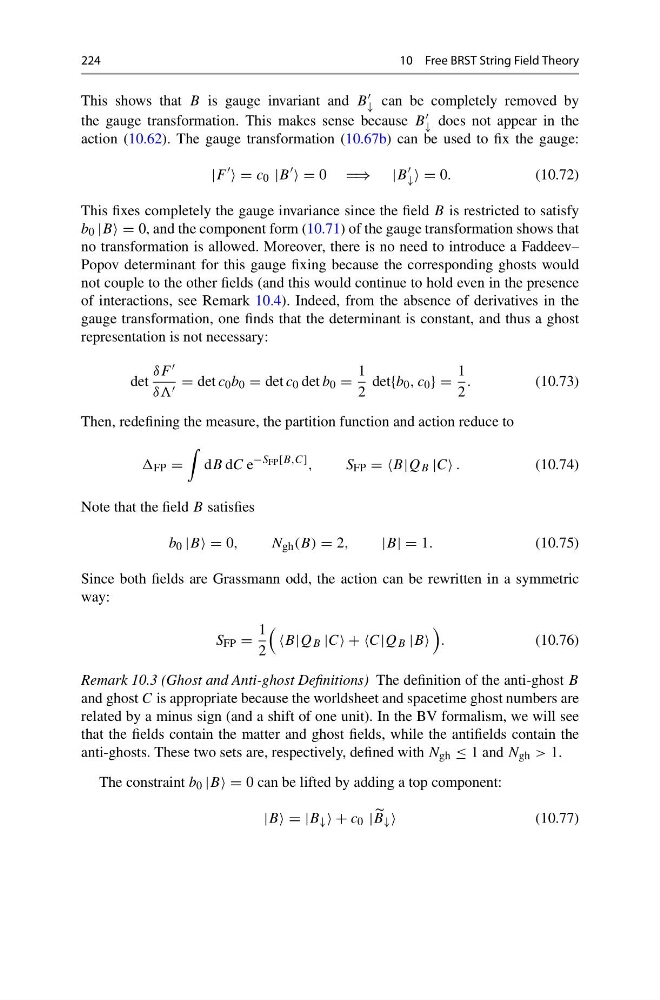
This shows that B is gauge invariant and B
↓ can be completely removed by
the gauge transformation. This makes sense because B
↓ does not appear in the
action (10.62). The gauge transformation (10.67b) can be used to fix the gauge:
|F
= c 0 |B
= 0 ⇒ |B
↓ = 0.
(10.72)
This fixes completely the gauge invariance since the field B is restricted to satisfy
b 0 |B = 0, and the component form (10.71) of the gauge transformation shows that
no transformation is allowed. Moreover, there is no need to introduce a Faddeev–
Popov determinant for this gauge fixing because the corresponding ghosts would
not couple to the other fields (and this would continue to hold even in the presence
of interactions, see Remark 10.4). Indeed, from the absence of derivatives in the
gauge transformation, one finds that the determinant is constant, and thus a ghost
representation is not necessary:
det
δF
δδ = det c 0 b 0 = det c 0 det b 0 =
1
2
det{b 0 , c 0 } =
1
2
.
(10.73)
Then, redefining the measure, the partition function and action reduce to
FP =
dB dC e
−S FP [B,C] ,
S FP = =B|Q B |C .
(10.74)
Note that the field B satisfies
b 0 |B = 0,
N gh (B) = 2,
|B| = 1.
(10.75)
Since both fields are Grassmann odd, the action can be rewritten in a symmetric
way:
S FP =
1
2
B|Q B |C + +C|Q B |B
.
(10.76)
Remark 10.3 (Ghost and Anti-ghost Definitions) The definition of the anti-ghost B
and ghost C is appropriate because the worldsheet and spacetime ghost numbers are
related by a minus sign (and a shift of one unit). In the BV formalism, we will see
that the fields contain the matter and ghost fields, while the antifields contain the
anti-ghosts. These two sets are, respectively, defined with N gh ≤ 1 and N gh > 1.
The constraint b 0 |B = 0 can be lifted by adding a top component:
|B = |B ↓ + c 0 |
B ↓
(10.77)
10 Free BRST String Field Theory
This shows that B is gauge invariant and B
↓ can be completely removed by
the gauge transformation. This makes sense because B
↓ does not appear in the
action (10.62). The gauge transformation (10.67b) can be used to fix the gauge:
|F
= c 0 |B
= 0 ⇒ |B
↓ = 0.
(10.72)
This fixes completely the gauge invariance since the field B is restricted to satisfy
b 0 |B = 0, and the component form (10.71) of the gauge transformation shows that
no transformation is allowed. Moreover, there is no need to introduce a Faddeev–
Popov determinant for this gauge fixing because the corresponding ghosts would
not couple to the other fields (and this would continue to hold even in the presence
of interactions, see Remark 10.4). Indeed, from the absence of derivatives in the
gauge transformation, one finds that the determinant is constant, and thus a ghost
representation is not necessary:
det
δF
δδ = det c 0 b 0 = det c 0 det b 0 =
1
2
det{b 0 , c 0 } =
1
2
.
(10.73)
Then, redefining the measure, the partition function and action reduce to
FP =
dB dC e
−S FP [B,C] ,
S FP = =B|Q B |C .
(10.74)
Note that the field B satisfies
b 0 |B = 0,
N gh (B) = 2,
|B| = 1.
(10.75)
Since both fields are Grassmann odd, the action can be rewritten in a symmetric
way:
S FP =
1
2
B|Q B |C + +C|Q B |B
.
(10.76)
Remark 10.3 (Ghost and Anti-ghost Definitions) The definition of the anti-ghost B
and ghost C is appropriate because the worldsheet and spacetime ghost numbers are
related by a minus sign (and a shift of one unit). In the BV formalism, we will see
that the fields contain the matter and ghost fields, while the antifields contain the
anti-ghosts. These two sets are, respectively, defined with N gh ≤ 1 and N gh > 1.
The constraint b 0 |B = 0 can be lifted by adding a top component:
|B = |B ↓ + c 0 |
B ↓
(10.77)