

10.3 Path Integral Quantization
223
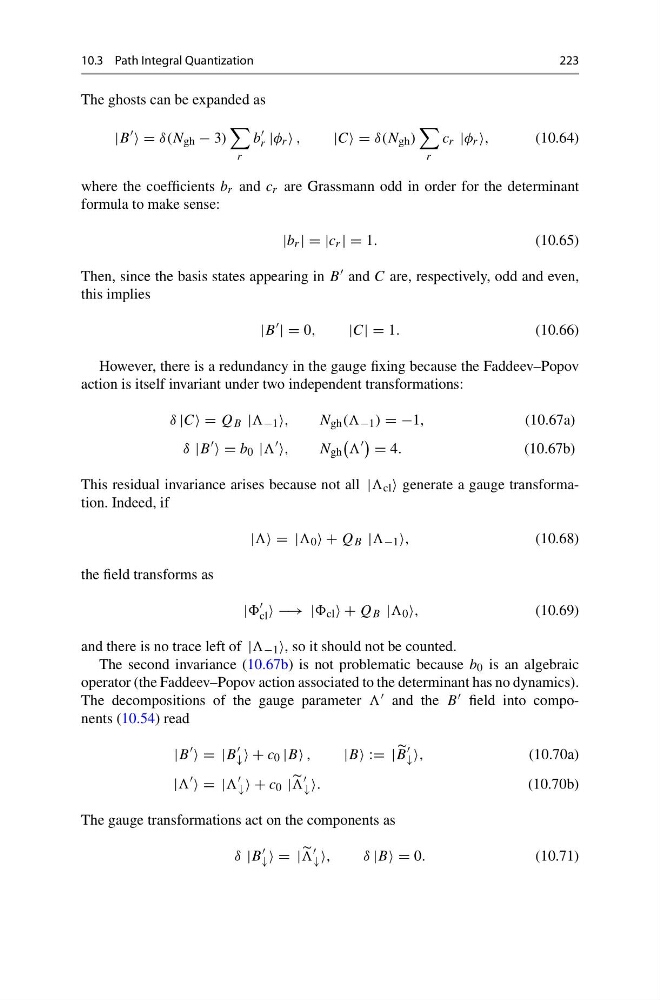
The ghosts can be expanded as
|B
= δ(N gh − 3)
r
b
r |φ r ,
|C = δ(N gh )
r
c r |φ r ,
(10.64)
where the coefficients b r and c r are Grassmann odd in order for the determinant
formula to make sense:
|b r | = |c r | = 1.
(10.65)
Then, since the basis states appearing in B and C are, respectively, odd and even,
this implies
|B
| = 0,
|C| = 1.
(10.66)
However, there is a redundancy in the gauge fixing because the Faddeev–Popov
action is itself invariant under two independent transformations:
δ |C = Q B | −1 ,
N gh (( −1 ) = −1,
(10.67a)
δ |B
= b 0 |
,
N gh
= 4.
(10.67b)
This residual invariance arises because not all | cl generate a gauge transformation. Indeed, if
| = | 0 + Q B | −1 ,
(10.68)
the field transforms as
|
cl −→ | cl + Q B | 0 ,
(10.69)
and there is no trace left of | −1 , so it should not be counted.
The second invariance (10.67b) is not problematic because b 0 is an algebraic
operator (the Faddeev–Popov action associated to the determinant has no dynamics).
The decompositions of the gauge parameter and the B field into components (10.54) read
|B
= |B
↓ + c 0 |B ,
|B := |
B
↓ ,
(10.70a)
|
= |
↓ + c 0 |
↓ .
(10.70b)
The gauge transformations act on the components as
δ |B
↓ = |
↓ ,
δ|B = 0.
(10.71)
223
The ghosts can be expanded as
|B
= δ(N gh − 3)
r
b
r |φ r ,
|C = δ(N gh )
r
c r |φ r ,
(10.64)
where the coefficients b r and c r are Grassmann odd in order for the determinant
formula to make sense:
|b r | = |c r | = 1.
(10.65)
Then, since the basis states appearing in B and C are, respectively, odd and even,
this implies
|B
| = 0,
|C| = 1.
(10.66)
However, there is a redundancy in the gauge fixing because the Faddeev–Popov
action is itself invariant under two independent transformations:
δ |C = Q B | −1 ,
N gh (( −1 ) = −1,
(10.67a)
δ |B
= b 0 |
,
N gh
= 4.
(10.67b)
This residual invariance arises because not all | cl generate a gauge transformation. Indeed, if
| = | 0 + Q B | −1 ,
(10.68)
the field transforms as
|
cl −→ | cl + Q B | 0 ,
(10.69)
and there is no trace left of | −1 , so it should not be counted.
The second invariance (10.67b) is not problematic because b 0 is an algebraic
operator (the Faddeev–Popov action associated to the determinant has no dynamics).
The decompositions of the gauge parameter and the B field into components (10.54) read
|B
= |B
↓ + c 0 |B ,
|B := |
B
↓ ,
(10.70a)
|
= |
↓ + c 0 |
↓ .
(10.70b)
The gauge transformations act on the components as
δ |B
↓ = |
↓ ,
δ|B = 0.
(10.71)